Urban Verticality

Posted by Bradley L. Garrett on Saturday Aug 14, 2010 Under Archaeology, Cultural Geography, Freedom, Psychogeography, Situationism, Urban Exploration

“To get back up to the shining world from there my guide and I went into that hidden tunnel, and following its path, we took no care to rest, but climbed: he first, then I – so far, through a round aperture I saw appear some of the beautiful things that Heaven bears, where we came forth, and once more saw the stars.” -Dante, Inferno, Canto XXXIV

Sloping

The blood bubble

It was a night to remember, wandering around in a team of 5 dressed as construction workers. Even at 2am, the yellow vest and hard hat that signifies us part of an invisible working class, rendering accessible the cavernous depths and dizzying heights of the city never ceases to amaze. I find it fascinating how many people in London ignore these hidden verticalities of the city – not just in a physical but in a social sense. People don’t touch spaces above and below because that is not where their class belongs. The middle class, true to its name, moves horizontally.

Tonight was a drift tonight tinged with a particularity lovely glow, plans of sewers flooded by rain landed us underground where trains sped by as we ran down the tunnel laughing. Our desires for a complete and situated urban verticality led us from low to high in search for adventure, insatiable in our lust to escape a capitalist suicide by instalment plan, spontaneously mapping sites of urban tenderness one after another.

Tender

That night, we once again forsook the pact the modernism asked us to make, seeing it as yet another impotent utopia, and found our own phantasms, cultivated during chemical visions in the sands of the Black Rock Desert, the swirling concrete flow  and smooth-waxed rails of skateboard parks, in the melted organic mental materialities of peyote festivals.

We weren’t really resisting anything because the resistance would eventually “turn to irony, irony to realism, realism to pragmatism, and pragmatism to solace in spectacular visions, consumerist monsters, development triumphs, and nostalgic dreams.” Perhaps, Vidler tells us, in his article Air War and Architecture, “such anxieties, brought once again to the surface, will stimulate new resistances, desperately needed right now – resistances that will not take the critical understanding of the past as mere pessimism or wrongful authority, but as salutary instruments against a globalising development frenzy that insists on burying history” (Viddler 2010 :39). All true, yet that as we rise and rise again to meet this city in all of its grandeur, in all of our might, these histories can’t be buried because we are building them one exploration at a time, a history of hidden dreams, of decay and of class and capital in all of its tropes and treats. And that is a geography of love.

Tropes

Treats

With love, ever-renewable

Share
Tags : , , , , , , , , , , , , , , , , , , , , | 2 comments

You give a man his daily bread so that he can be creative and he just goes to sleep; victorious a conqueror grows soft, a magnanimous man turns miser as he gains in wealth.    -Antoine de Saint-Exupéry

Are we at the top of the ladder or at the bottom of a new ladder?    -Silent Motion

Saddle up for

On our recent ProHobo trip into Europe, lovingly (if in the end somewhat flippantly) referred to as 3.0: ProhoBohemia, we pulled back from the infrastructural infiltrations that have become our daily grind here in London and went looking for ruins again. Coming back to ruins was like returning to a pleasant dream.

Magical realism

In our hired car, which we intended to push 3300 miles into Poland, our most ambitious trip to date, we cut through the corner of France as we have twice before and headed into Belgium. After a brief climb up a notable public building in a major capital city, we crept into an old train yard to spend the night. As you do.

Industrial nights

We woke up early full of enthusiasm and over the next week, we moved through Europe like a storm with an efficiency built over the course of three trips to the continent over the past year. We knew the sites we wanted to hit, we knew how to avoid security where necessary, we knew what to pack and, more importantly, what not to. We had, in fact, taken being temporary nomadic vagabonds to a whole new level. During the trip, we read passages from Tim Cresswell’s book The Tramp in America where he discusses the work of homeless-turned-Chicago-School-sociologist Ben Anderson. As we came to the realization that we could all likely keep this nomadic lifestyle going for a very long time (if not forever) I couldn’t help but think that we were working the other way around – there was a real possibility, is a real possibility that we could in fact drop it all and live like this indefinitely.

Probo

Looking for

Pure living

But the further East we went, the heavier our bourgeois baggage became. As we crossed the border into Poland, the car was filled with excited cheers quickly followed by confused murmurs. While the landscape here offered what we have come to expect from Europe – endless ruins – we found ourselves confronted with a place in which the relationship to derelict space was entirely different.

Secular

Imaginaries

Remembered

Here ruins were spaces not of bounded exclusion but of potential utilization. After driving for hours through a forest hunting for a soviet base called Keszwca Lesla, we arrived at 10pm to find rows of buildings, clearly Soviet-built, surrounding an undecipherable war memorial that looked like our standard fare with the addition of satellite dishes hanging off the sides of buildings. It seemed the local population here had turned this place into a summer holiday encampment after the collapse of the USSR and the abandonment of the base. Gangs of teenagers roamed the streets late at night in track suits and mullets, running in and out of the derelict buildings and bunkers. Inhabited buildings looked derelict, folding them right into the fabric of a lived landscape. There were no fences or security to be found, no rules, boundaries or exclusionary practices in evidence. It should have been paradise for us. Except that things felt different here.

Clearly

Something else

To be found

As we moved on from this site, we became more brazen, braving the sullen stares of thick-necked Polish men who could clearly throw us across a room to run in Soviet concrete blocks, shutters snapping. But what we captured in these places looked less like the western notions of the aesthetic sublime than we were accustomed to encountering and more like the war-ravaged Chechnyan ruins depicted in The 3 Rooms of Melancholia.

USSR

Afloat

No more

Site after site, I kept feeling that something was different here, something was missing here, but I couldn’t pinpoint it. It was something missing beyond a buoyant economy and door frames.

And then it hit me. It was nostalgia. As David Lowenthal writes, ‘nostalgia is memory with the pain removed.’ There wasn’t a hint of nostalgia to be found here. No one cared about stripping soviet blocks of all they were worth because they were still in pain here. It was probably, rather, a delicious catharsis to smash out those windows and excavate the rusting hunks of artillery from the ground.In the same way that we, in London, feel a need to write our own stories of places and to define our own boundaries for space, the Polish people who lived under communist control probably felt a need to assert their rights to newly reclaimed space by destroying the remnants of control that the Soviet Union has exerted over them for so many years. Like Scipio Africanis at the end of the 3rd Punic war, the only thing that would satisfy the pain of generations of struggle is to do everything possible to erase the memory of that pain, razing the buildings and sewing the Earth with salt.

The heritage manager in me is terrified by these ideas but the anthropologist and geographer in me tells me I have no right to dictate how others should interpret and interact with their places. We can’t know their memories; we can’t know their pain.

Pain

Lived

There a was a particular guilt that came with exploring Poland.  I think that guilt came from the clashing of different value systems in regards to derelict space. Perhaps it is an indication of a larger clash between capitalism and communism. Where east meets west, desire meets utility, nostalgia meets future promise and mobility meets placemaking. We all knew we brought the West with us and we all knew, deep down, that the social conditioning that resides in those templates can never be erased.

While we didn’t necessary find the ruins we were looking for in Poland, we did find a meeting point on that shifting frontier of Western values that is pushing its way inexorably East, met not with open arms but with suspicious stares. After what Poland has been through over the last 100 years, who can blame them?

Easterly

Share
Tags : , , , , , , , , , , , , , , , , , , , , , , , , , , , , , , , , , | 1 comment

Sewers are perhaps the most enigmatic of urban infrastructures. Most citizens of modern cities are aware of their existence, yet few could accurately describe their layout or appearance.
–Matthew Gandy

Clearly not accurate

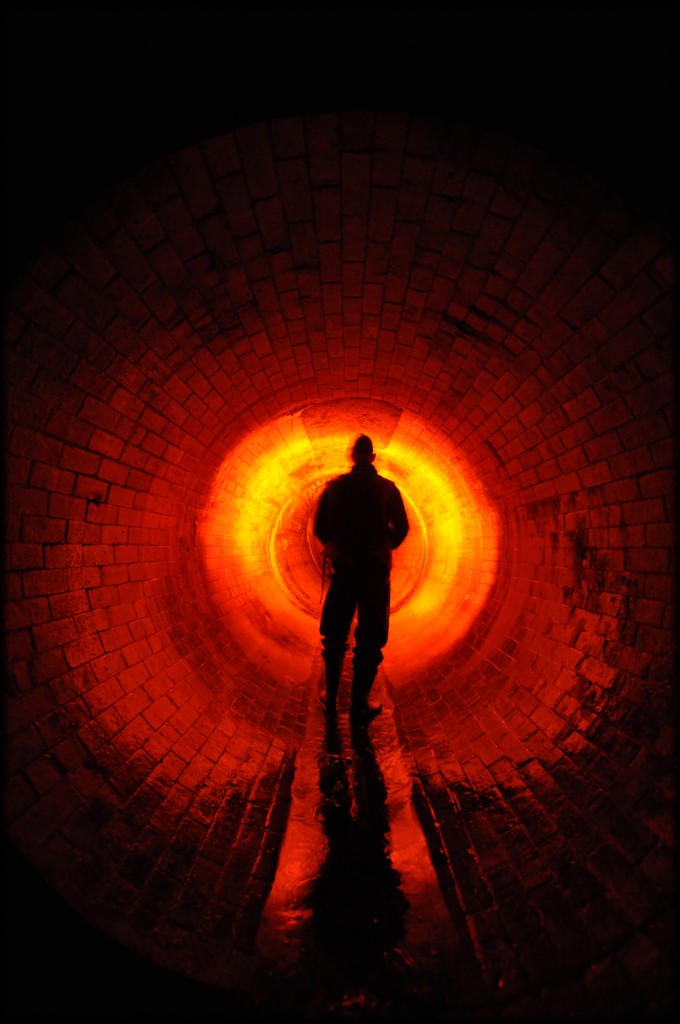
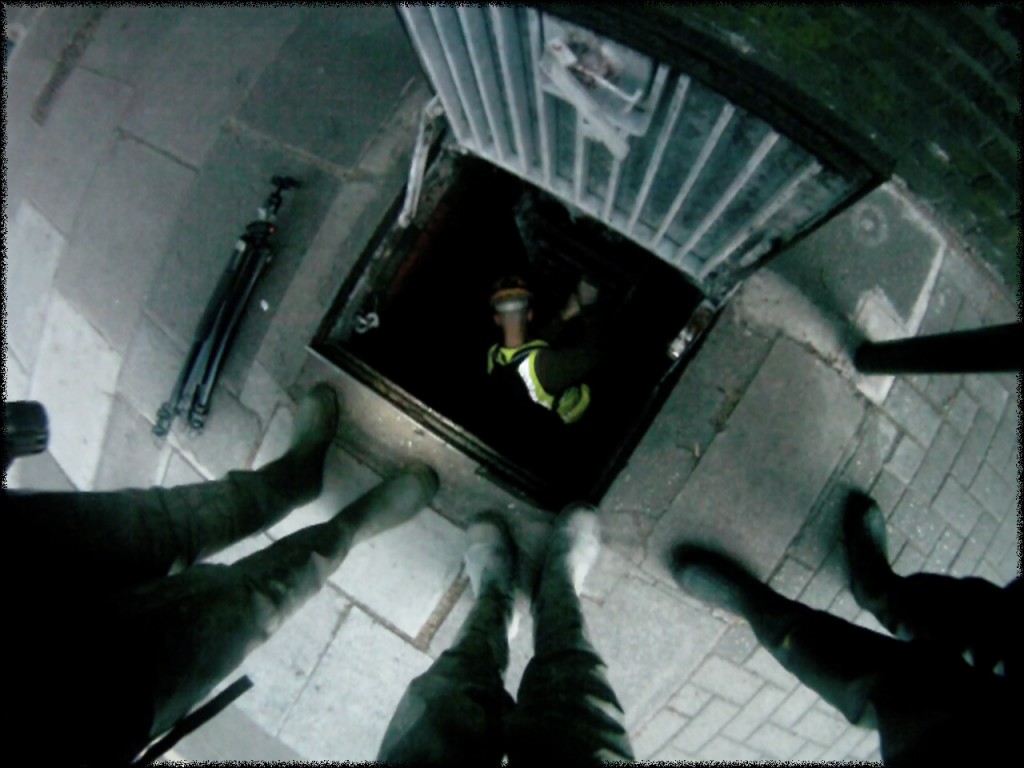
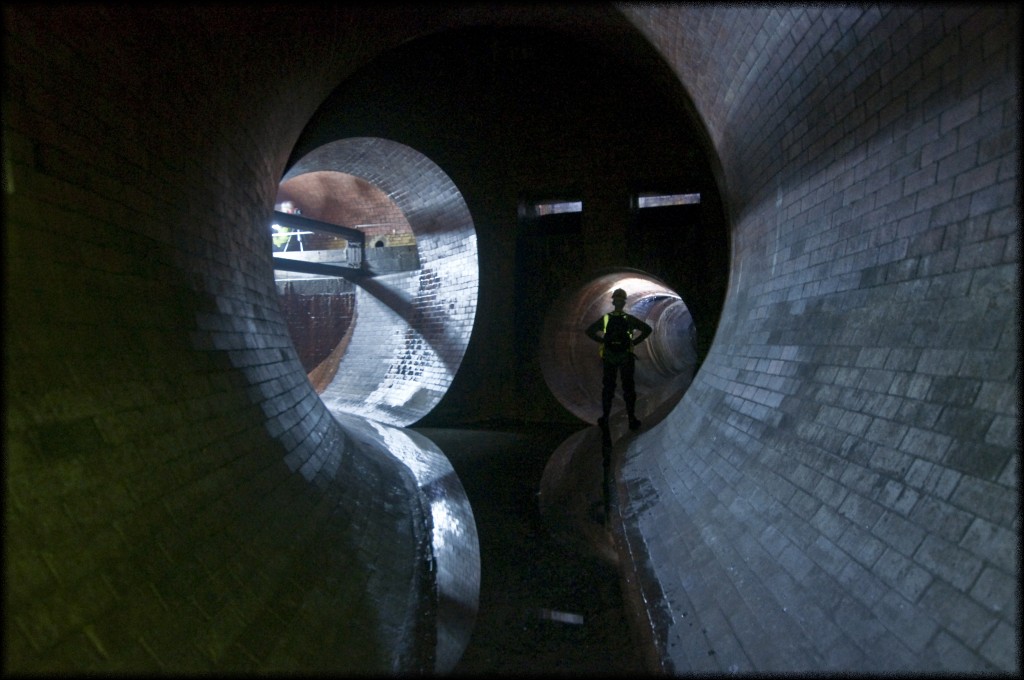
Above me, the heavy round metal doors into this underworld shake with a pinging metallic scream that reverbs down these watery tunnels, slowly fading into a seemingly endless succession of dull thuds that migrate down the street above us, some racing black cab speeding a jilted lover home from the pub after the last trains have stopped running. This overworld scenario interests me far more interpreted from below the undercarraige of the cab, little bits of shit-sticky mud dislodging themselves  from the freshly-pried manhole cover edges, plopping onto my bald head. Cue a shuddering shake, aural spell broken.

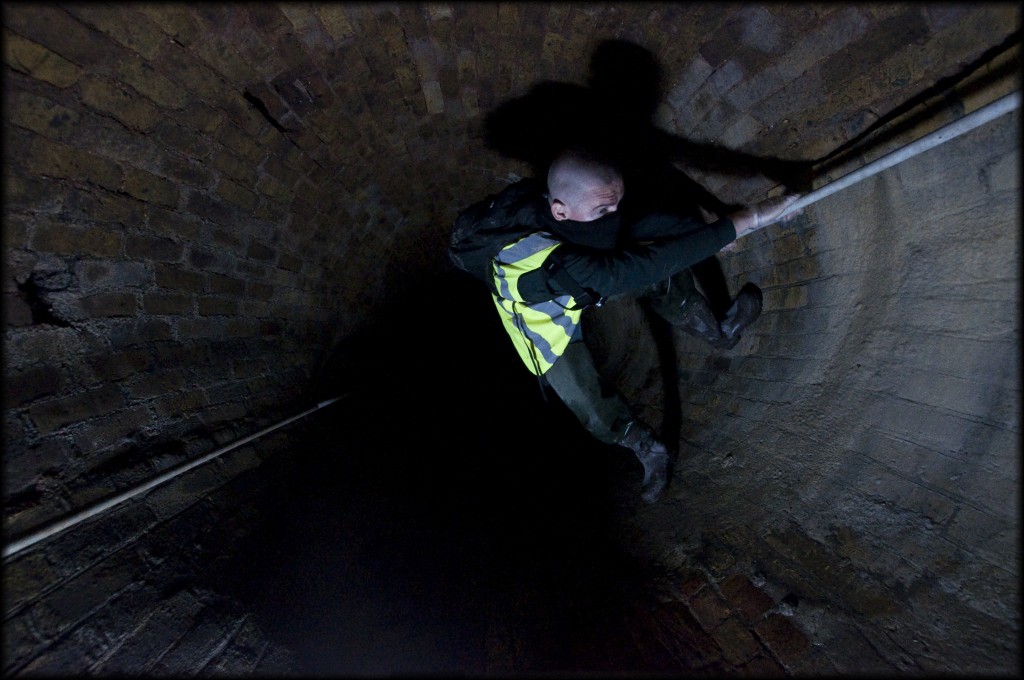
Water races around my feet faster than the cab, pinning my waders in a strange plastic comfort to my legs, little bits of used toilet paper and raw sewage which we lovingly call “the fresh” blocked by my PVC barrier, pushing around me angrily in an effort to make it down this old river and into the Thames like salmon swimming not toward their spawning ground but the river Styx where the boat will sink halfway across and they will float lazily to the bottom, never to move again. As drainers, we learn to love the waste just as we learn to love the trash left behind in the streets of London at 4am on a Friday night. It is the detritus of passion passion for life that staves off our impending deaths, as Michael Dibdin writes in Cosi Fan Tutti:

This place reeks of mortality.
I thought it reeked of rancid oil and bad drains.
It comes to the same thing in the end.

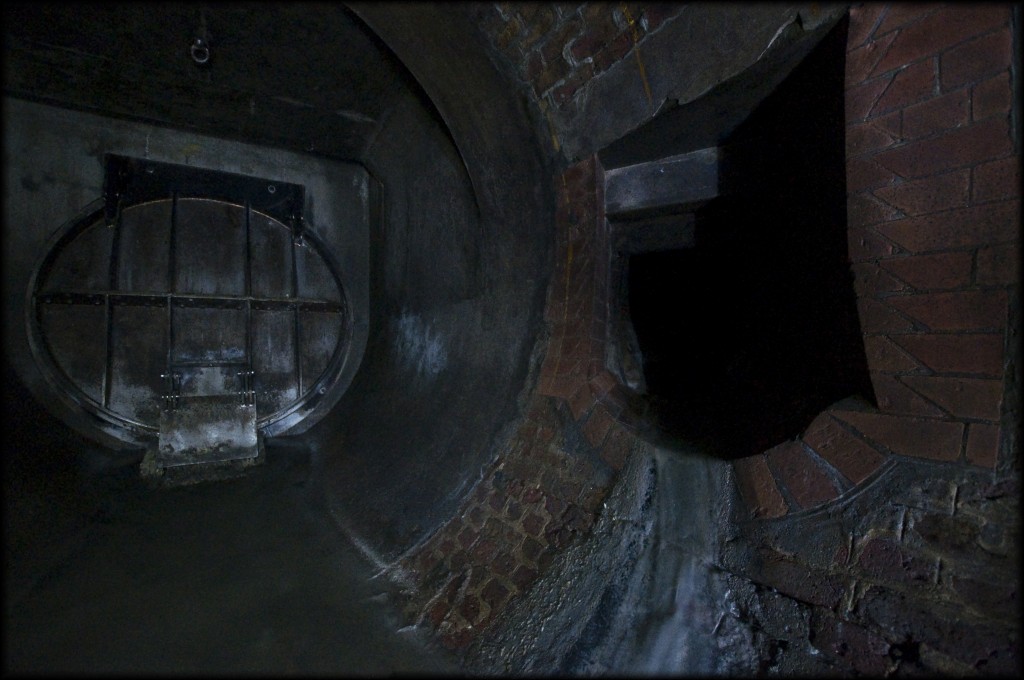
At some point in London’s Victorian Age, the separation between “river” and “sewer” became blurred. Technically, I am standing in the River Westbourne which no one but sewer workers and daring drainers have seen for a hundred and fifty years. Despite the fact that no one has drank the water from this river since the 1400s, it remains a vital waterway of this city, a throbbing vein of live humanness, rushing underneath our unknowing feet as we run to work on the pavement above. Seeing it is a reminder that, as Gay Hawkins writes, “our rituals of cleansing and disposal are enfolded with this landscape, our personal secrets are implicated in the public secret of sanitation.” This misadventure into the bureau of public secrets is the newest in our chain of London infiltrations, our most recent attempts to make sure that this city is documented from every possible angle through experience, fear and love. Just as I wouldn’t wipe the ass of somebody else’s baby, only London’s sewers interest me.

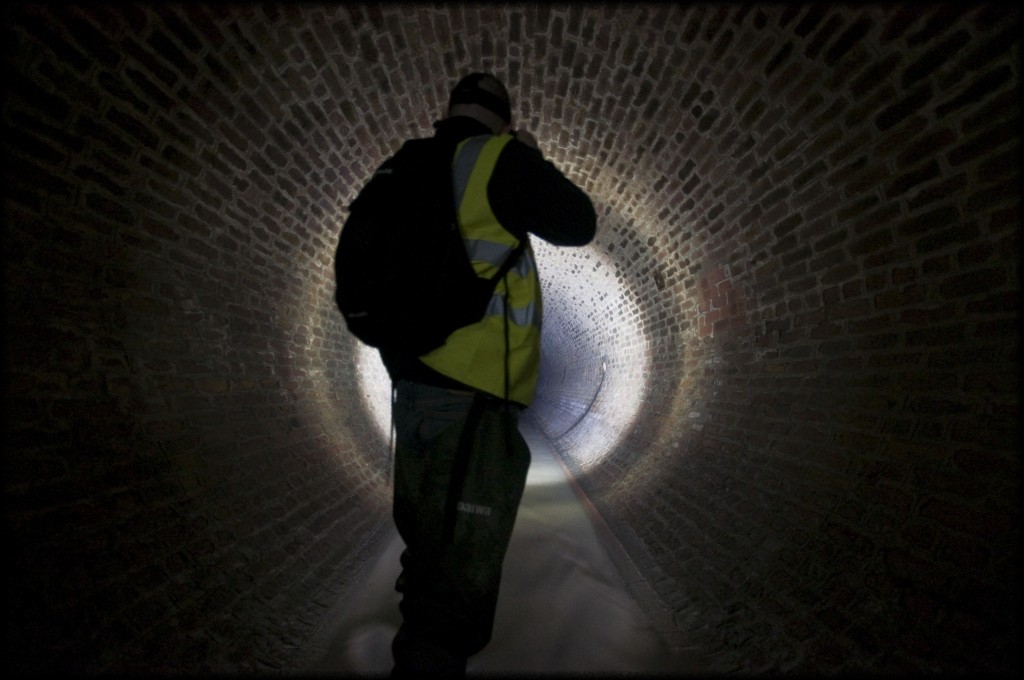
We view the stigma of what is flushes on these journeys both literally and socially. Our preferred mode of access to these hidden waterways is hiding in plain sight and the classism of London society works in our favour, with both police and the public ignoring everyone dressed in high-vis and a hard hat, benign foreign workers who make their living in places where no “respectable” Londoner would ever step foot. Our team of 4 digs into their toolbelts of large screwdriver, t-shaped keys and crowbars to break the seals into underdiscovered territory, finding what the city forgot existed, our brazen crew seemingly as hidden as this river when we actually look like we work for a living.

Cracked

Pull this bird

The addiction to infiltration does not lay in the adrenaline rush of the experience. Infiltration creates unwieldy complications, difficult mental junctions and moments of crises that confuse, inspire and complicate our existence. My second identity as the underclass, the role that I play to gain access to urban secrets, is slowly becoming my primary identity. My clothing, my language, my social class, all now defined by my behaviour “on the job.” Leaving this tunnel late on this night (early the next morning?), we were greeted by “real” workers at a tube station who tossed slight nods our direction, eyeing us with confused interest, suspicion, respect and likely some revulsion given we were covered in underground wetness that smelled even worse than the rank pub toilet across the street.

We have been systematically exploring London’s subterranean features for the last few months, cracking every stormdrain, abandoned railway, cable tunnel and sewer we can find in the city – elements of this urban environment that Steven Smith, in his book Underground London, calls “London’s best kept secrets.” We know why. Not only are they some of the most beautiful and surreal places in the city, they are also the most foul.

Pour your heart out

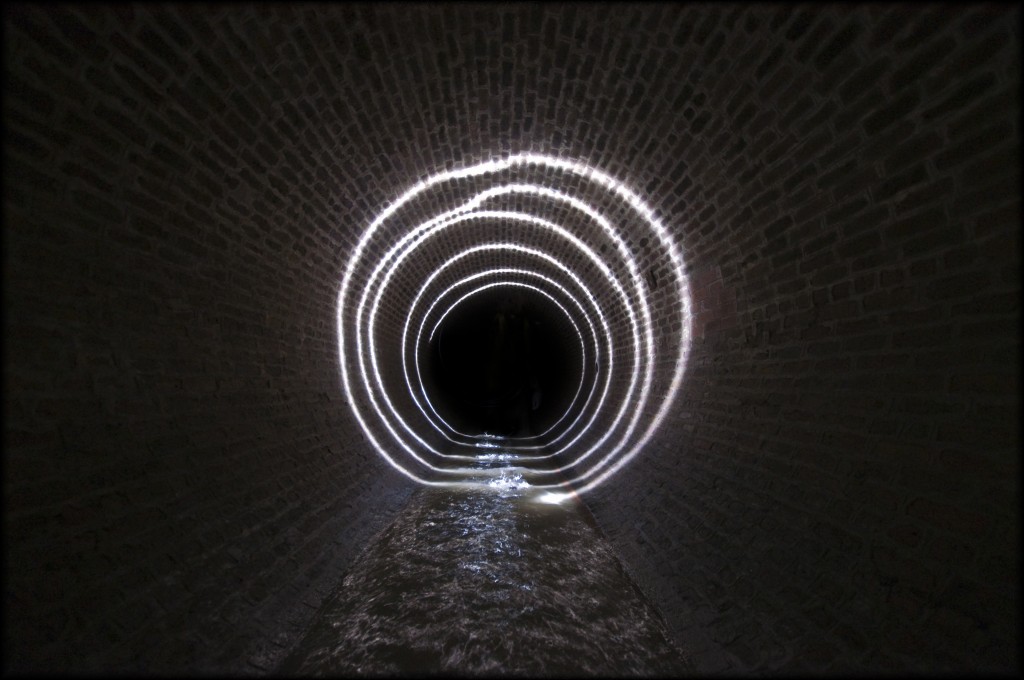
The sewer is a place for alterier cartography, a place where no one may reside but where one can pass through, cameras capturing endless angles of the oldly new, remapping our mental conceptions of where the verticality of the city begins and ends. Our embodied experiences move like the stinking water, shifting from one chamber to the next, chalk marks on walls marking our way home, level after level of underground run-off continually sinking into what we imagine to be an endless succession of metal grates covered in dried up cakes of unknown substances, unidentifiable pieces of fabric and scraps of food. Matthew Gandy, in his article The Paris sewers and the rationalization of urban space contends that “by tracing the history of water in urban space, we can begin to develop a fuller understanding of changing relations between the body and urban form under the impetus of capitalist urbanization.” Pretty sure he wrote that line from the Paris sewers.

Alterier chamber

We trace these cultural lines and flows, finding here that nature and culture drift at the same rate in an interdependent foulness. London’s legendary sewer rats are in full effect tonight, running from us in a terrified scamper, climbing the round slippery walls of the tunnel in inexplicable ways and disappearing into holes we can’t even see into. I want to explore what they can see. At one point, some sort of nest is disturbed and they came at our lights, their little claws feet screeching all around us. Staying in the middle of the slimy sticky mud, shit and runoff where the rats won’t swim was clearly our best option.

We spent 4 hours sliding around these chambers, building up our immune system with aching stomachs upon exit and mouth sores to come. As we emerged I felt, as I often have, that tonight was another attempt to document my own disappearance in the course of making the city reappear in alternative iterations. As I sink deeper into my PhD, I sink deeper in this city, still so in love that there isn’t even room for another human being. I can only hope that either I or the thesis emerges at the end of this torrid love affair, unsure I will survive the potential breakup. Until then.

Own the night.
Cherish these secrets.
Wield this power.
Love this life.

Explored

Beneath your pub crawl

More playful than righteous

________________________________________

This author’s endeavour should be to make the Past, the sense of all the dead Londons that have gone to the producing this child of all the ages, like a constant ground-bass beneath the higher notes of the Present.

-Ford Madox Ford, The Soul of London

Share
Tags : , , , , , , , , , , , , , , , , , , , , , , , , , , | 13 comments

Empire

Posted by Bradley L. Garrett on Wednesday Mar 24, 2010 Under Uncategorized

Now that I had been underground in New York, I thought I might as well go aboveground as well. Luckily, I happen to be staying in a lovingly decrepit 15 story building on 5th Avenue and 31st this week with a nice view of the Empire State Building.

Not nearly high enough!

Taking the lift to the 14th floor, I walked out into what was clearly some sort of space for workers living in the hotel. Luckily they were asleep. I took a quick tour around and found a big black door marked “Emergency Exit, alarm will sound.” That’ll be the one I want. I hit the lift button just in case the alarm actually went off so I could jump in and make my escape. The lift doors opened with a ding and I hit the the metal bar on the door. With a sucking sound, the cold air rushed in, alarm free.

I stepped outside onto a lovely roof. Not the highest I have ever done by any means but it had two sketchy water towers on it to get up on more floor (though you had to lay on their sloped roofs rather awkwardly to get shots!). There were also multiple levels connected by rusty ladders which I enjoyed walking up with no hands. I spent the rest of the night laying around staring at a beautiful skyline shrouded in moonlight and soft city glow.

Water Tower Tipsy

Peep show

Nights like these

Share
Tags : , , , , , , , , , , , , , | 1 comment

New York City, redefined

Posted by Bradley L. Garrett on Saturday Mar 20, 2010 Under Uncategorized

This city is crushing my soul, I will never come back here again.
-Bradley L. Garrett, New York City, 2008

Bad idea?

I was approached by David Gilbert, one of the faculty in my department, with this simple question – would I want to come help teach the undergraduate field trip to New York City this year? David had no idea of course that when he asked me that question, images of the most horrible 3 months of my life flashed across my mind.

Yeah, I lived in New York City for exactly 3 months. That was the amount of time it took for this city to squeeze all of my ambition, money and joy from me like a sponge in a vice. My time here always makes me think of Timothy “Speed” Levitch in The Cruise when he looks across the city and says “New York City is a living organism; It evolves, it devolves, it fluctuates as a living organism. So my relationship with New York City is as vitriolic as the relationship with myself and with any other human being which means that it changes every millisecond, that it’s in constant fluctuation.” And like all my relationships, that one failed miserably.

So when I accepted the post without reservation, I surprised even myself. I guess I knew that the fact I was scared of this place would push me even more to accept. Isn’t pushing the limits of fear and sanity what my life revolves around?

I decided pretty quickly that if I were to return to the Big Apple, it would be on my terms. Meaning I had to relearn it from the inside out. So I got in contact with Alan Rapp from Critical Terrain, Julia Solis form Dark Passage and Shane Perez, one of the most well-known explorers in NYC to make sure that on this trip, New York City would be redefined.

I failed to do much research but knew that there was an abandoned hospital reported about a year ago on Roosevelt Island and woke up early on my second day here to go scope it out. I found the hospital and grabbed some photos over the fence but it was clearly under renovation and I realized wasn’t worth going into. Still, it was good to finally see the famous Renwick Hospital in person. With that, I left to go wander around the city and take some tourist photos.

Just a shell

Tourist 2

Tourist 3

Tourist 4

Tourist 5

Yesterday morning I woke up, feeling frustrated and in dire need to infiltrate this city in some meaningful way. I decided that if this hospital was all I had to go on than I should at least go back and plant our Londinium flag inside.

In the early morning sun, I made my way to the F Train. I walked to the end of the platform, paced by a New York Transit Authority worker in a blue suit. It the end of the platform, he opened the gate to the tunnel, unlocked a door and disappeared into some subterranean depth.

I looked at the open gate and thought of my crew in London. I thought about Ninjalicious writing that one must always be ready for action. I thought about the gloves, camera and torch in my bag. I knew this was one of those rare moments that would come and go in an instant. I looked for cameras, saw none, and crossed the gate into the Metro tunnel, following the worker into the room. Inside the room was a stairwell where I heard him talking with someone else on an upper floor, cussing about some problem. I left the room and set down my backpack, quickly pulling out my camera, realizing I took my tripod out that morning. Oh well. Before I could hesitate, I started walking down the tunnel toward Roosevelt Island, under the East River. When trains came by, I hid behind railing, holding the camera up to grab impromptu photos. I knew they wouldn’t be beautiful, but the best explorations, I find, always end up with the worst photos. Nerves, the need for mobility and the fear of being seen always compromise good shots.

Hip Shot

There was a moment in the tunnel when I felt I had submitted to it, we became one as I slid along the wall, reveling in the silence in between trains, terrified each time I heard the rumble on the track that I knew indicated another on the way.

I don’t know how far I walked but when I got to the end of the tunnel, at the Roosevelt Island stop, I found that there was no gate and walked out quickly, stuffing my camera back in the bag. A wave of euphoria washed over me; I had walked a New York City train tunnel, right in the middle of the day. Epic. I wanted to run out of the station, up the three sets of escalators and out to freedom but I forced myself to walk calmly, my mind screaming with excitement. As the first escalator puked me out at the crest, I found myself standing in front of officer Rodriguez of the NYPD. He said “I need you to follow me” and proceeded to walk back down into the station. I responded “sure thing” and followed.

When we got back to his security hut, I was sweating. He put me in the corner of the station and stared at me until I finally looked away. “What the fuck did you think you were doing?” he said. I told him that I was a researcher here to teach a class and wanted to get some subterranean pictures for my students to see and that I had found a gate left open. He stared at me incredulously. “Why this station?” He says. “Do you know what this station is?” Clearly, I had no clue. Now I could see that he was sweating and I started to get nervous. He says “I can’t let this go… 9-11… protocol… etc.,” and started to tell me about how he was 3 years away from retiring, he had a pension to consider. What if I wasn’t who I said I was? I told him that I understood and would was behind whatever he wanted to do. The cuffs came out.

Now, I should mention that officer Rodriguez was incredibly friendly, almost apologetic when he cuffed me. He said, I just have to call the sergeant, I don’t know what to do here. Again he wailed “Why this station?” I apologized and told him I would happily wait for the sergeant.

It took ages for the sergeant to get there. Maybe an hour. I felt that officer Rodriguez and I had a good repertoire at this point and thought he might give me a break with the sergeant. Then sarge rolled in, fat-necked and scarred, looking like that captain from Starship Troopers that got his arm gnawed off by a giant bug. When he found out I had a camera full of photos he grabbed his head and cried, “oh fuck”. He had to call Homeland Security. It turns out that the photos I took were very close to a new subway power station being built. It also turn out I had photographed this power station a day earlier (above ground – the pictures still on the camera) and this was really freaking them out. The sergeant then said, “this is going to take a while, you might as well uncuff him.”

I took another hour for the security check to go through, me in the corner reading Cormack McCarthy and the cops chatting about some drama back at the station with pay raises.

The sergeant walked back out and looked down at me. “The good news is”, he said with a smile, “you are not on a terrorist watch list. The bad news is I can only offer you two options. Options one is that I place you under arrest and we do further checks while you are locked up to decide whether you can keep those photos. Option two is that you delete your photos in front of me and I give you a trespass violation.” Guess which one I took?

$50 out

So, hours later, I am sitting in Bryant park in the glorious Spring sunlight, sipping a Heineken and listening to Delphic singing “Let’s do something real”. Way ahead of you guys. I feel really good. The mission, strictly speaking, was a failure. Well, shit, they both were. But you know what, I feel like New York and I are better friends than ever. We spilled a little blood together today, I took a trespass to show her what kind of explorer I am. I showed New York that she won’t own me, crush me or rob me ever again. She knows I will go to the mat now to protect my right to exist here on my own terms. And that, my friends, is a win.

Share
Tags : , , , , , , , , , , , , , | 8 comments