There he goes. One of God’s own prototypes. A high-powered mutant of some kind never even considered for mass production. Too weird to live, and too rare to die.
Raoul Duke

Intentions

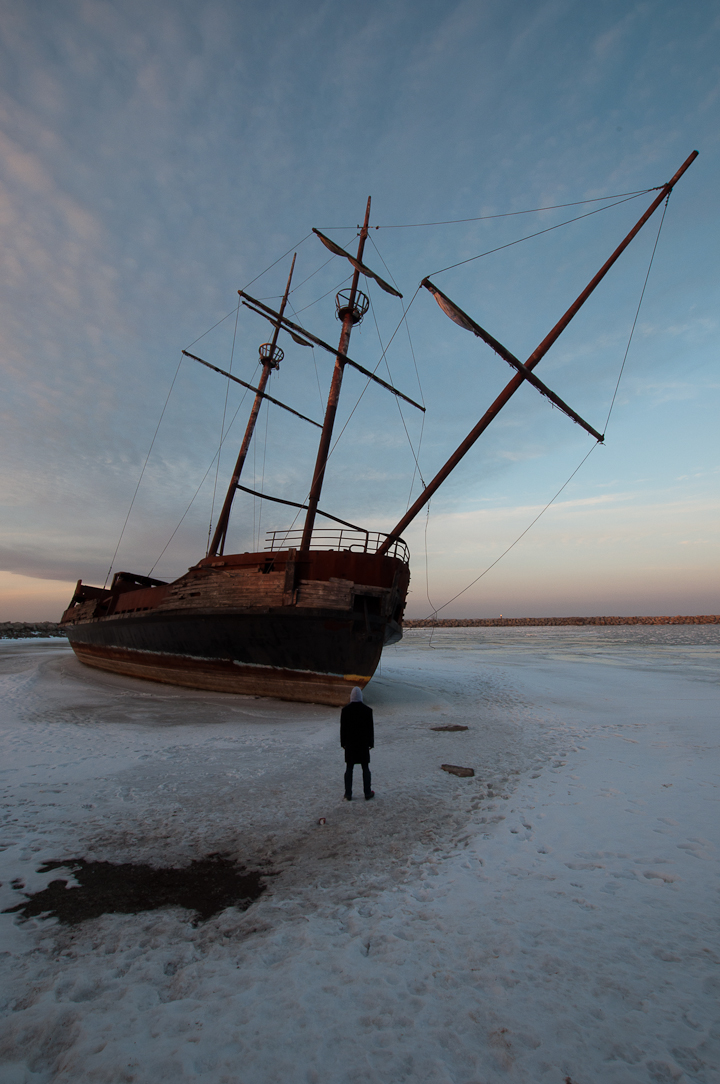
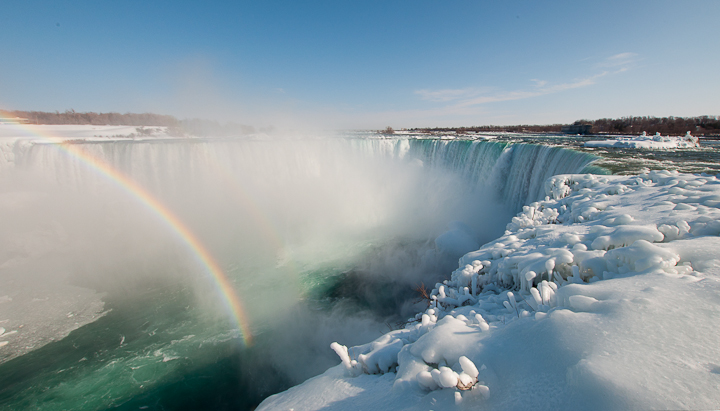
I arrived in Syracuse, NY and escaped as planned in my newly-acquired ’88 Dodge, speeding into the Canadian winter wonderland with every intention of sucking the life out of every moment that I encountered. Dressed in black, masked up, layering my thin California skin against the wrath of Persephone, I had every intention of doing what we do best – turning an idea, absurd, slippery and unmanageable, into resolute action with a resultant outcome of epicness. I know the formula. However, expressed in this way the “idea” is only an ideal problem, which in reality takes on an unsettling and radical complexity. The problem was, perhaps, in the way I had become accustomed to how our band operated; firstly in our interdependency and then in our relative immunity. Crossing the border into Canada, I screamed through like a drunk whirlwind, smoke from a California sage bundle pouring through the windows, blasting leftover dubstep which had fermented in a Tupperware container with the lid taped down so it wouldn’t spill, jumping around in the passenger seat, totally unaware that I was radically out of place. The topographical fractilisation finally evidenced itself when I pulled into Niagara Falls to stare at a tailrace now inaccessible. I have clearly underestimated the impact that seeing the Belly of the Beast sewn shut would have on my explorer constitution. Soberly drinking a very well made whiskey sour, I took a photo of Niagara falls with the other tourists and drove off to park in some farmers crop where I slept in the car, shivering and bored.
Fissure

It occurred to me in a frostbitten hallucination that the photos I took were not flatly captured do to any technical limitation but because of the lack of required investment in either meaningful human exchange at the moment of shutter release nor interesting endeavour toward the moment of acquisition. A determination as to which of these factors was leading to my disillusionment became a primary goal for the trip.

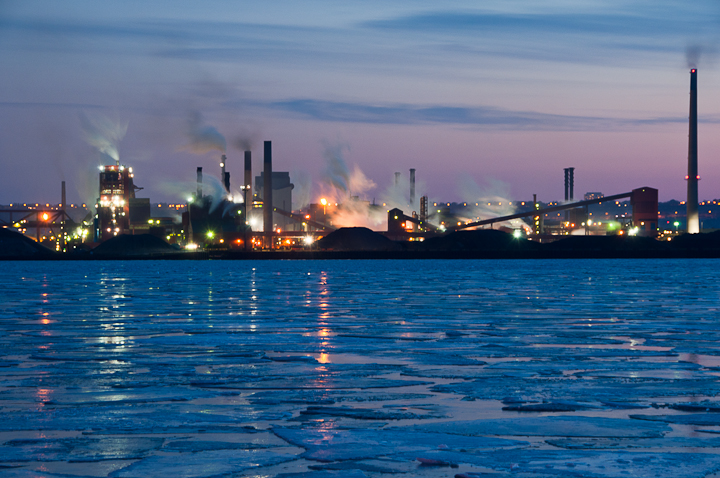
But the fear set in with the realization that the expectant fracturilisation had begun to make it’s move from spatial to psychological.  Mental processes began to take unrecognisable forms which, at times, could only be understood in moments of lucid dreaming or utopic drug visions. My PhD thesis began acting as a gravitational tractor beam, pulling me back to the mother ship as I continued to struggle toward the liberating slavery where my work could be completed in an appropriately manly fashion. This seemingly productive internal feedback loop taking me to ‘work’ however, in this context, led me to a constant sensual disenfranchisement that I had forgotten in London. The pinnacle came in Chatham, Ontario, where the car broke down and I was yanked from it by a thick-necked Canadian with a machine gun who told me I ‘had a mouth on me’. He seized the vehicle, called me in a ‘transient’, and left me standing in sub-zero temperatures with my roly suitcase. It was fucking cold.
Disillusioned

I left the burning, green fluid-spurting car with the police and escaped Canada on a boarder-hopping shuttle full of old people without event. I caught a plane from Detroit. My line of flight to Minnesota was not to be realised and I called Darlinclem from the airport, impossibly bitter. Sweet as ever, she agreed to reschedule our Subterranean Twin City rampage for the summer.

Upon arriving in Las Vegas, the suggested endpoint for my roadtrip that barely happened, it occurred to me that the required to remedy for the situation was some old school Place Hacking. A quick personal database query revealed an aircraft boneyard halfway to LA and I hit the road. Arrival revealed incomprehensible dereliction, dozens of square miles of dead planes, military housing, cinemas, shopping malls and a giant hospital now used for urban military training. All required sneaking around inside the defunct George Air Force Base, now the Southern California Logistics Airport. It felt a lot like an abandoned Soviet military base in Poland. Except for the tumbleweeds and sand. And paintball remnants. Well that and there weren’t statues of Lenin everywhere. I guess they weren’t really that similar.
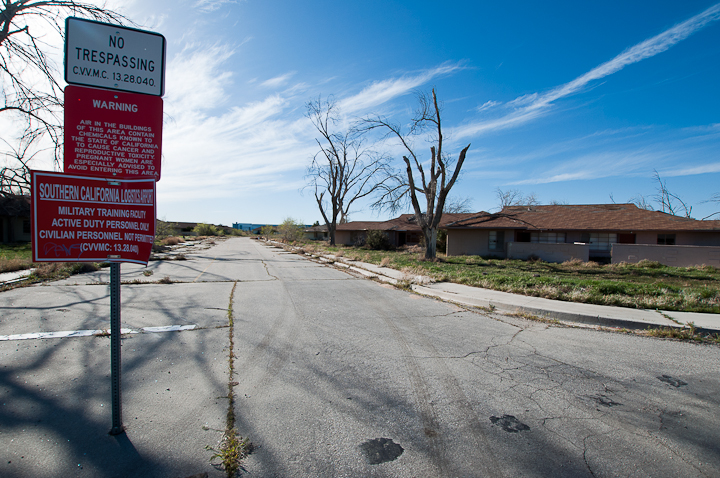
Warning signs
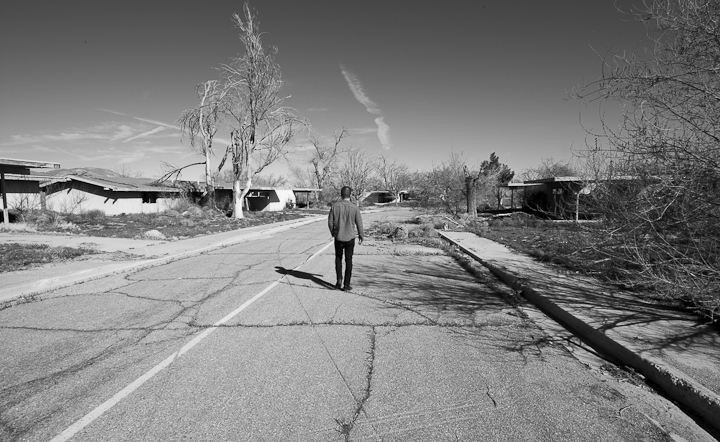
Not that sneaky
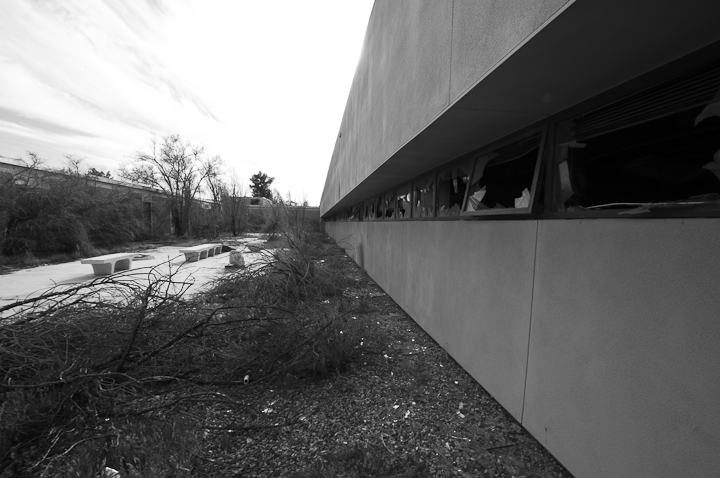
Places
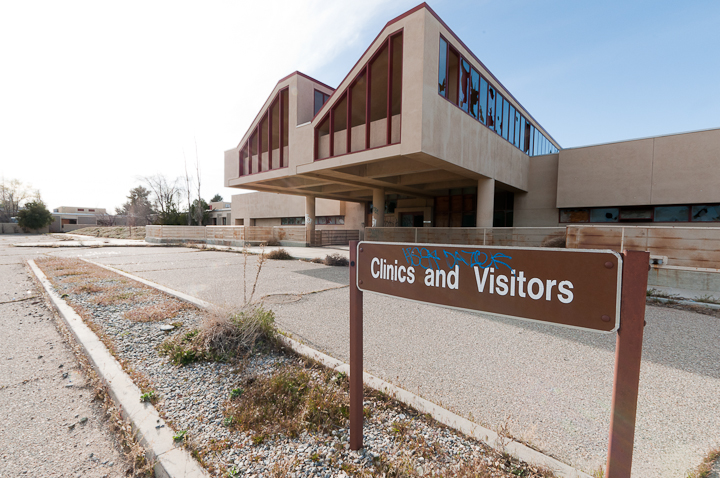
Not that freaky

I was relying on known variables here trying to rip space into time with my subtle knife, creating temporal amalgamations and fresh spatiotemporalexperiential concoctions with salt and lime. My own past was here somewhere, past the Canadian ice sheets and industrial ruins of Detroit, here in a desert full of tumbleweeds, sagebrush, jackrabbits, adobe and agave. This past had to retain it’s juvenile viscerality, that recognition that it’s articulation historically does not mean recognizing it ‘the way it really was’. It means appropriating a memory as it flashes up in a moment of danger. But the danger coalesced limply. Rather than London riot police attacking me with batons, I found overweight security guards easily converted though commiseration with their existential misery. I kept praying for military police to show up so Silent Motion would descend from a rooftop to take one in the eye with a ninja star while Patch kicked another through a wall with his famous swift boot. Everyone I encountered was so apathetic, they didn’t even care what my mission was, why I was wearing a giant cowboy hat covered in bodhi seeds or for what reason I was photographing their derelict hospital. The contrast between the furiousness of their illusions of control and the lacklustre enforcement of the stated boundaries was nothing short of disheartening. Freedom without boundaries is pointless.
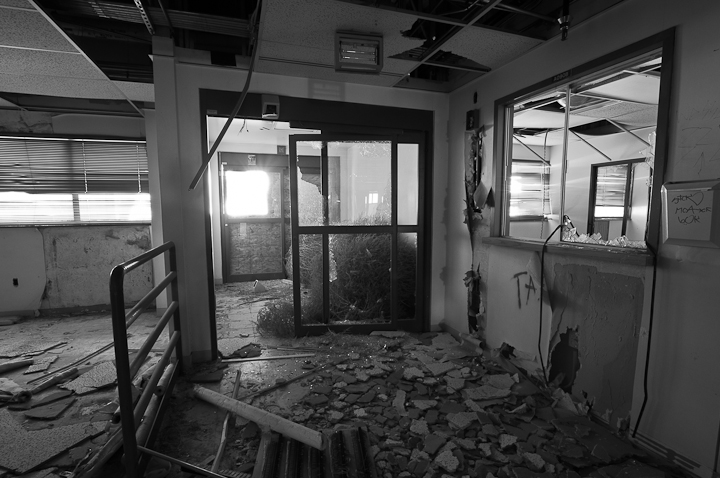
I'm doing this
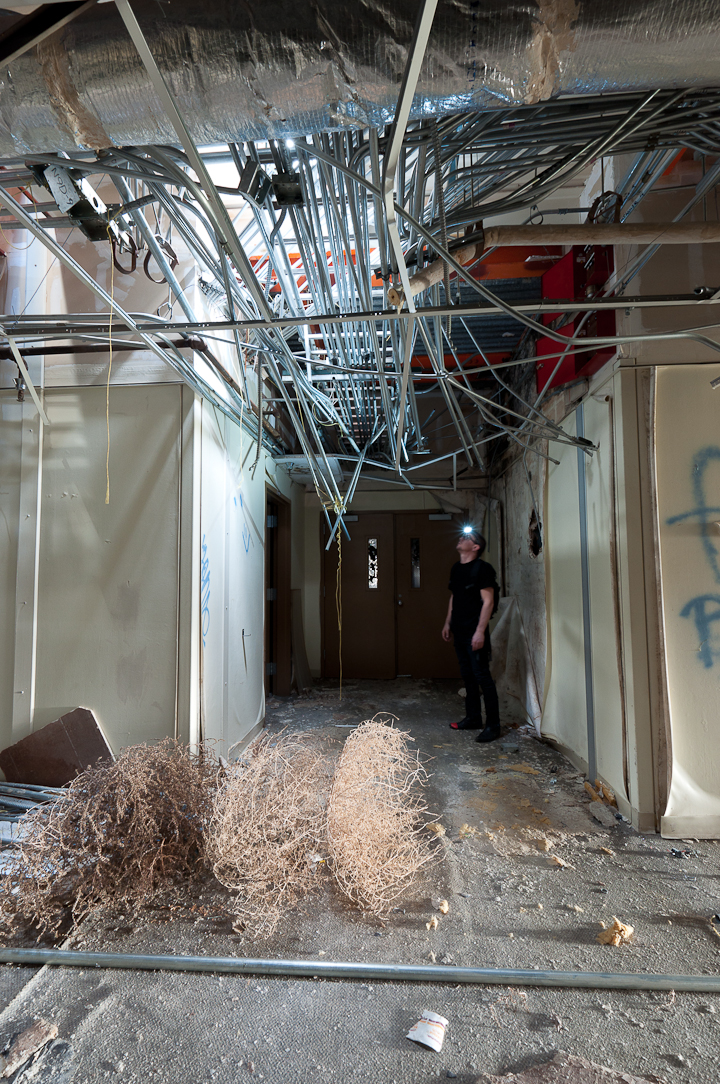
For no reason

Despite my misgivings, the moments of encounter between the present and the past, experienced through physically exploring abandoned architecture, uncovered that old embodied practice that mirrors the role of the archaeologist assaying surface material without deep excavation to analyse the character a place, as expected. It’s just that I undertook my surface survey of affectation by making connections more topologically than topographically these days. I successfully temporarily inhabited those sites of material history and constructed assemblages of emotional and memorial attachments that melded pluritemporal geographic, historical and experiential imagination, perhaps one day subject to nostalgic romanticism and that was sort of satisfying. But they remained, in my mind, the product of a life left behind, each composition an infantile regression. As such, I revisited those sites of old from my research, a babe suckling a solipsistic personal history missing all my favourite characters.
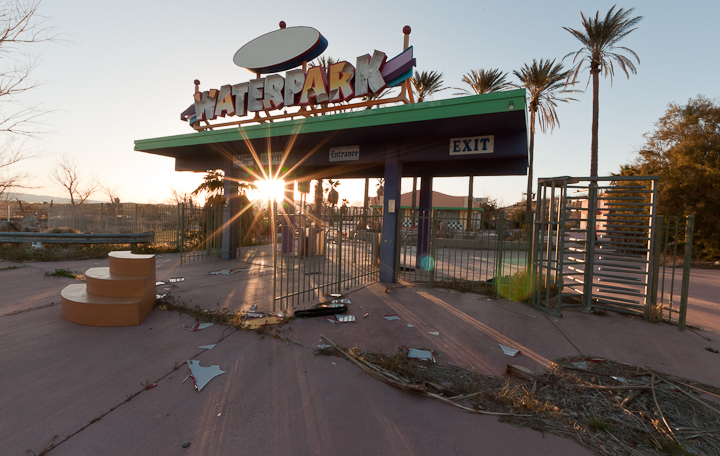
Still rotting
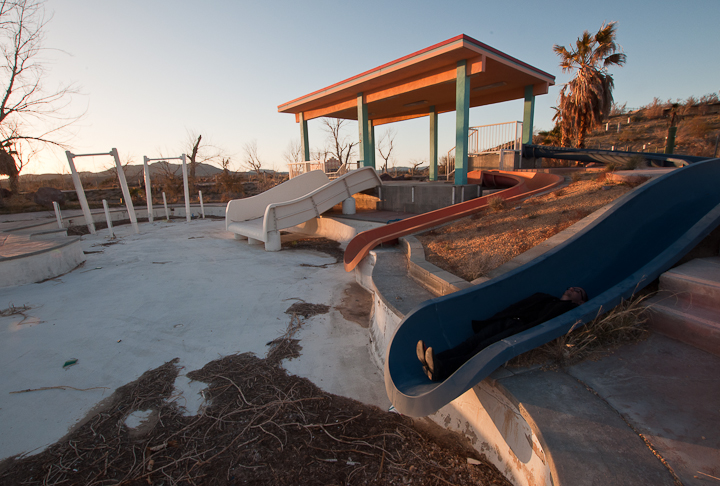
Despite it all

The only thing, as always, that remained of interest was those impossible-to-ignore topographic characteristics, those moments when I felt London was in the desert in me and that my crew could feel the Mojave through our tingling warder bond. These are the singular incorporeal constellations which belong to natural and human history, and at the same time escape them by a thousand lines of flight. I arrived in the desert where I will write our stories and found that here the radio crackles and hums with talk of evacuation zones and potassium iodide. I’m sitting here picking at my fingernails and refreshing news pages over and over to the faint scent of burning plastic and I’m in Fukushima. It is heavenly in it’s apocalyptic serenity, useless it is ineffectual attempt at human connectivity, terrible in it’s aftermath.
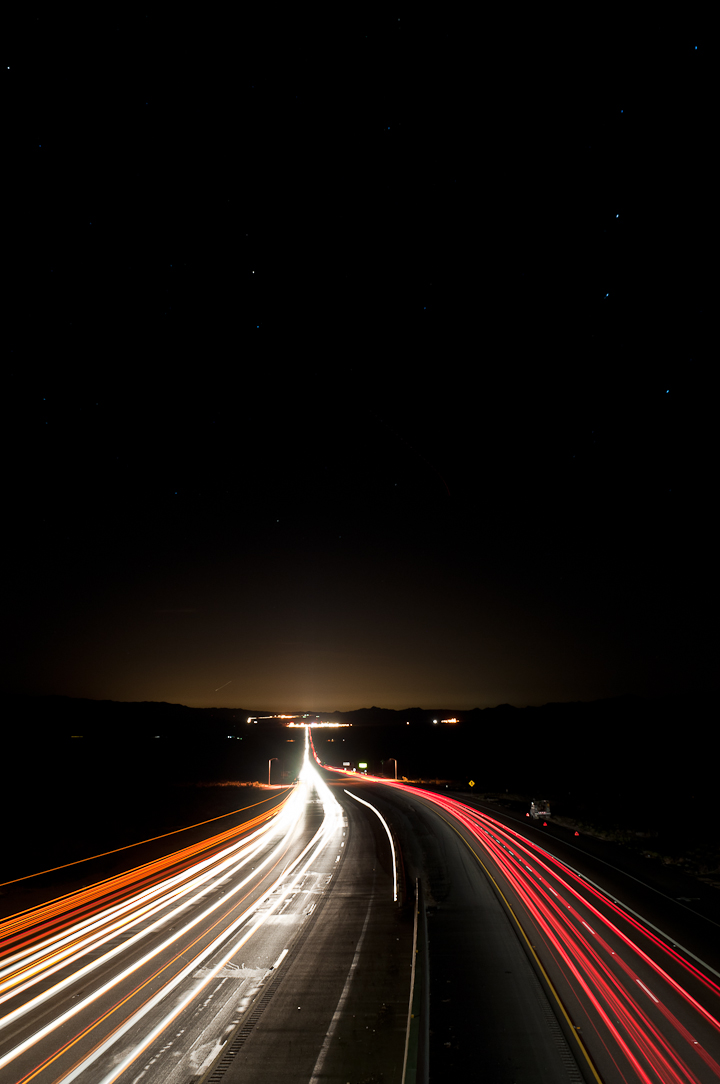
Lines of flight

In the end, it is the decentralization of disruptive energy created by my need to tug my thread into the desert that is causing the angst behind it all. I need it. I know that. At the same time, the media connectivity feeding me streams of information from the home I left, knowing that I am here to produce a theoretical contribution that neither I, or anyone I have come to respect by now cares much about also lingers. But more than that, it is the realisation that the dream of freedom I was taught as a child is a sham. The United States is not the land of the free, it is the land of the subjugated, the apathetic and the weak while the fight rages on in Europe and North Africa for the future world we will inhabit. My throat is dry while the deserts of the Middle East run red with the blood of a desire the population in this derelict desert has forgotten is theirs to take. And so I write.
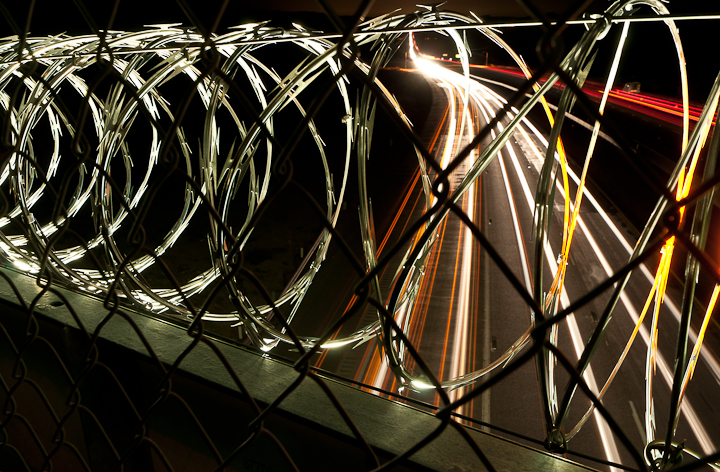
Feels like this

______________________

Explode Everything


Share
Tags : , , , , , , , , , , , , , , , , , , , , , , , , , | 4 comments

Paris Questing

Posted by Bradley L. Garrett on Wednesday Feb 2, 2011 Under Cultural Geography, Film, Geography, Infiltration, Infrastructure, Urban Exploration

As I make my slow pilgrimage through the world, a certain sense of beautiful mystery seems to gather and grow.
-A.C. Benson

Otter at Silent UK put together this really lovely video of our recent trip to Paris. Enjoy!

Share
Tags : , , , , , , , , , , , , , , , , | 1 comment

I like to just gobble the stuff right out in the street and see what happens, take my chances, just stomp on my own accelerator. It’s like getting on a racing bike and all of a sudden you’re doing 120 miles per hour into a curve that has sand all over it and you think “Holy Jesus, here we go,” and you lay it over till the pegs hit the street and metal starts to spark. If you’re good enough, you can pull it out, but sometimes you end up in the emergency room with some bastard in a white suit sewing your scalp back on.

–Hunter S. Thompson, Playboy Magazine, 1974, discussing drug use as edgework

Keep looking

Edgework was a term first used by gonzo journalist Hunter S. Thompson in his book Fear and Loathing in Las Vegas to describe the necessity some people find in pushing boundaries to find fulfillment. The idea is to work as close to the “edge” as one can without getting cut (or at least not too deeply). For Thompson, this meant putting himself in perilous situations such as doing ethnographic research with the notorious Hell’s Angels Biker Gang, ingesting various intoxicants to the point of near overdose or taking drugs of unknown origin in unexpected combinations.

The term edgework was appropriated by the socialist Stephen Lyng as a blanket term for anyone who “actively seeks experiences that involve a high potential for personal injury or death.” In his 1996 article Edgework: A Social Psychological Analysis of Voluntary Risk Taking (expanded in 2004 as an edited book), Lyng goes on to explain edgework as a negotiation between “life and death, consciousness and unconsciousness, and sanity and insanity”.

Relatively conscious (photo by Otter, Yaz and Goblinmerchant)

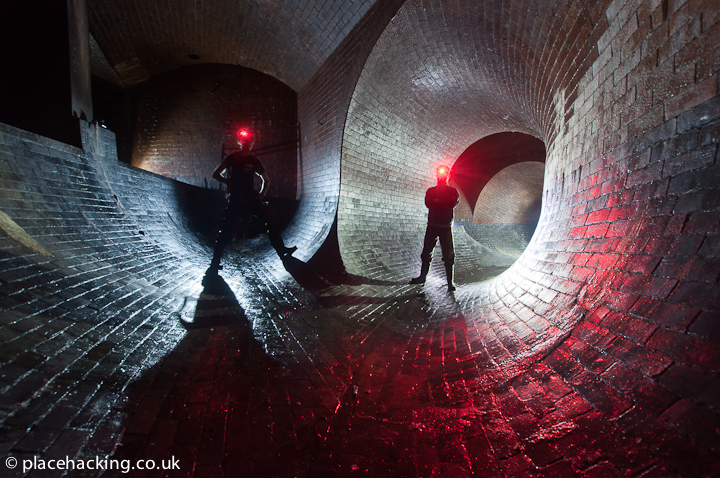
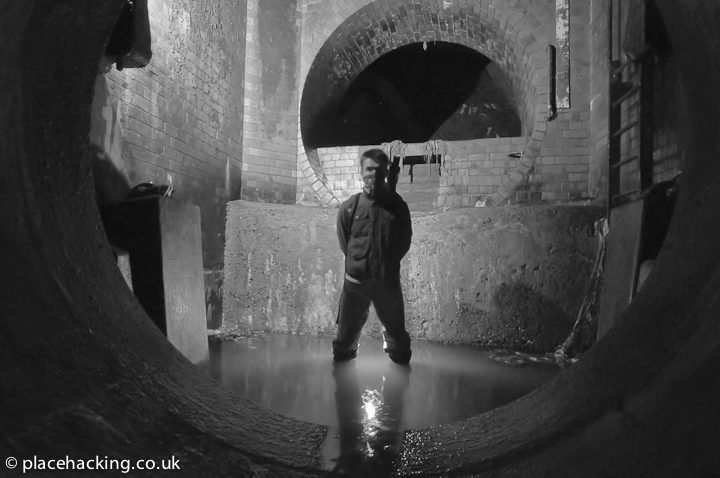
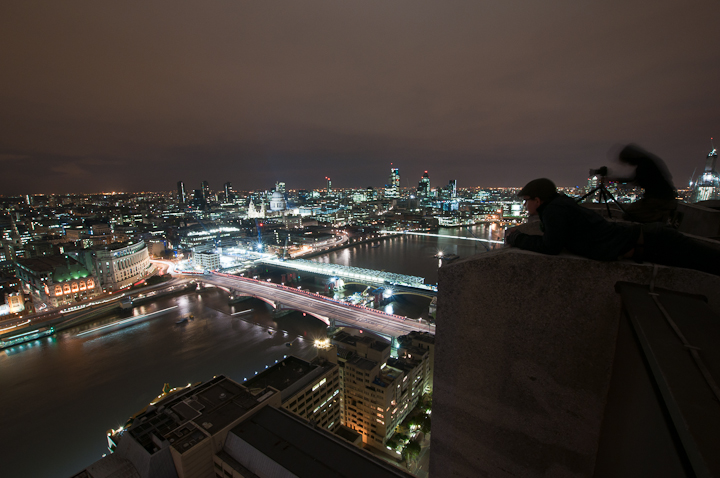
It seems to me that most urban explorers not only feel the need to test those limits, but to push them. We find those opportunities in drain systems, where the obvious risk comes from flooding and drowning to abandoned buildings which have both short term (collapse) and long term (respiratory problems, cancer etc.) negative impacts on our bodies. Many urban explorers also frequent high places where falling is always a possibility. In these locations we are free to do our edgework, pushing these boundaries by hanging from cranes, balancing on edges of long drops, precariously tiptoeing over weak floors and scrambling under collapsing roofs.

Edging (image courtesy of nocturn.es)

In wider society, inevitably connected to the concept of “liability”, is the notion that these activities are trangressive. UrbEx, like street art, skateboarding and parkour, is a practice which reappropriates urban space for an unintended or unexpected use that may result in bodily harm and one of the common reactions to people choosing to take unnecessary risks is, of course, suspicion that these people are “out of place”. But as Christopher Stanley has written, “these subcultural events [could] assume the status of resistant practices not in terms of ideology but rather in terms of alternative narratives of dissensus representing possible moments of community.”

Sinking feeling

As Lyng rightly points out later in his article, “risk taking is necessary for the well-being of some people” as individuals work to “develop capacities for competent control over environmental objects” (see Klausner 1968) inspiring edgeworkers to sometimes speak of a feeling of “oneness” with the object or environment while undertaking these risks.

I know that the places where I feel most embedded in the “fabric” are places where I have taken risks. In those places, I have bonded not only with Lyng’s “object and environment” but also with my friends who shared in those risks.

Alternative cathedral use, Paris (image courtesy of Marc Explo)

The desires to explore for the sake of exploring, to take risks for the sake of the experience, with little thought to the “outcome”, is something that runs deep in us when we are children. Urban explorers are, in one sense, rediscovering and forging these feelings of unbridled play, of useless wandering, of trivial conversation and of spontaneous encounter, all of which lead to the creation of very thick bonds between fellow explorers who use play as a way “to de-emphasize the importance of work and consumption and their pervasive monetary components.”

These explorations bond people in an emotive embrace, tendrils of affect conjured by shared fear and excitement, experiences that have become increasingly hard to find in many modern city spaces which Guy Debord argues “eliminate geographical distance only to produce internal separation.”

Perched

Despite the ways edgework may be seen as trangressive, the empowering and inspiring process of undertaking edgework is exactly what is lacking from many people’s lives in global cities. Edgework may in this sense be seen  healing rather than severing, a hot blade that melts. Physical human connections through shared experiences of peaked emotions build stronger bonds of community, and I am proud to belong to this tribe of urban bodhisattvas.

Tribe

Share
Tags : , , , , , , , , , , , , , , , , , , , , , , , , , , , , , , , , , , , , , , , , | 8 comments

The desire for alternative options starts with disappointment and anxiety.
–Alan Rapp

We live a free life. Very few people can say that.
–Marc Explo

Stretching

Following from Rapp, where does disappointment start? Why did we have expectations to that lead to anxiety to begin with? Are disappointment and anxiety internally or externally imposed conditions? Finally, what is the organic link between urban exploration and infiltration?

In the course of the following visual spectacle, I present two important case studies: an exploration of a derelict London Tube station paired with a live infiltration of a number of Paris Metro stations sprinkled with a sugar coated topping of French cathedral brachiation. The link between these seemingly disperate case studies in time-wastery, I will suggest, is desire.

Fragments

Of Time

Less interesting

Our desire to seek ruins is as obvious as the motivations behind the expeditions. We seek them to find pieces of what was, was is, what could have been. The failure of planning, execution and participation found in this empty station is comical and sad but not necessarily disappointing. We assure ourselves that the only thing that could make the situation more amusing would be if a train were suddenly to pass though, disrupting our notions of what we thought we barely understood. By the time we leave, we are pretty sure something happened. We can see it on our skin, taste it in our teeth, wash it out of our clothes but the experience remains so ephemeral that to speak about it is almost blasphemy. The satisfaction that comes with that feeling is almost as wonderful as the peals of laughter that ring out from our throats as we leap from the back of the speeding train into the dark tunnels, drunk on the screams of platform perambulators who are sure that we are the demons they heard about on the 10 o’clock news.

The multiplication of the third rail

The eminent anthropologist Marc Augé is disappointed with our play space. Throughout his entire book on ‘non-places’, poor Augé is a victim of one postmodern monstrosity after another, striking out at remnants of what remains with a panicked grab, decrying the end of history, implying that there is no place for us in a world of machines, of mobility, of ‘urban concentrations, movements of population, and the multiplication of what we call “non-places”, in opposition to the sociological notion of place…”. But as Alastair Bonnett writes, this ‘sociological’ notion of place is was a false consciousness imposed by bureaucratic minds ‘colonized by the language of academia’ be begin with.

Your illusion

I contend that place is what you make it and the responsibility to make space viable, vibrant and interesting, the responsibility to create places of desire is only limited by our individual and collective capacities for love and the level of our energies devoted to giving a shit. As Sartre has taught us, since we all share in the same situation, we must embrace our awesome freedoms, deliberately rejecting any (false) promise of authoritative moral determination. Freedom is not given, it is obtained. I hear Marc Explo teaches a seminar on the rooftops of Paris with beer in hand on this very topic.

7.5%

My comments are not intended to be solely derogatory. I am not suggesting that a vision of life which is guided by another person’s ideals is inauthentic. Indeed we are all, to some degree or another, remixing, reusing, embracing, contesting and disputing all that has come before. Individuals that I quote, in speech and text, have quoted others before me, a lineage stretching back as far as communicative origins. This continuum of thought and energy should be celebrated with toasts to the heavens for the graces of wisdom. We have inherited more knowledge, more beauty, more potential, than any human beings who have come before. To suggest that that knowledge and the possibilities that cause fragmentation of self awareness are disappointing is in itself disappointing. Join the party Augé, I have a bottle of Beaujolais Nouveau waiting. Make no mistake, it will be messy, it will be confusing, it will be the ruin and the construction site, Battersea Power Station and Heathrow Terminal 5. It will be the informal state of constant becoming but ‘to embrace the chaos is not to slide toward entropy but to emerge into an energy like the stars’.

Forming

Spontanous combustion

While we can all clearly see that within a capitalist system, the invitation to co-produce place often has a price or that the output of that production is expected to become commodified, we may choose to operate outside of that system. Maybe that operation requires giving up watching East Enders tonight. Maybe it requires operating at a loss. Maybe it means writing a shitty Ph.D. because you were in a sewer instead of resting up for the next wrestling match with Microsoft Word. Fuck it, people begin participating in informal modes of cultural production because they want human bonds and community to take precedence over outcome. People want becoming over being. People want the freedom of the present! ‘On the other hand, anyone trapped in the anemic and atomized everyday routine of our residential deserts might doubt that such determination could be found out there anymore. Reconnecting with such gestures, buried under years of normalized life, is the only practical means of not sinking down with the world, while we dream of an age that is equal to our passions.

Marinetti

As the Invisible Committee reminds us, the primary component of that freedom is not just enthusiasm but passion. And the passion for joy, for bonding, for shared experience and community goes beyond the specifics of the practice (read: UrbEx). The one thing ALL explorers of space share is a passion for life, ‘an exuberant and playful negation of the alienation and exclusion provoked through axiomatic consumeristic machinations.’ And here, we begin to see the contemporary critique of traditional notions of exploration in the rejection of the idea that only some can be involved or that a passion for adventure can only be satiated through grand international expeditions. Urban exploration teaches us that those stories, those adventures, are found in our backyards also – if you choose to chase them.

The Rabbit Hole

Follows no cardinals

If this sounds polemic, that’s because it is. I am tired of disappointment, resentment and critique being the only accepted modes of critical academic engagement. We do what we do because we love it. It produces nothing. It hurts no one. It endangers our lives. That is our choice and no one else’s. And in expectation of the showering critique, the next person who tells me that my happiness is subject to an economic audit can keep chewing on that corpse because my fingers are in my ears.

There's no such thing as ghosts!

Barthes writes that pleasure is continually disappointed, reduced and defeated, in favour of strong, noble values: Truth, Death, Progress, Struggle, etc. It seems that our society refuses (and ends up ignoring) bliss to such a point that it can produce only epistemologies of the law. Well if that’s the case then fuck the law. I never consented to it’s construction in the first place and I am pretty sure that democracy isn’t supposed to resemble a Mafia extortion scheme. But don’t take that as a threat, it is rather a populist invitation to playfully reinterpret what the state holds so sacred, it’s an invitation to critically and playfully engage with the humiliating notions of ‘morality’ and ‘progress’ that dehumanize, commodify and deterritorialize our places of occupation to create what Guy Debord called “an impotent utopia of pretensions and complicities.” We intend to end the humiliation of a sham democracy by resituating ‘strategic sites of power beyond the depersonalized representation of an impotent democracy and back into the multitude.’ Following Laurie Weeks’ Theory of Total Humiliation: “we don’t erect monolithic reified barriers against the humiliation; rather we welcome it, embrace it; then everyone wants to fuck us, for mysterious reasons.”

Fuck us

So that we come full circle here, what does an exploration of a derelict London Tube station paired wimh a live infiltration of a number of Paris Metro stations and some rogue climbing of outdated religious architecture have in common? The answer is desire. We desire, and take, opportunities to ‘slip into a paradoxical position between the “real “and “not-real” in that it incorporates “real” words, gestures, hopes and intentions, that are framed as “unreal” through playful context.’

_________________________

We play out of desire

Desire sprouts love

Love is like oxygen

Share
Tags : , , , , , , , , , , , , , , , , , , , , , , , , , , , , | 2 comments

Pure

Posted by Bradley L. Garrett on Saturday Aug 28, 2010 Under Archaeology, Cultural Geography, Freedom, Infrastructure, Psychogeography, Situationism, Urban Exploration

The expanding subterranean metropolitan world consumes a growing portion of urban capital to be engineered and sunk deep into the earth. It links city dwellers into giant lattices and webs of flow which curiously are rarely studied and usually taken for granted. – Graham 2000

Vision

3am. Antwerp. Pissing down rain. Lovingly cared for yet hopelessly abandoned, the Antwerp metro never came to be. Halfway down the 30 meter drop into the network, my hands burning down the slick rope, stomach twisted in knots, fear welled up in my throat with my held breath, I already know that I am in love. It’s that feeling that you have known each other for ages, finishing each other’s sentences, laughing until we cry about the absurdity of it all. That’s the moment that I knew you and I were destined for this encounter.

Lemon

Drop

The love affair with places begins as a tumultuous panicked grab, pinned against the wall in a desperate attempt to hold on to something we both know is sacred. The problem with smooth, clean glass, polished metal and concrete that there is nothing to hold on to, fingernails scratching in a desperate attempt to make a mark.

Here I find chunks of concrete delicately separated by little tendrils of green vines which grab at my legs as I repel down the wall, terrified that the rope hanging over the edge above is fraying against the sharp concrete edge of the drop zone. But she wouldn’t let that happen to me, she is already too curious to let this pass.

When I my feet touch the ground again, wet and smiling, I look to either side and realise that we have entered a new world, a world all our own. That is how I begin this love affair, with a tacit acknowledgement that neither I, or this beautiful unfinished beauty, will ever tell anyone about this love affair.

Conjunction

Junction

And yet those pictures in the scrapbook of our memories are just too much. All those photos of us laughing and playing together, falling in love for the first time. It was all so new, so pure. Not only do I need to experience that again, I need to share it. I need to scream out loud to the world that someday, somewhere, I found something sacred. So listen up planet earth: she was modern and stoic, sleek and brutal but knew sadness and tribulation just like us. I love her dearly and fear, above all else, that this was a one night stand.

Looking

For Love

Share
Tags : , , , , , , , , , , , , , , , , , , , , , , , , | 3 comments