Playing with Power

Posted by Bradley L. Garrett on Sunday Jul 11, 2010 Under Freedom, Psychogeography, Situationism, Urban Exploration

Your pain is the breaking of the shell that encloses your understanding.

-Kahlil Gibran

We are not depressed; we’re on strike. For those who refuse to manage themselves, “depression” is not a state but a passage, a bowing out, a sidestep towards a political disaffiliation. From then on medication and the police are the only possible forms of conciliation. This is why the present society doesn’t hesitate to impose Ritalin on its over-active children, or to strap people into life-long dependence on pharmaceuticals, and why it claims to be able to detect “behavioural disorders” at age three. Because everywhere the hypothesis of the self is beginning to crack.

– The Invisible Committee

Prison

Exploration is the only medication my body subscribes to. My trembling fingertips reach for the sewer keys on my way out the door and my bowels twist in satisfaction. This addiction began as research, then I went native, then I lost my way. My love for ruins, my love for old stuff, slipped quietly into the present without even a little wink to let me know what was happening. A life spent looking for material traces of the past morphed into a series of events connected only by my churning belly that vaguely resembles art or a job in construction.

Please don’t expect me to say I found my way again because I didn’t. I was at Tate Britain the other day listening to Joseph Heathcott talk about digging through a photo archive. He said that as he dug, he became more and more confused, buried in images that he didn’t know how to contextualize. When he reached the bottom of the box of images, all he could see was himself.

We explore not to find places but to find meaning. Place hacking is only partly about architecture, history, dereliction or photography. It is about reminding ourselves what in life is worth experiencing. Our explorations embody a consistency between action and thought where what we dream becomes real. The addiction that comes along with that is the point at which your synapses start firing in new directions, making connections you didn’t know existed or that you lost somewhere along the way. It’s the point at which you realize you never want to work again, the instant at which you understand you never want to own a home, the moment when the revelation occurs that the terrorist threat is as non-existent now as it was in 1972 and 1023 and that most of the world, despite what the media would have you believe, is full of love and attachment, not hate and fear.

Thinking of you

I have lost my way. I hardly know the (a?) government exists. I have forgotten about commitments. I have widened my focus to the point that I can barely see anything not in front of me and yet eschew almost nothing, an optic of total stimulation. I spend all day with my friends. I am in love with every moment. I know my neighbourhood, my city, inside out. I just described childhood.

We have built up a shell around ourselves to defend our bodies and minds from the barrage of victimisations they are subjected to. We are left staring stupidly at what it is we are being asked to do, wondering again and again “is this it?” Joshua Ferris, in his novel And Then We Came to the End sums it up in this tidy moment seen through the eyes of Carl, a copywriter for an ad agency: “Directly to his right, something curious was going on. Two men in tan uniforms were hosing down the alleyway – a small dead-end loading dock between our building and the one next to it. Carl watched them at their work. White water shot from their hoses. They moved the spray around the asphalt. The pressure looked mighty, for the men gripped their slender black guns, the kind seen at a manual car wash, with both hands. They lifted the guns up and sprayed the dumpster and the brick walls as well. They spot cleaned, they moved refuse around with the stream. For all inert purposes, they were cleaning an alleyway. An alleyway! Cleaning it! Carl was mesmerized….good god, was work so meaningless? Was life so meaningless?”

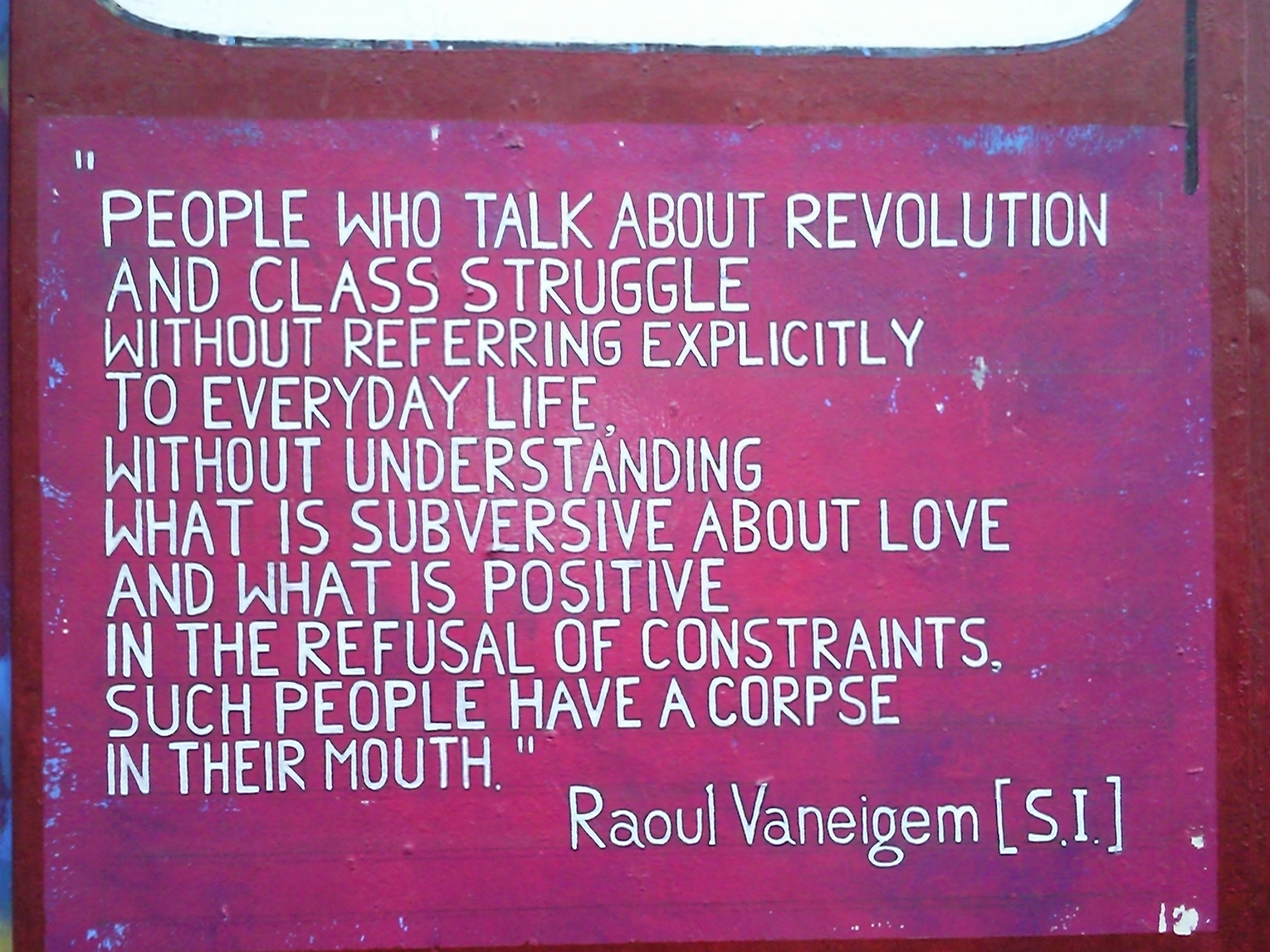
We have become desensitized to the everyday. We have become part of the spectacle, ignoring emotional engagement with the world because we are so alienated by it. We formulate emotional shells that lock out beauty as well as pain and stop us from taking action. We are left in a state of perpetual isolation, mouths open, ready to pour in pills to fix what we lost. We are left inert, flaccid, empty. As Raoul Vaneigem once said, “people who talk about revolution and class struggle without referring explicitly to everyday life, without understanding what is subversive about love and what is positive in the refusal of constraints, such people have a corpse in their mouth.” Raoul’s thesis is outlined succinctly in the following diagram.

I suggest a different sort of medication to cure that corpse-filled mouth. Explore everything, shatter the shell and live free.

Dreamers

get vertical

Playfully

Move beyond your conceptions of exploration. Explore your mind, explore the dance floor, explore your broken family that your are ignoring while you read this drivel. Move into abandoned buildings, take locks off of doors, turn CCTV camera so they only see each other, light off fireworks randomly. Scream at people in the streets, talk to strangers, photograph police. Stop paying the state until they give something back other than the promise of a good pension if you join the military and avoid dying through war X. Take what’s in front of you and pour your heart into it. And if you have to quit your job to make that happen, then go. But do it in style – run out screaming into the sky to invoke your freedom. Even better, abseil out of your window and rappel to freedom.

Play is power. Freedom is power.

Photo by Marc Explo

We don't need 4th of July or 5th of November as an excuse to explode things in celebration (Marc Explo).

Our work ethic

__________

Share
Tags : , , , , , , , , , , , , , , , , , , , , , | 4 comments

Psychogeography

Posted by Bradley L. Garrett on Monday Oct 19, 2009 Under Anthropology, Cultural Geography, Film, Psychogeography, Urban Exploration

I was recently contacted by Emma James, a researcher at Newcastle University studying the recent re-emergence of psychogeography. The following is a short interview I did with her.

SI graffiti in Amsterdam

_________________________________________________________________________________

Emma James: How / where did you first hear about the concept ‘psychogeography’?

Bradley L. Garrett – The first time I heard the term psychogeography was on the cover of a book by Merlin Coverley in the London Review Bookshop, I think I read half of it standing in the store! It was a good introduction and branched me into the work of academics working with the concept like David Pinder and Alastair Bonnett, then deeper into the Lettrist Movement, Raoul Vaneigem, Guy Debord and ‘work’ of the Situationist International (SI).

E.J. – In various articles I have read, people have observed that there has been a recent re-emergence of psychogeography in the last decade.  From your research have you found this to be true?

B.L.G. – I absolutely see a renewed interest in psychogeography. There are numerous clubs on the internet devoted to the practice and the mass-market work of Ian Sinclair and Patrick Keiller in particular really make me feel like psychogeography has ‘gone mainstream’. A quick youtube search of the term reveals that many people are using psychogeographic techniques to navigate city space in new and interesting ways all the time, such as walking the city using algorithms, applying random models to a (supposedly) fixed template, replacing one arbitrary motivation (I am walking to work) with another one (I am walking 4 streets North, 2 streets East and 1 street North until I can’t walk anymore).

E.J. – ‘Who’ do you understand to be modern practicing psychogeographers (e.g. artists, geographers, everyday civilians’ etc)?

B.L.G. – I see geographers are the preeminent drivers behind the modern psychogeographic movement, primarily because their inspiration has come from reading the work of the situationists who pioneered the concept, the problem is that a lot of them write about it without ever practising it, which I see as a failing. But there popular writers such as Ian Sinclair and Will Self who are quite aware of the lineage and practice the techniques also produce work is much more widely read, so they might be considered the primary ‘practitioners’. But, of course, we also find a lot of artists, counter-cartographers and people on the street using these techniques, even if they are not (wholly) aware of the theory behind the practice.

The other thing I find interesting is that this ‘new’ psychogeographic movement appears to be centred primarily in Britain (and especially London), which implies to me that it may be reactionary – perhaps due to the increase in government control and surveillance that has taken place over the last 10 years, making people feel a greater need to defy order, even in small ways such as walking across a piece of grass signposted not to or speaking through a bullhorn for a day. The time and space in which this resurgence is taking place sure feels a lot to me (from my readings) like the governmental regulations and reactions that led to the founding of the SI, and ultimately to the French Wildcat revolts of 1968.

So I would say that although psychogeographers tend to invoke small actions, it would behove both academics and governments to pay attention, as these small resistances may be an indication of a larger social consciousness of boredom, restlessness or downright anger. People using psychogeographic practices are just one of the groups who dare to push back a little sooner than others.

E.J. – I understand that you are studying ‘urban explorers’.  How would you view them in relation to psychogeography (e.g. as a branch of psychogeographers?  Or just another term to use for practicing psychogeographers?)

B.L.G. – In my discussions with urban explorers, most would not want to be labelled as psychogeographers, though there are some clear similarities in their practices; both are instances of what I might call mobilities of transgression or, maybe more specifically, place hacking. Both psychogeographers and urban explorers seek to redefine and/or experience space and place on their own terms, regardless of pre-existing rules, social templates or cultural norms.

E.J. – As part of my dissertation question, I am interested in people’s motivations behind practicing psychogeography.  According to various writers there are a few different ideas, e.g. political motivations/an interest to connect with the past/as a sort of rebellion against modern consumerism e.t.c.  From your research and interaction with urban explorers, what have you found their motivations behind practicing it to be?

B.L.G. – I think that most people would find that they have a range of motivations behind anything they do that requires some effort, there is rarely just one driving force behind action, especially when that action is activistic, dangerous or trangressive. There is an investment/reward ratio at work where you think to yourself “okay, yes, I could climb that crane and get some photographs, but is the experience, or the photograph I bring home, worth the possibility of arrest?”

Most urban explorers would I think contend that they are interested in the historic background these places, though one person did tell me that they “could give a shit about the history, I just like to explore.” I have heard the suggestion that urban exploration is about bearing witness to the failure of capitalism, especially in seeing sites such as industrial ruins folding back into the landscape after their abandonment. I don’t think this is true at all. To be honest, most urban explorers are in these places to get photographs that most people do not have; to see something that no one else has seen. So it is both the experience and the production/acquisition (which is of course part of the capitalist system they are supposedly subverting) that becomes the motivation.

I would say that people who define themselves as psychogeographers are much more likely to have political motivations than people who define themselves as urban explorers, though the practices are intertwined.

E.J. – As a geographer, I have noticed that there is very little writing on psychogeography within the discipline, though I have come across a few lecturers who have tried to introduce it within the course.  Would you say that there is a valid place for psychogeography within the discipline of geography, and should it perhaps be promoted/expanded?

B.L.G. – I think that geography has a lot to learn from psychogeography, both in terms of its historical roots and trajectory and in terms of modern practice. It certainly seems like there is some resistance to the concept, great publications like Alistair Bonnett’s journal Transgressions came and went, snuffed out, I think by academia’s inability to challenge theory with practice, or maybe more fairly, academia’s inability to ground theory in practice. A similar stigma exists against participatory geographies, I think, for the same reason – essentially many academics are afraid of becoming activists, afraid of getting their hands dirty, afraid of testing an armchair theories, afraid of failure. I believe, as I think many psychogeographers would, that we should celebrate failure. We would like to think that academia is a haven for free thinking, but the Ivory Tower also has its social and cultural models.

E.J. – What is your opinion on the argument that psychogeography could be applied as a new way of re-writing and representing the city (e.g. the idea of psychogeography maps alongside ‘mainstream’ mapping)?

B.L.G. – I think that this is a wonderful idea, the thing is that psychogeography, and psychogeographers, tend to not want to be boxed in. This poses difficulties when, for instance, writing grant proposals for projects. If you were to suggest to a funding body that you were going to spend a year following the ‘densest’ flows of people off of the London Tube to try and psychogeographically map nodes of interest at different times of day in the city (as I have done for fun!) you would find this funding body likely feeling that the research has no ‘research question’ or ‘direction’. The fact of the matter is that it does have a direction, it’s just that you have taken that power of direction out of the hands of the ‘elite’ academic and put it into the hands of the anonymous city dweller. I think that there is something profound in that. That is where, I would argue, the real solid tendrils of politic challenge come from in psychogeography, not from the esoteric writing style or wandering corporeal experiences, but from having the openness to resist being the one who defines what those experiences should be.

Just as psychogeographers work to subvert political, social and cultural templates, they also, I think, would be reluctant to create those templates, making playing the dual role of being both an academic and a practising psychogeographer a rare one.  Would we benefit from melding those illusory dichotomous positions? Absolutely.

Share
Tags : , , , , , , , , , , , , , , | 1 comment