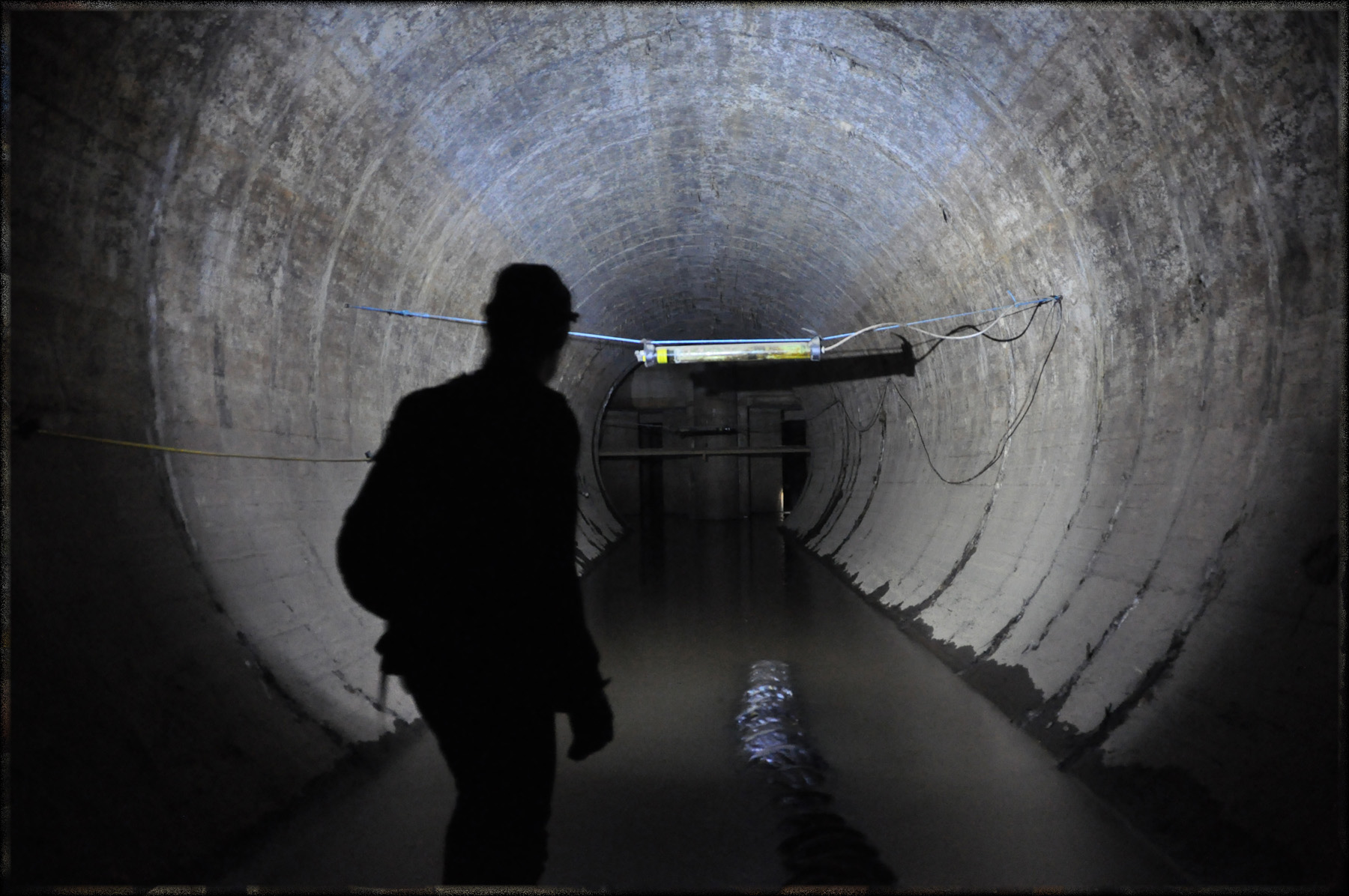
Solo Rooftopping in Clapham

Posted by Bradley L. Garrett on Saturday Jan 16, 2010 Under Archaeology, Cultural Geography, Psychogeography, Uncategorized, Urban Exploration

This morning, diligent as ever in my new year resolution fervour, I was at the gym at 8am. I needed it, needed time to think. I have recently been going through this crisis trying to “return from the field” and have been experiencing what can only be called withdrawals. People talk about this, but in my case, given the high-adrenaline nature of my work, I think it is actually physical. Maybe it is for everyone. My point is, I looked out the window while I was doing sit-ups and listening to a lecture on Heideggerian phenomenology and noticed that this really locked down construction site had entered the demolition process. The builders had busted out windows to throw stuff out of the top floors, right next to the scaffolding. The barbed wire was taking a beating form the work. Good news for me.

Hours later, I was having a conversation with my friend and colleague Erika Sigvardsdotter about the fact that we can never become our research, to do so would be to deny that we had bodies, to suppress our physical existence for an intellectual one. Neither extreme is healthy we decided, balance must be maintained between experience and analysis. I figured this weekend was my last chance to crawl around in this place and Erika encouraged me to go. So I did. Alone.

The other week, I went into Battersea solo to meet up with friends and found it to be… well… rather liberating. Knowing that you only have to depend on yourself, you can be as quiet as you are able. You can take your time. You can pay more attention to your experience. You can run like hell if you have to.

Since my research is about urban exploration culture, I don’t usually solo places. I also don’t usually do infiltrations. But as I mentioned in my last post, change is in the air this winter. After short walk, I was over the fence, staring at the scaff on the side of the building.
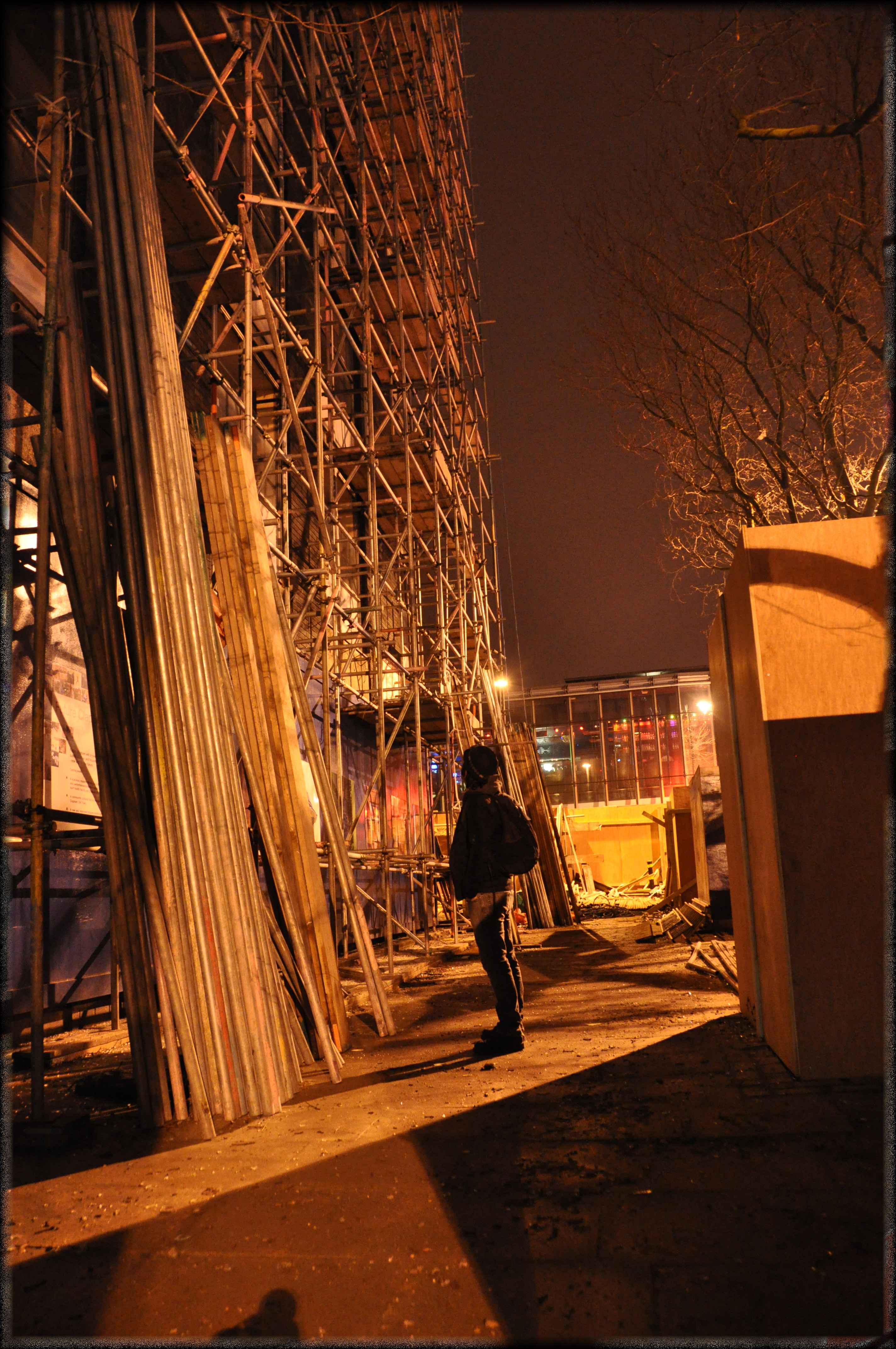
Stuff to climb. Dope.

I believe it is, at the moment, the tallest building in Clapham (maybe 10 stories?). Whatever the case, I was determined to get to the roof. Determined enough to ignore some things on the way up.

Sure thing guys
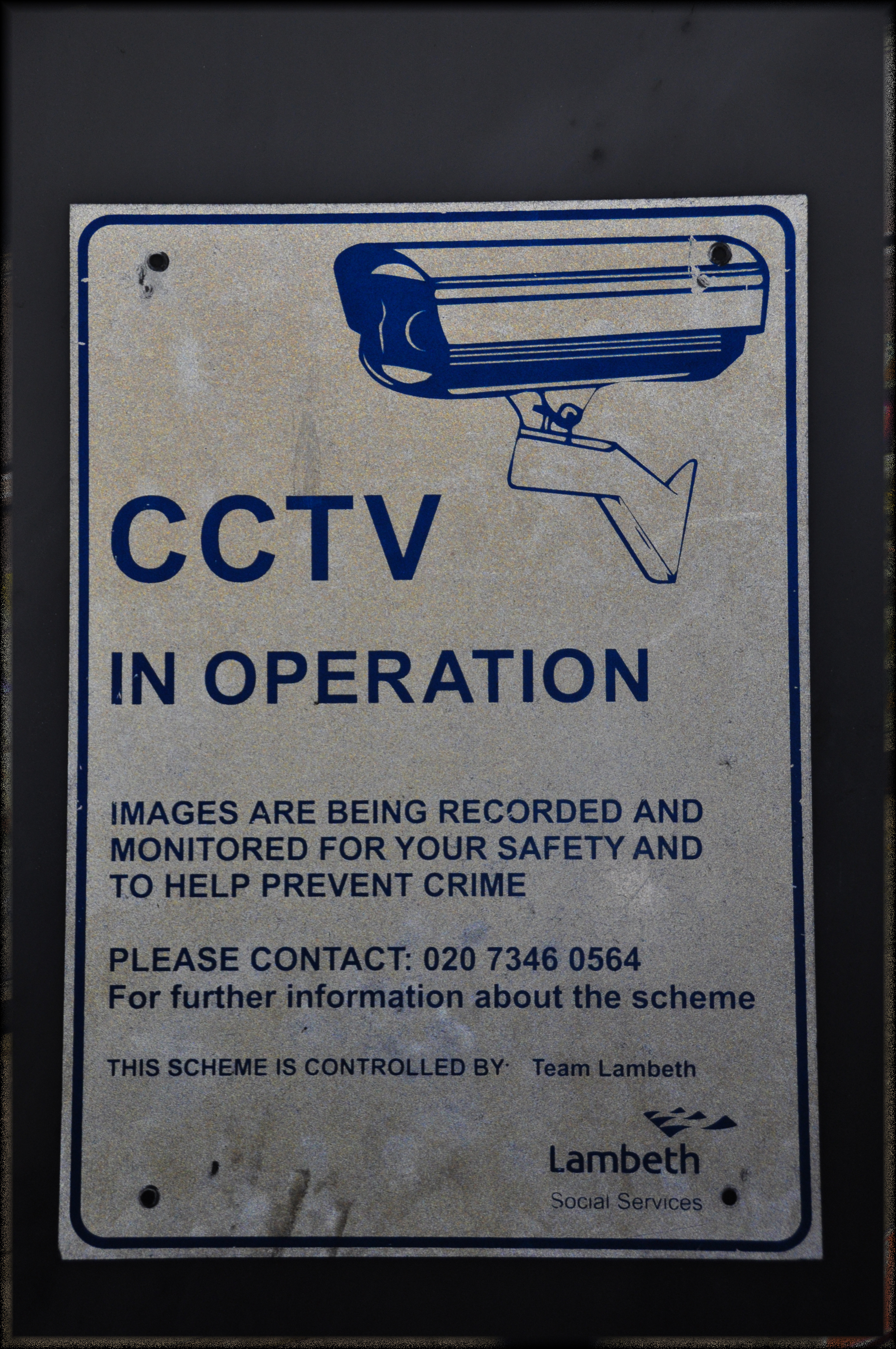
Yeah okay I got the message

On the way to the top, I ran into a brochure for the development. It was strange to think that someone may have placed it there just this afternoon; maybe giving a tour to the new owners.
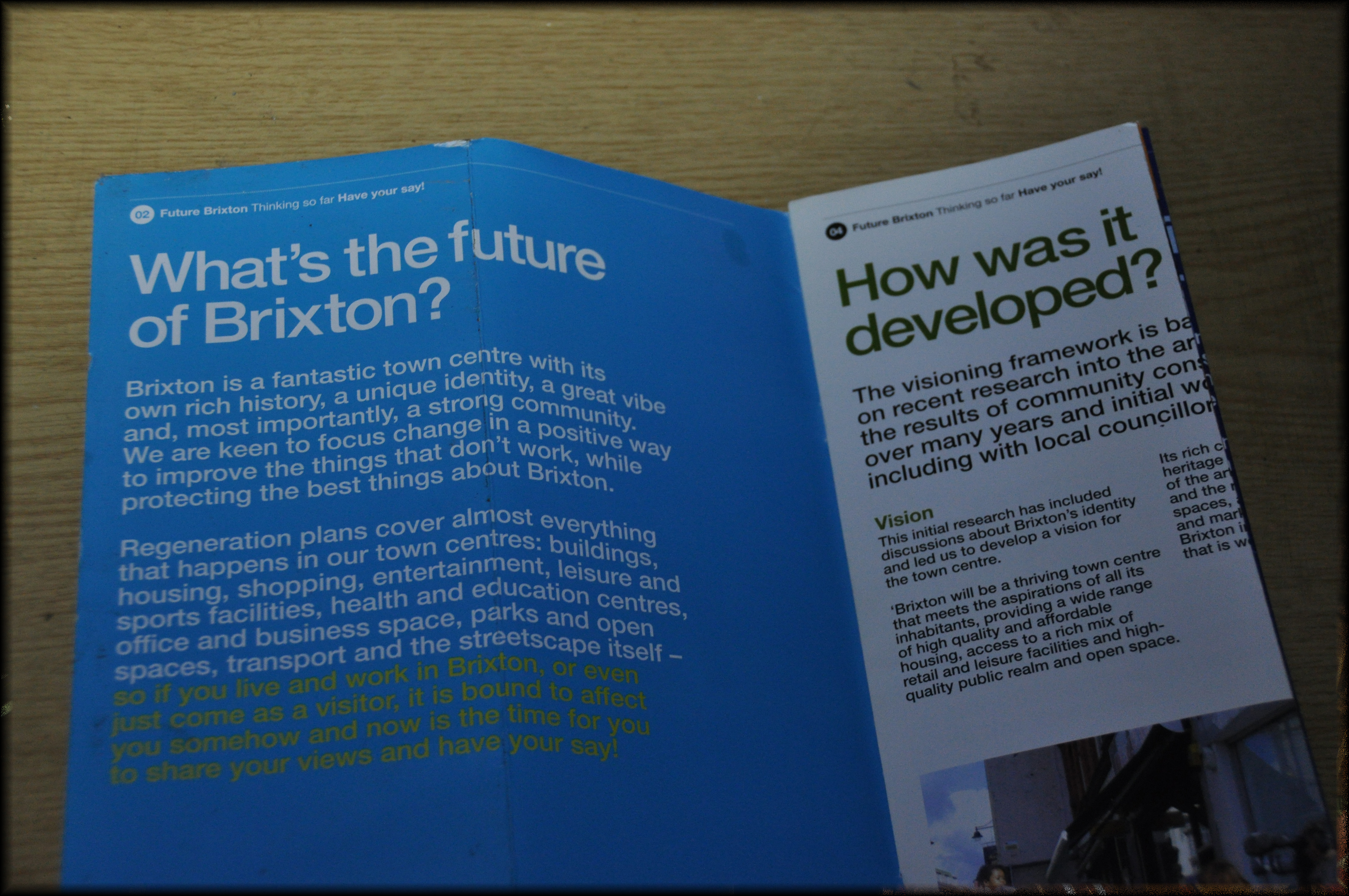
Pamphlet for gentrification

If fact, the whole time I was there, I held an amazing sense of euphoria. Hours ago, people were at work here, throwing “trash” out of the windows. Now I was here while they were at home drinking beer in front of the telly. I was wearing their high-vis vest, trying on their hardhats, playing in their machines and kicking their “trash” around. It made me think of Danny Pack‘s comment on my last post;

sharing a live site with security, workers, staff and cctv cameras provides the adrenaline hit that abandoned buildings never can – its the polar opposite of the trust you gain knowing you have a certain space to yourself, if just for a few hours.

As the climb continued, the horrible Friday night cacophony from Clapham High Street turned into a whisper.
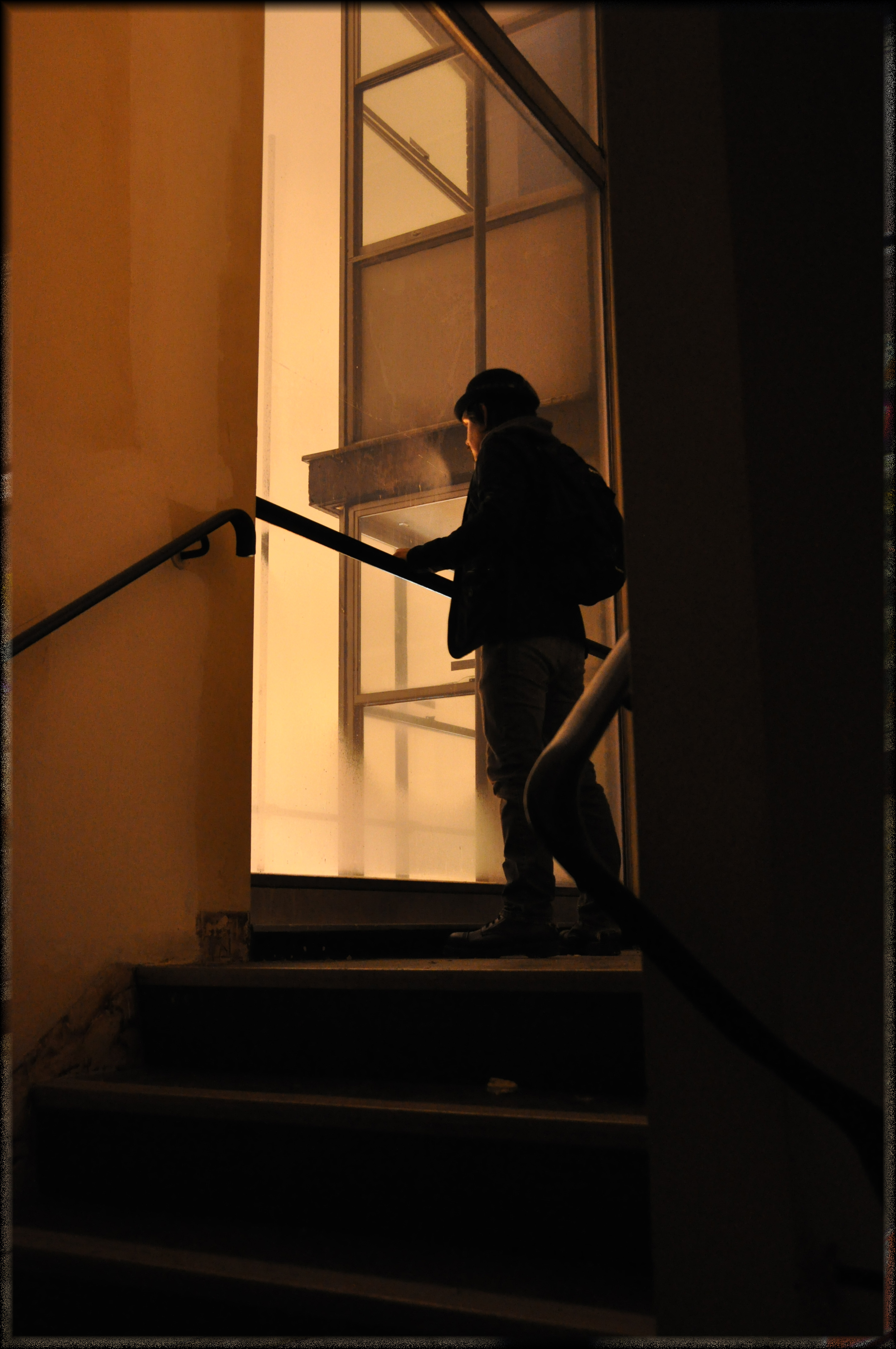
Going up

Soon I found the ladder to the roof and looked down on the day’s work that had taken place. It always amazes me how slowly a building goes up and how quickly they can come down. This building was sitting there, stagnant, a week ago; now half of it is missing.
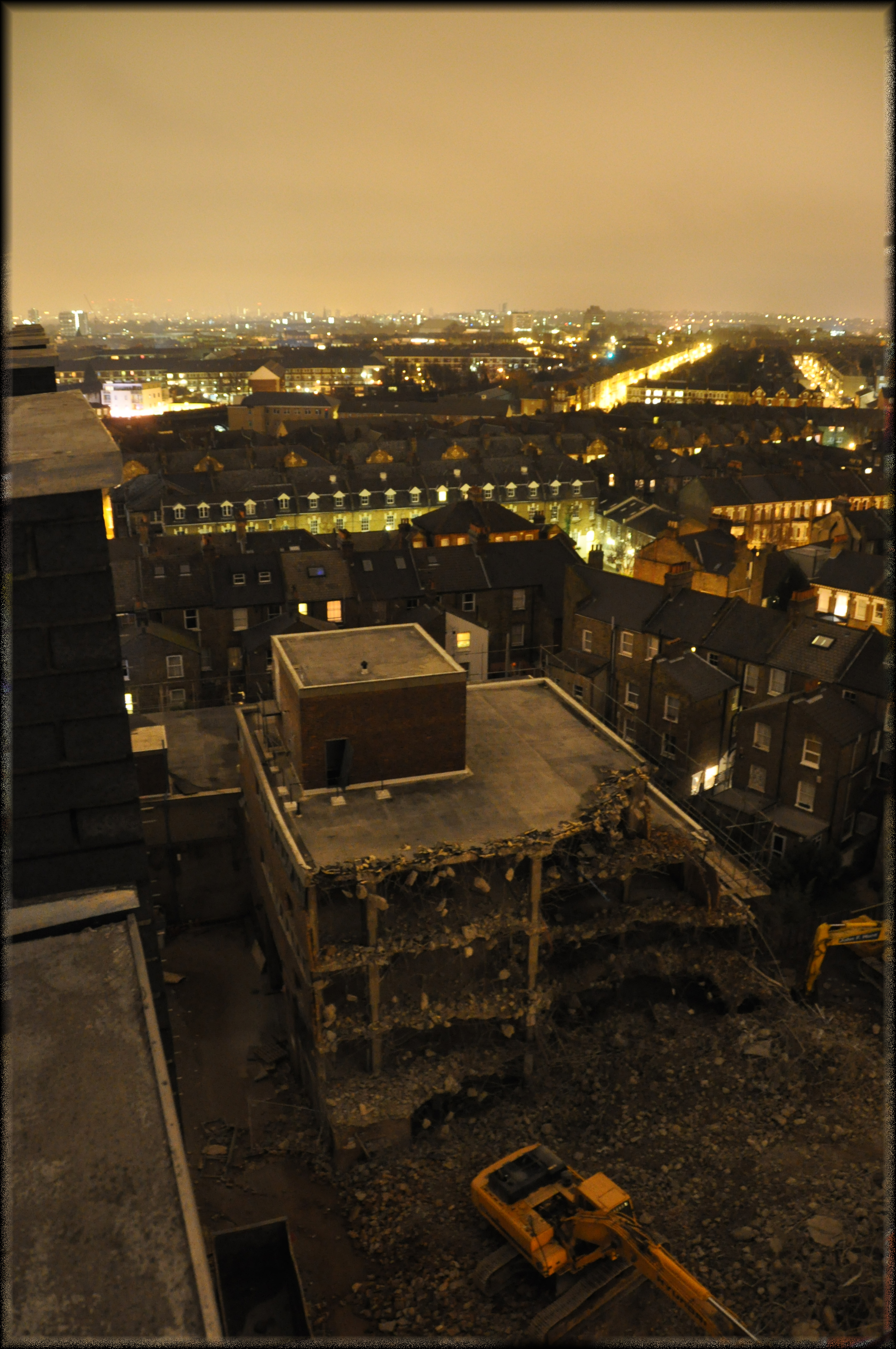
Wave goodbye!

I become suddenly righteous behind the camera, the paladin of the forgotten, running around the rooftop screaming and capturing every angle.
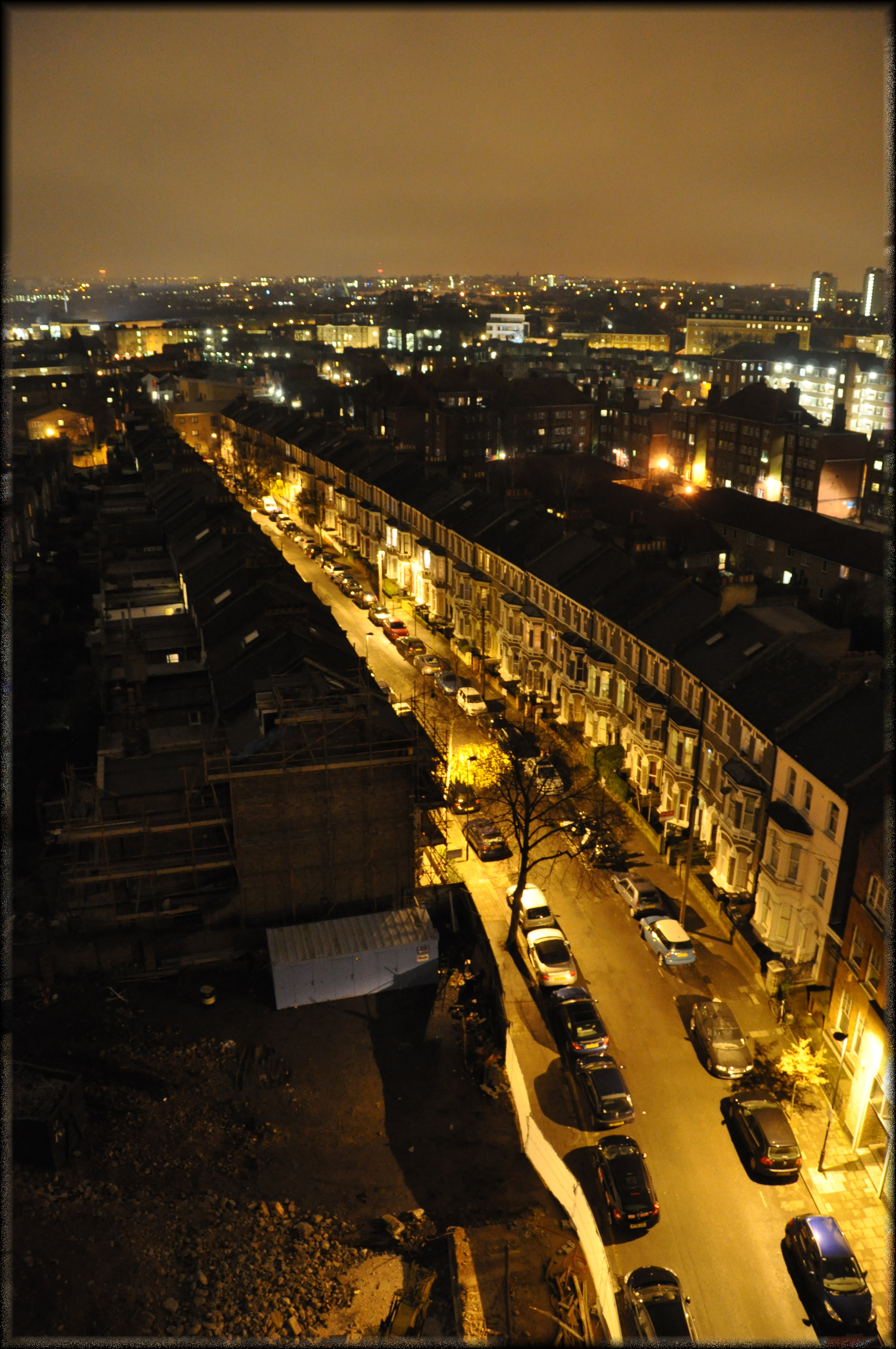
Silent side streets
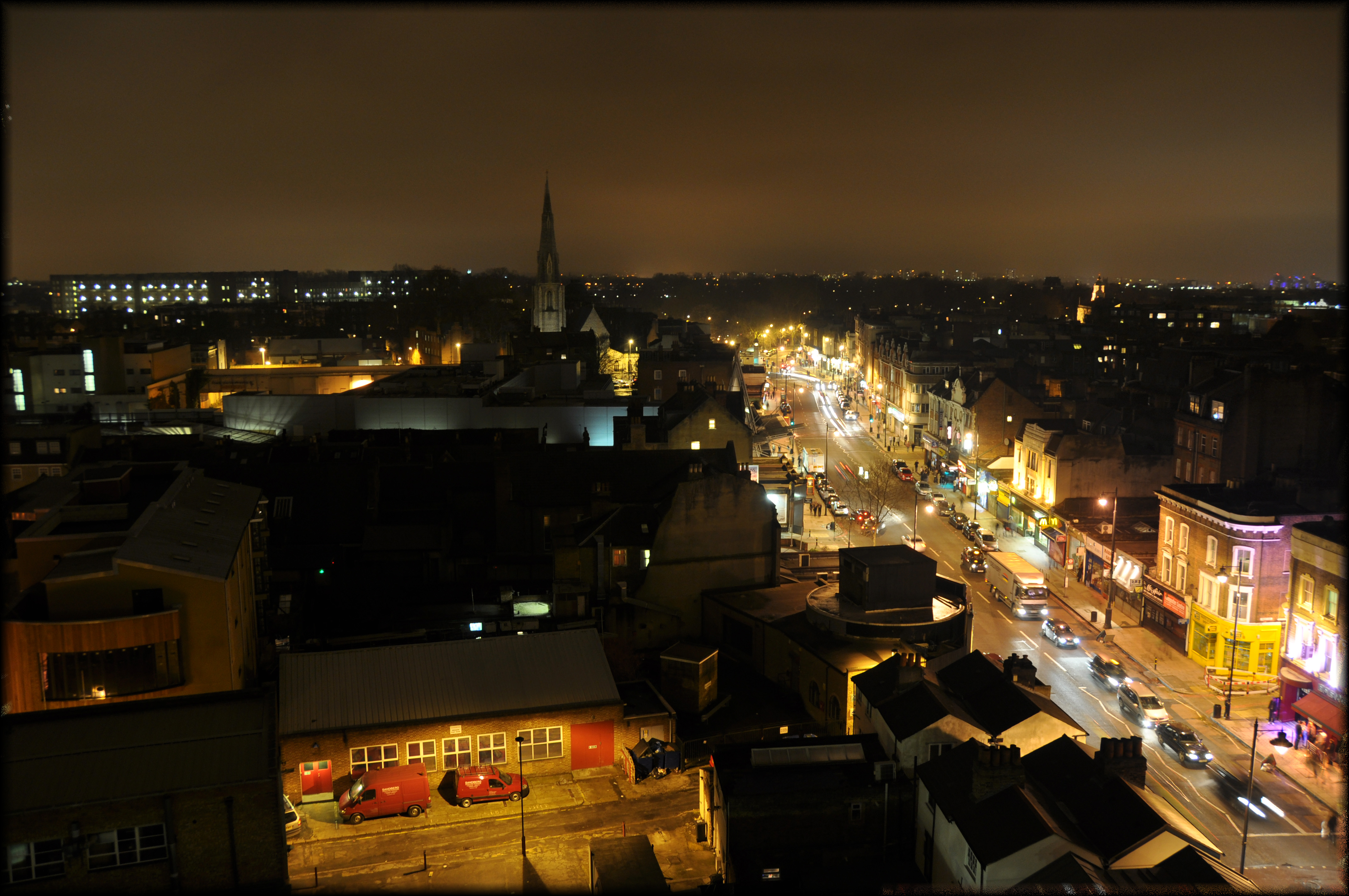
Not-so-silent high street
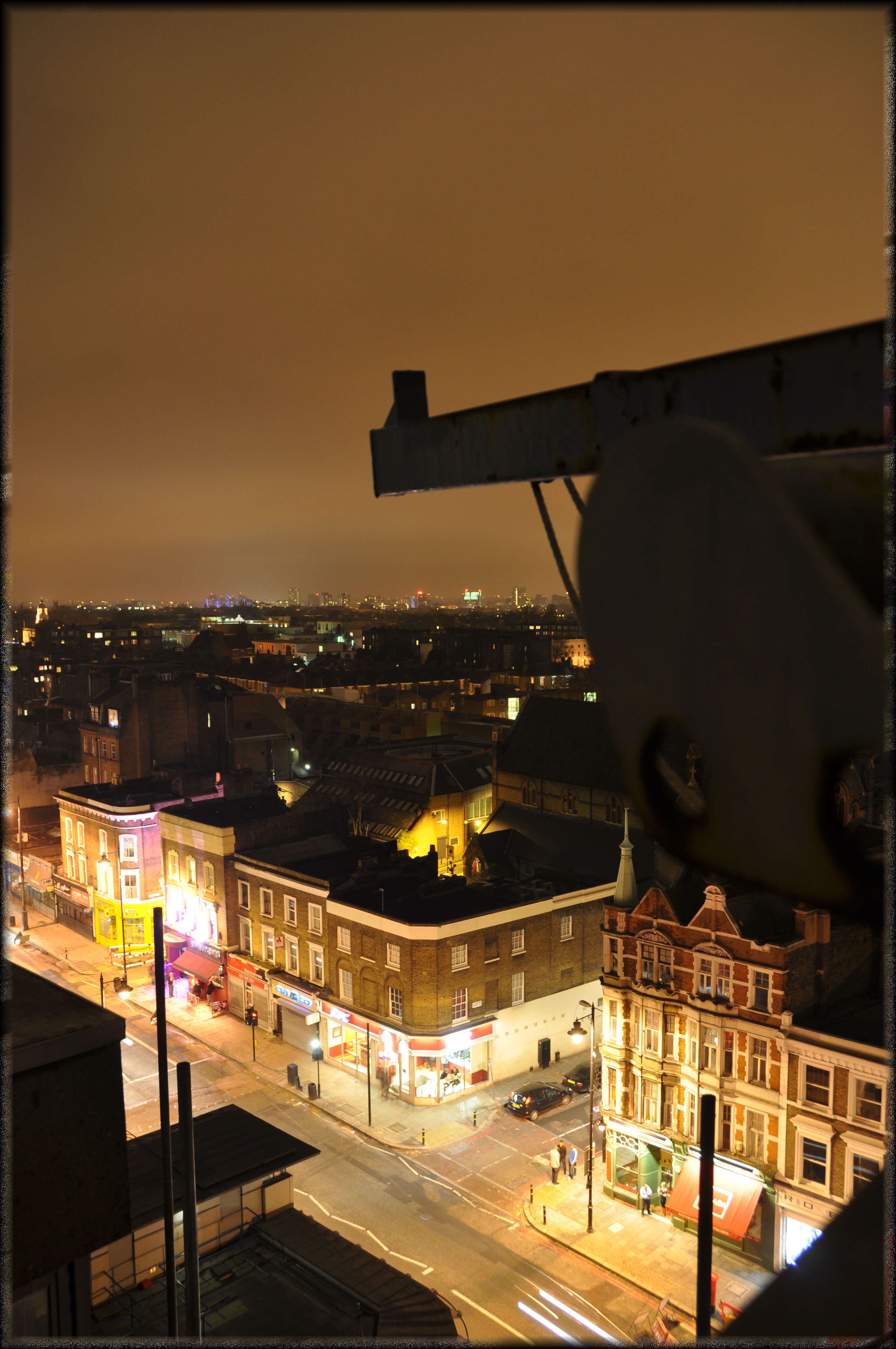
Oh look, something hanging over the high street

All pumped up on my perceived powers over time and space, I grab the metal and swing out over the high street…
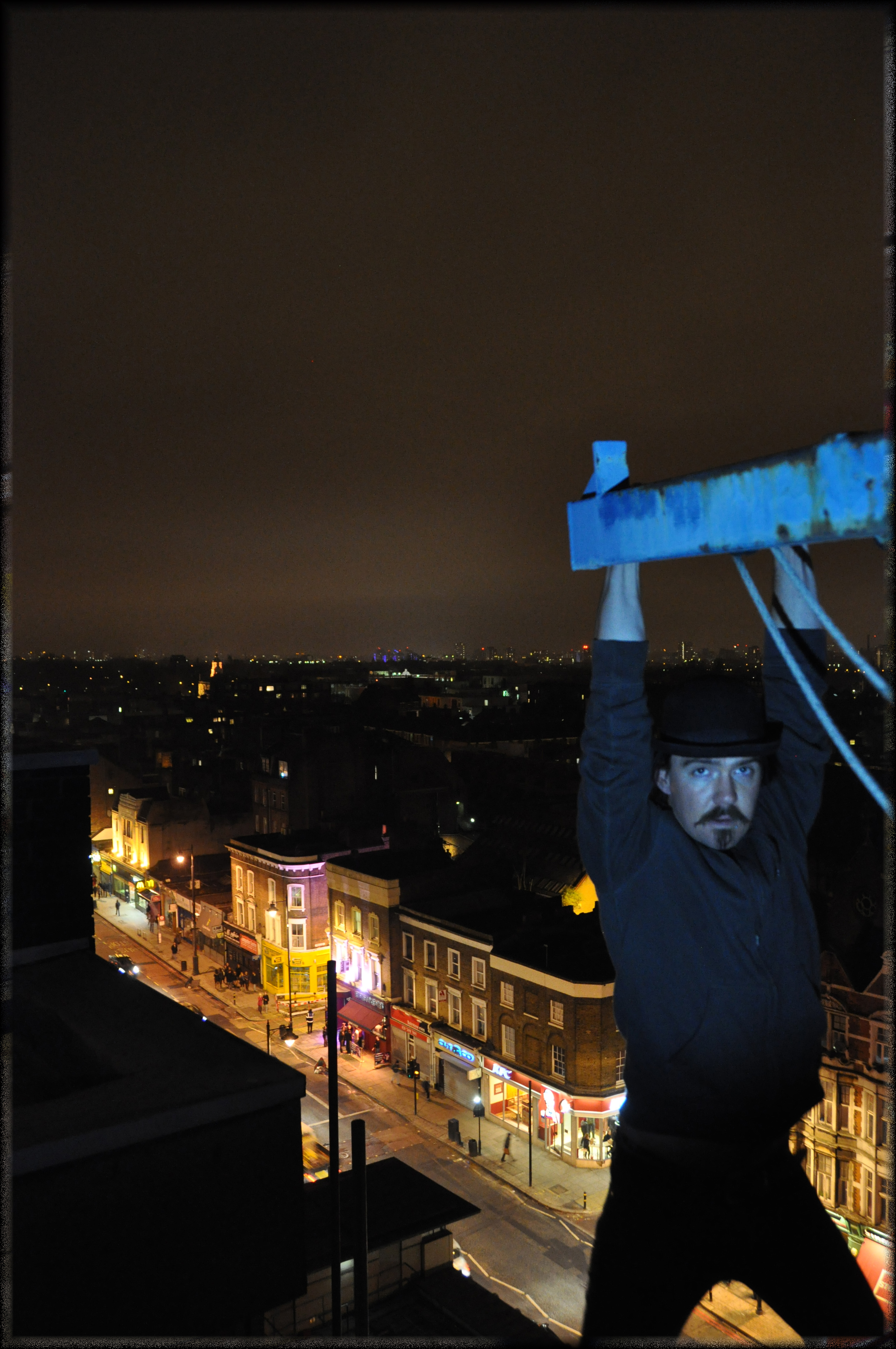
You knew that was going to happen didn't you?

I spent a while sitting on the rooftop, doing nothing. Thinking. Being in love with the experience. This is the part of UrbEx you don’t usually share with people. I watched the lives moving below me, trying to not let my vision filter into some nerdy academic thought about rhythmanalysis or something. I found it difficult, until I caught this moment.
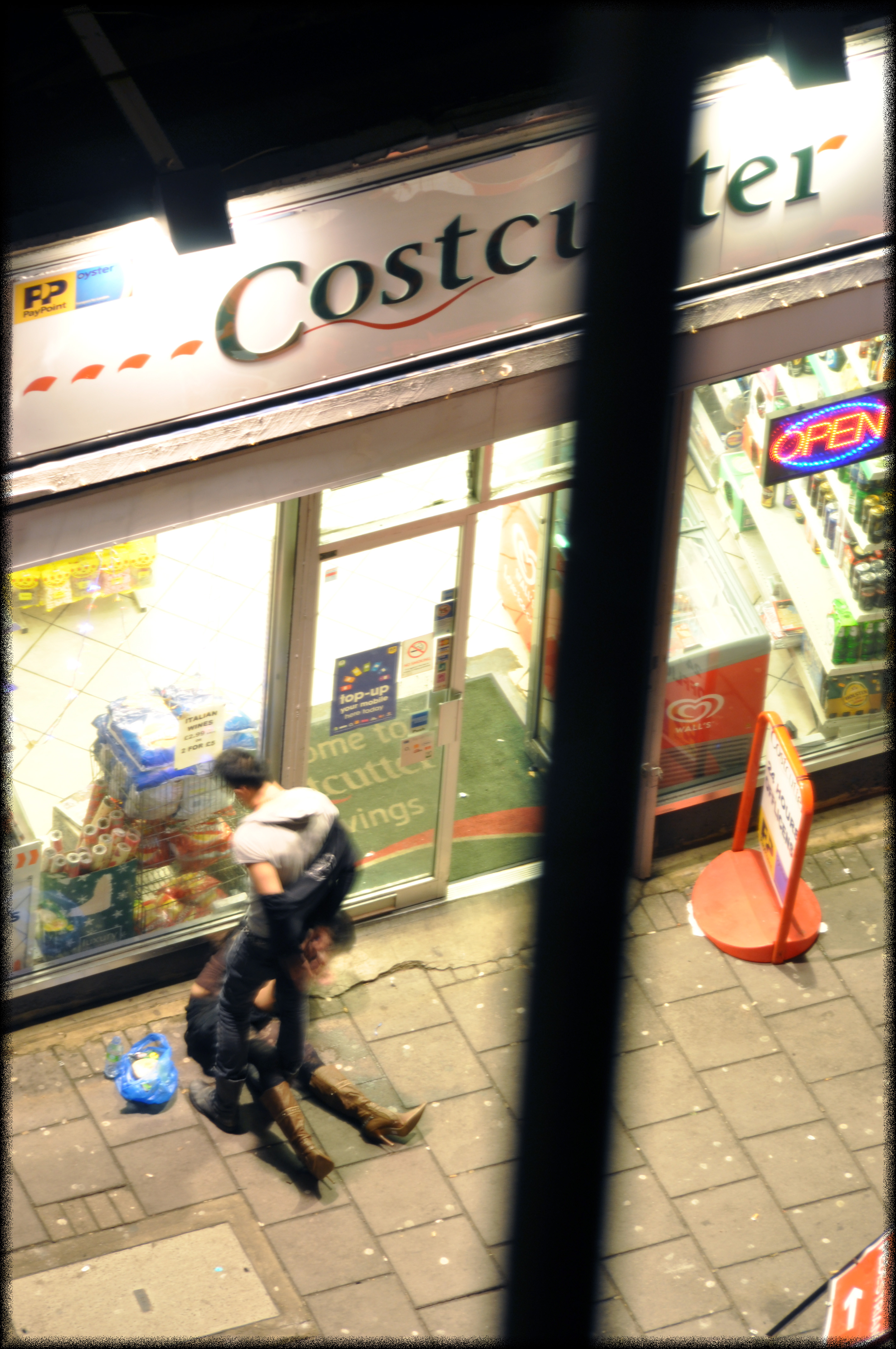
I don't want to guess, seriously.

Now, I was too high up to hear what was going on. I wondered who these people were. Did they meet tonight? Have they been together for ages? Is he offering her his jacket or getting ready to assault her? No way to tell from here. I feel bad for watching them, then I feel I have a right to. If CCTV can watch all these people, so can I. These conflicting emotions are confusing and after fighting with myself for a minute I walk away, laughing out loud at my propensities fro overanalysis, to go take pictures toward London, Dark Princess Battersea glowing off in the distance. My home. My city.
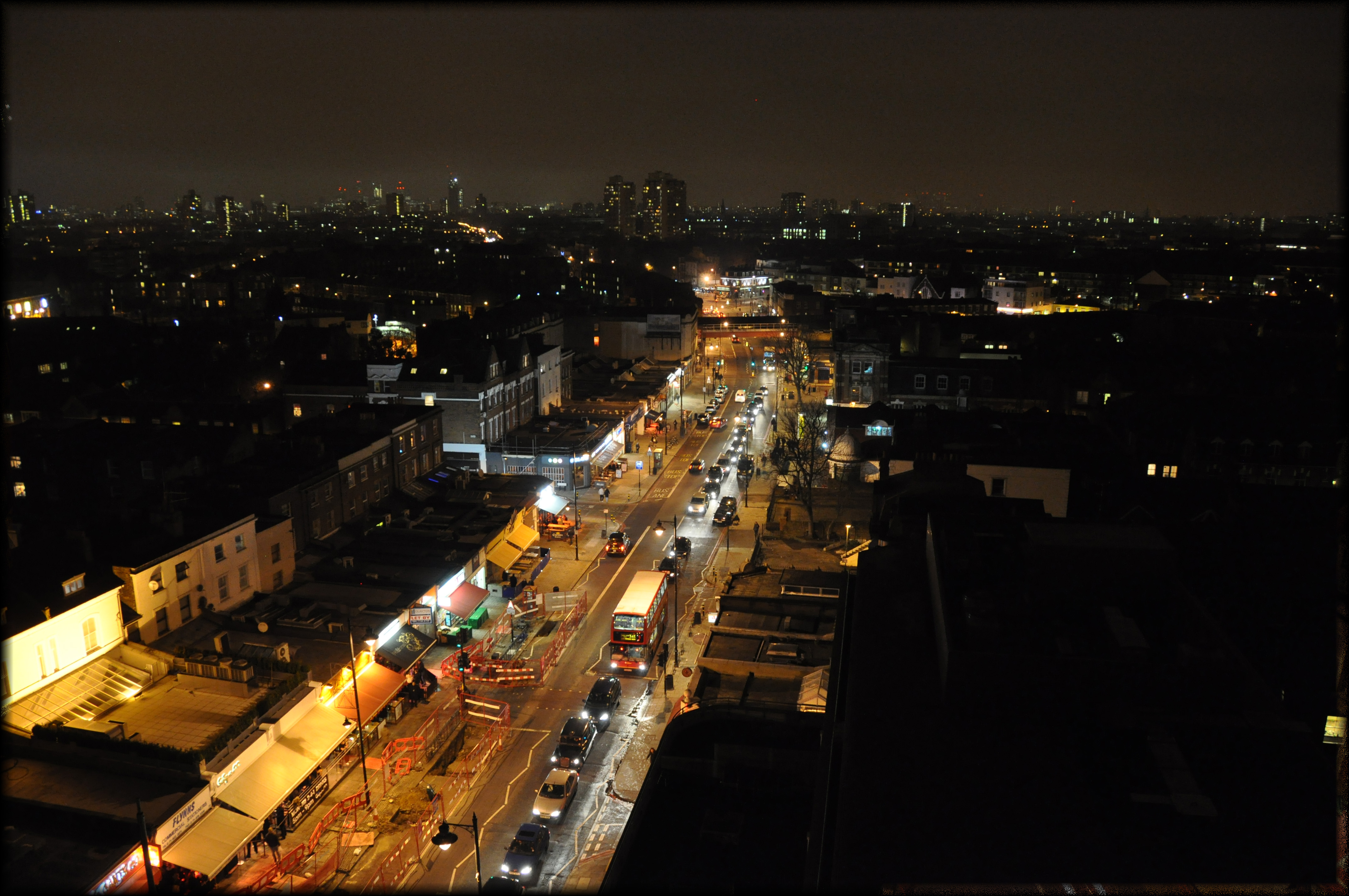
Chartered street toward the chartered Thames

The walk down was quiet, I took my time and even sat to cry for a while when I thought of the memories that would collapse with this building. Urban exploration is more real than my real life.

So, here is the nightcap. I walked home from here at 2am, noticing for the first time how stupid I look when I am out drunk in my neighbourhood. Everyone kept chatting with me and I wondered why. I Realized when I got home that my fucking headlight was still perched on my bowler hat. FAIL!

Anyway, a great Friday night. I look forward to more of them. Off to sleep I go at 5am, goodnight Clapham, goodnight London!

Share
Tags : , , , , , , , , | 2 comments

Secret Histories of Infiltration

Posted by Bradley L. Garrett on Thursday Jan 14, 2010 Under Anthropology, Archaeology, Cultural Geography, Uncategorized, Urban Exploration

Sometimes it's an accident

When I began exploring here in London over a year ago, I was never quite sure how secretive I needed to be about what I was getting up to. But in the interest of academic transparency, I decided to be less cautious that I might have otherwise been. I felt an obligation, being here on a generous scholarship, to put my work “out there” to be crossed-checked, criticized and appreciated. It did not go unnoticed; a couple of people challenged my decisions to openly discuss certain exploits.

To tell you the truth, now that I know these places well, I think there was never much harm done in being open about my nocturnal wanderings. But some things change. Not because writing about the places I have been is going to get them locked down, not even because they are super-secret or ultra-sensitive. The real reason is, I think, a philosophical one.

Sometimes it's not

At some point in the last few months, I started doing infiltrations. It wasn’t really intentional; I just lost sight of the line between UrbEx and infiltration.

To be honest, I am not that interested in infiltration. Being an ex-archaeologist, I get really excited about the histories of sites and love seeing them falling apart and decay. Many infiltrations take place on construction sites and I spent a good chunk of my life working in these sorts of places. I therefore don’t find a lot of magic in them – too close to my own history I suppose, though I often make the argument that they are too close to the mundane existences of those who work there, hence my indifference.

So why are we interested in these places? They might be considered the polar opposite of the derelict building, going up instead of down, though they are both in a transitional state. They are also both, in a sense, “hidden”, off the grid and not to be seen. But I think our fascination with these places lies, as with most things, in the experiential fascination and secret personal histories to be found there.

So okay, yeah I am coming out of the closet and admitting that I have done some infiltrations that I have not shared, neither here nor on facebook. I can’t share them, either because I was recorded there on CCTV at some point during the explore, or somebody I know might have a connection to these places, or… I don’t know… that’s somebody’s job site. It would be like publishing pictures of your desk after hours when you weren’t there and I sat in your chair and went through your drawers. It’s just a little too personal. Maybe this is why we like it, because in these places we touch living histories, not dead or forgotten ones.

I wonder how many other explorers have secret histories of infiltration, how many sketchy night wanders were not photographed, caught in the memory of someone a little too nervous to ever talk about it? How much of urban exploration consists of secret histories of infiltration?

Either way, I'm still in love

Share
Tags : , , , , , , , , | 3 comments

Please support Scott Demuth

Posted by Bradley L. Garrett on Wednesday Jan 13, 2010 Under Academia, Animal rights, Anthropology, Cultural Geography, Uncategorized

I do not usually post things that do not directly relate to my research, but after following this story on my twitter feed and on facebook, I have decided that it warrants a full blog posting. This case is sickening and threatens the very heart of academic scholarship, please support Scott in any way you can.

On November 17, 2009, Scott DeMuth was jailed for contempt of court, since
he refused to answer questions posed to him by a federal grand jury in
Davenport, Iowa. They were interested in questioning him about his knowledge
of an unsolved Animal Liberation Front action in 2004 at the University of
Iowa. At the time, Scott was only 17 years old and was a resident of the
Twin Cities (Minnesota). Scott is a University of Minnesota graduate student
and Dakota language student whose research focuses on liberation struggles
and social movements in the U.S. and globally.  In his work, he has
researched and/or interviewed numerous activists from Native American
struggles for sovereignty and land, and environmental and animal liberation
movements in the U.S. The grand jury was interested in asking him to divulge
the names of activists, which would violate the confidentiality agreements
that he made with his research participants.

Scott took a principled stand against the grand jury’s fishing expedition,
and instead decided to go to jail rather than be party to what many
attorneys and the American Bar Association (ABA) view as a dangerous
practice that deprives people of basic constitutional freedoms. But it gets
worse. Two days later (November 19, 2009) Scott was charged with conspiracy
under the Animal Enterprise Terrorism Act (AETA) of 2006. This indictment
came just one day before the 5-year statute of limitations was to
expire.  Attorneys have speculated the indictment was rushed through to
freeze the statute of limitations, with the intent of buying them time to issue
a future indictment.   These legal maneuvers are indicative of an investigation that
has gone nowhere, and prosecutors who are desperate to locate members of the
Animal Liberation Front, no matter what legal acrobatics are required.

REGARDING GRAND JURIES:
The federal grand jury is a legal proceeding used to investigate possible
organized criminal activity rather than a specific crime. It is held in
secrecy, and does not grant rights to representation or the right to obtain
transcripts of the proceedings to those subpoenaed: those served with a
subpoena face only a federal prosecutor and 16-23 jurors who are not
screened for bias. Federal grand juries are used not to prove guilt, but to
coercively extract evidence without due process from third parties under
threat of imprisonment. They have a history of being used to intimidate and
suppress movements for social change.

REGARDING SCHOLARLY RIGHTS:
The American Sociological Association’s Code of Ethics states:

Section 11.01:
“Sociologists have an obligation to protect confidential information and not
allow information gained in confidence from being used in ways that would
unfairly compromise research participants, students, employees, clients, or
others.”

Section 11.06:
“Sociologists do not disclose confidential, personally identifiable
information concerning their research participants, other recipients of
their service which is obtained during the course of their work.”

This scholar-research participant confidentiality is the bedrock of academic
research and without it the public would lose trust in scholars seeking
important information (concerning, for example, social histories or
institutional discrimination practices), leading to the incalculable loss of
invaluable data for community preservation, public policy, and university
teaching purposes. Scott is being charged with conspiracy for invoking his
constitutional rights and heeding to professional codes of conduct.

REGARDING THE AETA:
More than 160 non-governmental organizations opposed the passage of the
AETA. The opposition includes such influential groups as the National
Lawyers Guild, American Civil Liberties Union (belatedly), New York City Bar
Association and other bar associations, Natural Resources Defense Council,
Humane Society of the U.S., and American Society for Prevention of Cruelty
to Animals (ASPCA).

The AETA:
– is excessively broad and vague and imposes disproportionately harsh
penalties

– brands animal advocates as “terrorists” and denies them equal protection
under the law

– brands civil disobedience as “terrorism” and imposes severe penalties

– has a chilling effect on all forms of protest by endangering free speech
and assembly

– interferes with investigation of federal law violations by animal
enterprises

– detracts from prosecution of real terrorism against the American people

The AETA is designed to punish actions that instill a reasonable fear in
employees of an animal enterprise, or their families. In its application,
AETA also criminalizes many First Amendment activities, such as picketing,
boycotts and undercover investigations of animal abuse if they interfere
with an animal enterprise by causing a loss of profits. It unnecessarily
expands punishments for crimes that existing federal laws already cover.
This law has created a chilling effect on constitutionally protected
activities and many activists, scholars, attorneys, and elected officials
believe that was the intention.

Our goals are simple and direct: we want the judge, prosecutor, and U.S.
attorney to dismiss all charges against Scott, protect academic freedom and
integrity, and denounce the Animal Enterprise Terrorism Act.

The newly formed Scholars for Academic Justice is developing a website and
we plan to roll it by this weekend at the latest. More on that soon.

In the meantime, here’s what you can do:

*write a statement of support for Scott (concerning the issue of academic
justice in relation to research ethics, grand juries, etc.) (in PDF format
please, send to [email protected])

*sign a petition supporting Scott:
http://www.ipetitions.com/petition/freescottdemuth/

*write letters to the editors of the MN Daily, the Pioneer Press, the
Star-Tribune, the Chicago Tribune, the Quad-City Times, New York Times, and
San Francisco Chronicle.

*write letters to the prosecutor, the U.S. Attorney, the judge, and
Representative Keith Ellison (see info below).

*Record a digital audio statement of support. We can help you do this via
skype, over the phone, or in-person if you are in the Twin Cities area. Just
let us know!

Please contact David Pellow at [email protected] for more information or to

send statements of support.

Please send polite letters to the following individuals requesting that they
work to dismiss all charges against Scott, protect academic freedom and
integrity, and denounce the Animal Enterprise Terrorism Act:

U.S. District Judge John A. Jarvey
United States Courthouse
131 East 4th Street
Davenport, Iowa 52801

U.S. Attorney Nicholas Klinefeldt
United States Courthouse
131 East 4th Street
Davenport, Iowa 52801

Assistant U.S. Attorney Cliff Cronk
United States Courthouse
131 East 4th Street
Davenport, Iowa 52801

Representative Keith Ellison
2100 Plymouth Avenue North
Minneapolis, MN 55411

Share
Tags : , , , , | Comments Off on Please support Scott Demuth

Today I am 29 years old

Posted by Bradley L. Garrett on Monday Jan 4, 2010 Under Uncategorized
Brad at 29

1/3 of the way done?

I have been on planet earth for 29 years today. Whether due to existential crisis or healthy reflection and introspection, I thought it would be fun this morning (6am, in my pajamas) to try and quantify my existence. Here is my shot at it:

Alive for 29 years
2 bachelors degrees
1 masters degree
3 ex-girlfriends
1 ex-wife
318 facebook friends
15 best friends
15 countries visited
250 cities visited
4 countries lived in for 3 months or more
15 previous and current addresses
68 urban explorations
42 skateboard tricks learned
30,819 photographs taken
56 mini DV tapes recorded
43 hours of HD video on hard drive
10 terabytes of digital storage filled
20 years vegetarian
15 years vegan
396 animals lives directly and indirectly saved
660 books read
590 films watched
586 websites bookmarked
3 companies owned
2 of them legal
7 websites built
16 jobs held
22 publications submitted
5 documentaries completed
1 dog, 3 cats, 1 chicken, 2 Mice, 2 rats raised
1 parrot babysat for 6 months
68 scuba dives completed
10 scuba diving qualifications received
22 U.S. National Parks visited
180 trails hiked
7 cars owned
11 computers owned
42 archaeological sites excavated
184 units/trenches dug
53,440 songs in my itunes library
$108,000 in scholarship and grant money received
$80,000 in education debt accrued
22,553 emails archived
8 public presentations given
1 PhD undertaken

Share
Tags : , , , | 1 comment

Call for Papers: Royal Geographic Society 2010 Conference

Posted by Bradley L. Garrett on Monday Dec 14, 2009 Under Uncategorized

CFP RGS-IBG 2010: “Urban Subversions: Conceptualising alternative urban pastimes in the modern World City”.

The deal:

Oli Mould from Loughborough University has invited me to co-convene a session at the next RGS-IBG conference and we are now accepted abstracts for papers to be presented at the session. Details can be found at Oli’s blog or below. Please do get in touch if you have something that you believe would fit well into the session!

Call for Papers:
Royal Geographical Society with the Institute of British Geographers Annual Conference, 1st – 3rd September 2010, RGS, London.

Session conveners:
Oli Mould, Department of Geography, Loughborough University.
Bradley Garrett, Department of Geography, Royal Holloway, University of London.

Session discussant:
Tim Cresswell, Department of Geography, Royal Holloway, University of London.

Sponsors:

Urban Geography Research Group
Geographies of Leisure and Tourism Research Group

Abstract:

The increase of the urbanised population (presently and in the projected future) and the rise of procedures for creating a ‘world city’ to attract the global flows of capital, means that the usage of urban space is coming under increasing tension. Not only in terms of a city’s primary functional capitalist usage, but increasingly so in terms of alternative, subversive or ‘underground’ uses. Alternative urban activities (or subcultures, practices, pastimes – what we have termed ‘urban subversions’) such as skateboarding, graffiti, parkour, exploration, guerrilla street theatre and many others, have all seen an increase in popularity (in terms of participants and coverage), but often exist uncomfortably with city authorities and in many cases are marginalised or prohibited altogether. In other cases, the march of commercialisation has seen these practices been subsumed into the capitalist regime, either by sponsorship, tight regulation or dilution of content.

In these modern complex times, these ‘alternative’ usages of the city by a variety of different groups and individuals are becoming more prevalent. This is in part due to the increase technological capabilities of citizens, with the Internet facilitating the dissemination of information, videos, ideologies and trends. This has had the effect of these practices becoming more ‘visible’ and hence is adding to the complexity of urban studies. The duality of capitalist versus subversive urban practices is no longer sustainable as the boundaries are being blurred by the practices (both physical and virtual) of urban citizens practicing these urban subversions.

Therefore, the session organisers invite papers that discuss the alternative uses of urban space by a multiplicity of practitioners. In particular, we will look for contributions from scholars who are engaged in any one of a plethora of ‘urban subversions’ and the theoretical implications for city life. This may include, but are not limited to:

  • Street Art and the City
  • Activism, urban movements and cityscapes
  • Technologies, Social networking and the mobilisation of urban sub-cultures and communities
  • Subversive Practices as Placemaking
  • Performing the Urban: Embodiment and Participation
  • Case studies and empirical cases of specific urban subversions such as parkour, skateboarding, urban exploration, urban pranks, trial riding, urban golf, graffiti and guerrilla street performance

Moreover, the session encourages presentations that blend theoretical and empirical case studies to further develop our understanding of how the urban terrain will be utilised in our increasingly urbanised future. There will also be a ‘fieldwork’ session in which participants will be encouraged to visit particular sites nearby to observe particular urban subversions (such as parkour, graffiti, skateboarding etc).

Please submit an abstract (of no more than 250 words) to [email protected] or [email protected] by Friday 12th February 2010.

Share
Tags : | Comments Off on Call for Papers: Royal Geographic Society 2010 Conference