“It’s about the risk sometimes.”
– Winch

A matter of scale and distortion

Part I: The Sounding

Let’s get those photoreceptor cells warmed up and neurons bouncing people, it’s time for Place Hacking Chicago, where secret spatial knowledge leaks out like early-morning pillow drool through cracks in the urban security infrastructure.

Chicago was a slimy glimmer as Marc and I sped in, sleep deprived, stinky and tweaked out on our successes in Detroit. We had been hearing rumours of an extensive tunnel system modelled on London’s Mail Rail where some fiendish little schizophrenic called Dr. Chaos had hidden cyanide stolen from the University of Chicago back in the early aughts. Apparently it was accessible through manhole covers, gated up with steel doors that had pins we could pop out with a hammer and screwdriver. Next stop Home Depot we figured, we’re going underground.

But Chicago presented those tunnels as false idols to be chased and worshipped by neophyte place hackers looking for lone star epics to boost international credibility and couch surfing bonus cred. Marc and I read the runes and realised our destiny lay in the heavens of the Windy City. We first hit the Hilton Chicago where we were advised the doors to the elevator controls were poppable with a credit card. Within minutes of arriving downtown, we were up the fire escape and on the roof.

Simple tech

Warm up

But the Hilton’s rooftop, sexy as it was, left us unsatiated. We looked higher and noticed a thunderstorm of epic proportions coming to meet us downtown. It was prime time to climb the highest the midwest had to offer and grab hold of Chicago’s gods – big cumulonimbus death eaters ready to thunder down bolts of righteous over Lake Michigan.

The 40-story Ritz Carlton Residences had the Eye of Suaron on them, a bulbous 360-degree inverted black dome swivelling around and gaping at the piddly four-foot fence into the site. By the time we were standing in front of it, the rain was coming in from five sides, threatening to breach our bags and assault the fragile electronics in our cameras. I looked to Marc. He nodded. We ran across the street and gave the camera the finger as we ninja’d the scaffolding and ducked inside. The first set of stairs was easy to find but hominid specific ultrasonic vibrations on the third floor revealed a fat man in a bright vest reading Maxim at a desk facing the wrong way to actually perform the job he was being paid for. We left him to it and hit the crane to bypass third floor stair ‘security’. As soon as we swung onto the crane we got hammered by the gods of Lake Michigan again. Their wrath was significant at this point. The thunderstorm had intensified into a full-fledged sensory cacophony complete with blue forked lighting strikes jabbing in dangerous proximity as our shadowy figures scaled the steel cage toward the stars. A few floors up, past the stair barriers, we snuck back to the concrete steps and climbed. Now I don’t know if you’ve ever climbed 40 floors but the thing is that if you’re in reasonably good shape at 20 you’re fucked. After that, it’s just sheer adrenaline, fear and unquenchable anticipation that keeps the legs moving. Add to that the fact the we were eating primarily trail mix and woke up that morning (14 hours ago? 20?) on top of a port building in Detroit and you start to get an idea of what we are up against here. We chilled for a second.

Our move

Then we heard them. Sirens. Everywhere. They converged on our location and the blood drained from Marc’s face. Without a blink, he cinched his pack straps and said ‘if I’m getting busted, I’m getting busted on top’ and resumed climbing. Cheeky. We hit the stairs with renewed vigour, every turn in the case cranking up the heat, the angst, the fervour. By the time we get the top, I’m locked in a perpetual dubstep stair wobble and my thighs feel like they’ve been skewered and stuck over a campfire until they involuntarily pulsate.

Nights that thunder

Dripping, panting and wrecked, we walk outside on floor 40 to a nightmare of epic proportions. The architecture is in the midst of supra-environmental contractions rolling in every two minutes, ready to electroporate holes in our cell membranes. The place is heaving and screaming as the gods of Lake Michigan hurl down forks of fury at this giant concrete and metal phallus we just climbed. I am, quiet seriously, terrified that the air ducts, which appear to be zip-tied to the scaffolding, are going to come down on us. And then I see it. Marc Explo is standing on an incomplete ledge being whipped by the rain, defying the gods of Chicago. And the rain stops. And the sirens stop. We look over the edge and there’s nobody there but methamphetamine-addled cab drivers, confused, jetlagged tourists and drunk dudes in loosened ties cruising the Magnificent Mile for violence. Turns out, the sirens probably had nothing to do with us. More false idols.

Godslayer

To this day I still swear Marc assassinated the gods of Chicago. Or maybe he just appeased them with his audacity, for they appeared to linger in wait, providing us with ample opportunity to take our photos in their image, replicating their relentless bombardment for the sake of the Powerslide. In that brief respite between aerial assaults we became the new gods of Chicago and we didn’t intend to take our responsibilities as false prophets lightly. We immediately ran back down 40 floors, bought a beer and popped a hatch in the middle of the one of the Chicago River bridges, toasting those who failed to attend this feckless roadtrip, and those who were on different ones, while the monsoon continued.

Bobble headed optimist

Tributary

The next day we found ourselves working harder than we should have to sneak into an abandoned Brach’s candy factory. The two events of note within that dirtheap of a building were (1) a guy living in a tent on the third floor of the Chewy Candies Caramels® assembly line (who had clearly located a superior ingress/egress route to us) and (2) the fact that the whole factory reeked of marshmallows, nuts and chocolate. If Place Hacking was scratch and sniff, I could have bottled and relayed the smell of derelict chocolate. Since we haven’t uncovered that particular technological wonder just yet, you will have to fly to Chicago and climb over that fence yourself. Sorry.

The bridge to Candyland

Aromaquest

We saw other places. Events transpired. Sometimes we catalysed them. In other moments we were the victims of dirty tricks and absurd bureaucratic mishaps. I got hurt again falling in a hole somewhere and reinjured my broken rib. Such is life on the road. Then I woke up on a sand dune in Gary, Indiana and Marc wasn’t with me. I found him later at Michael Jackson’s childhood home where he was hanging out with Michael’s cousin Ron (no joke).

Lost only on maps

_______________________

Part II: The Legacy

“We must act out of passion before we can feel it.”
– Jean-Paul Sartre

Fast forward a few weeks to Indianapolis where we gathered with the world’s great place hackers, blaggers, security subverters and professional infiltrators. After hearing of our successes in Chicago, Marc and I headed back downtown on our way to Minneapolis with Witek, Craig, Darlin Clem, Babushka, Otter and Adam. Everything is more fun with friends. Especially friends like these.

After nailing the Hilton one more time (in the middle of the day no less), Marc had this crazy idea to try and social engineer our way up the 72-story Legacy Tower by following in residents, acting like we were headed to a party. We all tried to hold our giggles as the residents in front of us swiped their keycard and we packed our crew into the lift with them. On the 72nd floor, the lock to the roof fell off. Must’ve been some lingering remnant of those false god superpowers.

The social building hack

No panic attack

We collectively decided to wait for sunset to see the city light up from 250 meters above the city streets. As night descended, eight of us perched on the ledge, my heart bloomed. It was one of the most spectacular things I have ever seen.

Spectacularity

A surety of

Elevated conciousness

The Great Legacy Tower Infiltration, our final mission in Chicago during the 2011 Midwest Powerslide, was a wonder. I left with the feeling that if I were ever to move back to the United States *gasp*, Chicago would be the place. When we walked out the lobby, security opened the door for us and told us to have a good night. Thus is the gift to those who don’t play by the rules.

_________________________________________

Cheers to my family for having us over in Elgin for BBQ, a much needed night’s sleep in a bed and, of course, pool time. A huge shoutout to Chicago for being such a bucket of win – that’s some city you’ve built there people.

_________________________________________

The spatial revolution is upon us; join us in making place open access again.

Explore Everything.

Share
Tags : , , , , , , , , , , , , , , , , , , , , , , , , , , , , , , , , , , , , | 23 comments

The voyeurism isn’t just gawking at the old buildings; it’s gawking at the possibility and the danger of death.
Kyle Chayka

Momento mori

Detroit’s reputation as a destination for encounters with epic industrial ruins, burned-out residential blocks, dead bodies frozen in ice and hard pipe-hitting thugs ready to elbow you in the face and abscond with your camera gear is internationally gelled in the urban exploration community. When Marc Explo and I started planning our trip to The D, we wanted all that action. But we were also interested in getting beyond stereotypical post-industrial tourism to see what Detroit could offer in terms of live infiltration. Surely, we figured, a city now saddled with a perpetual (and seemingly unshakable) image of crime and desolation wouldn’t mind if we preferred to climb some of their hot new construction projects and wade around in their massive new storm drains. So Marc flew from London, I flew from Las Vegas and we met in the middle of the United States to begin the 2011 Midwest Powerslide.

Powerslide

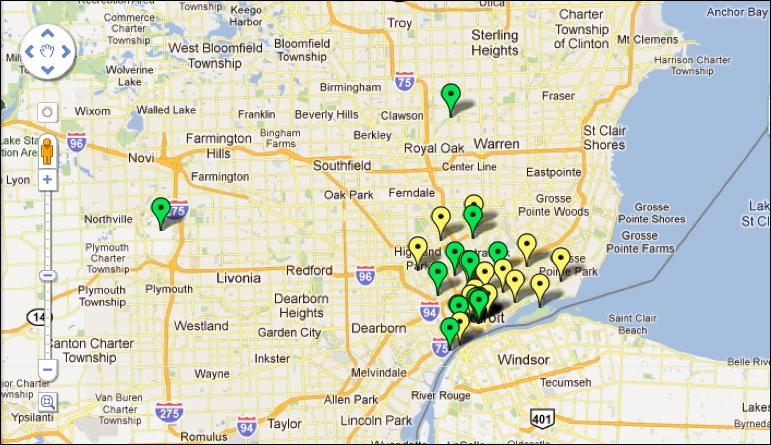
The queasy feeling in my stomach while I was on the plane to The D told me we were on the right track. I hadn’t seen Marc in 4 months, enraptured as I was by the ceaseless stream of verbiage and audio/visual fornications that were spilling out of my Vegas retreat, where I wrote the bulk of my PhD over the Spring. Truth be told, I was looking forward to seeing the bald Frenchman. As exploration partners, Marc and I seem to create something like a bilateral energy arc that spews sparks of tesla typhoons capable of disabling security cameras and shocking guards into limp-kneed awe. I couldn’t wait to tear the city up with him again and neither of us had ever been to Detroit (minus my failed Canadian road trip nightmare last December which I’ve burned from my memory – a renewed middle finger to the Ontario Provincial Police by the way). After three weeks of scouting in Google Earth for drains, construction projects and derelict industrial areas, unabashedly pillaging leads from the best US explorer blogs and taking a few wild guesses that had the possibility of ending badly, the map we were working off of was so littered with pins for our 4 day trip we could barely see it anymore.

Pin Porn

Our first stop was a no-brainer. Michigan Central Station is one of the largest and most beautiful ruins in North America, an icon of Detroit, even in death, much like Battersea Power Station in London. As Leary writes, Michigan Central Station appears to be a potent symbol of decline and the inevitable cycles of capitalist booms and busts. As a result there is a continual stream of tourists idling their rental cars in front to stare up at the monolith through the barbed wire fence. We sped past them in our red Dodge Charger, parked the car and unceremoniously squeezed through a kicked out piece of plywood under a railway in the back. Sneaking through a network of decaying corridors, we made our way to the main building and started climbing. Up top, we got our first taste of the Detroit skyline, only hours after landing. We were immediately impressed. Later, while we were running around playing on the roof, we were slightly shocked when three other explorers clamoured out of the stairwell and greeted us, two from Paris and one from Melbourne. Later, we tried to entice them to squeeze under a fence into the old school building across the street where they found a body of a homeless man frozen in the ice last Winter but they gave it a miss and we went on without them. George, if you read this, I hope you three had an amazing trip!

Stasis

Seared

Lacking any plans for sleeping (of course!), we decided Michigan Central Station was as good a place as any to kip and rolled out our sleeping bags in the main hall. In the morning, we were greeted by two swaggering kids wielding tall cans of cheap beer and 2x4s who had clearly been drinking until 7am. One of them, stumbling and dragging his weapon as we sat up in quickly our sleeping bags and prepared to tackle him, said he was really sorry to tell us that we didn’t look very homeless. We quickly gathered these kids were cool, just a bit hammered and scared – nevertheless we decided it was high time to pack up and start working on tracing our pins. So we bailed from central station and sped off into the suburbs.

Perspective

Activated

I won’t lie, Detroit was shocking. I have a hard time imagining such an economically depressed city existing in the United States. However, everywhere we went, the people of The D were candid and kind, even in what might be considered the worst neighbourhoods, waving at us as we drove down their street and laughing at us when we explained our mission to hobo our way through the American Midwest for the whole summer. Although I’ll try to avoid celebrating the economic devastation the city has experienced, I have to say I felt the place was sizzling with creative energy that somewhere like Los Angeles could never dream of. Monstrous art projects, weird games, quirky cafes and spontaneous happenings were in abundance. At one point, we even randomly found a house covered in stuffed animals that I found out later was part of Tyree Guyton’s Heidelberg Project. That kind of shit is weird and wonderful, the world needs more of it and, well, I just can’t imagining it happening anywhere else in quite that way. I think that’s also the reason why urban exploration has taken off so much in Detroit. Yes, ruins are everywhere, but the city also has a really raw “if you want it, go for it” attitude that I find refreshing. Artistic liberation always seems to flourish where capitalism takes a fatal dive.

Toxic

We knocked out the sites on the outskirts of the city pretty rapidly, finding them satisfyingly sketchy and yet feeling increasingly guilty about our ‘targets’. We knew we wanted to see the remains of Detroit’s automotive empire, I mean, leaving the city without seeing it would have been a travesty, but every place we entered was either very clearly a crack den or homeless shelter, incredibly sombre, or filled with other people wielding cameras and spray cans. Everything was trashed. We took the pictures we wanted to get, saw the places we wanted to see, but I couldn’t help feeling that I just was not that interested in ruins any more. It was clear to me, as it has been for the past few months, that exploration is all about the adrenaline rush for me now, the history of places is an afterthought. It’s part of the inevitable fragmentation of being involved in this practice on a more-than-casual basis. Some of us become graffers, squatters or proper artists. Others settle down and quietly slip away. In any case, I don’t think any of us with any common sense or critical thinking skills can abide the hunger for derelict places and photography for more than a few years, it’s got to evolve into something.

Bones of industry

Shells and husks

What's left

Bereft

Of lust

However, later in the trip, we rolled into a suburb to relocate an abandoned church. Sneaking in through a back door ripped off the hinges, the place appeared to be trashed. My shoulders slumped until we walked up to the first floor and were greeted with this incredible sight. The Woodward Avenue Church brought the energy right back up.

Sacred space

Relocated

We spent the night on top of an abandoned port building called Boblo overlooking the Ambassador Bridge to Canada. Earlier on in the day, in the middle of a pretty rough neighbourhood where we were trying to break into a Leer plant, I fell off a fence and sprained my hand, broke a rib and smacked my head pretty hard on the concrete. It was a stupid move that would haunt me for the next 5 weeks and damn near killed me sleeping on the rocky roof of Boblo Port that night.

Just add water

Wishbone

Passed out

On day three, Marc and I needed an adrenaline shot so we drove downtown and started scoping infiltration locations. One of the first places we had a look at was the Farwell Building and after a pint in the Detroit Beer Co. (we love you guys!). We decided to give it a crack in the middle of the day. The fire escape was a nightmare, some hellish rusty hunk of shit ripping itself out of the brick under it’s own weight. We ran down the alley and scurried up it, having no idea whether it would hold and, if it did, whether we would run into a swarm of crackheads inside once we wiggled through the broken window on the third floor.

Surreal

Instead of crackheads, we were rewarded with a surreal central hall that seemed right on the verge of structural collapse. Checking out the adjoining corridors, I felt a wind blowing through a boarded up door and ripped off the plywood to reveal another fire escape, this one leading to the roof. Up top, when it started pouring rain unexpectedly, I stripped of my clothes and danced in the rain (hey, it had been three days without a shower at this point!). Figuring no one was watching during the shower, a stepped onto the ledge of the roof and stared down at the street. As I did, I saw a woman with a stroller look straight at me as she popped her umbrella. Pointing, she yelled, “Oh my god, that little white boy’s gonna jump!” Two minutes later we heard the sirens coming from every direction and scrambled down the building as the police blocked off the street, waiting for the jumper. As we were hanging off the fire escape, trying to get out of the building before they sent cops up to the roof, a police cruiser stopped at the end of the alley. Marc hissed “freeze!” and we hung, the rusty bolts of the fire escape slowly ripping out of the brick. I knew we were busted. And then, miraculously, the cruiser drove off. I still don’t know whether we were seen and dismissed or whether the cops seriously missed us hanging off that fire escape, but as I stood minutes later with Detroit’s finest staring up at the Farwell Building, waiting for my naked self to jump and listening to the cops laughing about “that twisted tweaker that called it in”, I knew I loved Detroit.

As it turned out, Paul McCartney was playing downtown that night so we had free reign in the city while the cops spent their time directing middle class white people into the stadium and reassuring them there were no Muslims there. We went nuts. At 2am we climbed on top of an Italian restaurant and squeezed though an open window to ascend Broderick Tower, the best view we got of Detroit. It was stunning and really gave us a sense of Detroit as a light, bright, vibrant, beautiful place, in contrast to all the archetypal dereliction we had been seeing.

Veg rock

For the love

It occurred to me at this point, staring out over the city, that Detroit was in fact far from derelict and we had succeeded at breaking the mould. Ruination is, of course, a large component of the urban landscape now after years of corporate corruption, economic destitution and mass population exodus. However, the city remains full of life, events, cool people, great places to go out and a plethora of sites ripe for infiltration that are largely ignored by tight-jeaned camera-toting dereliction fetishists and local explorers unwilling to carve their own path.

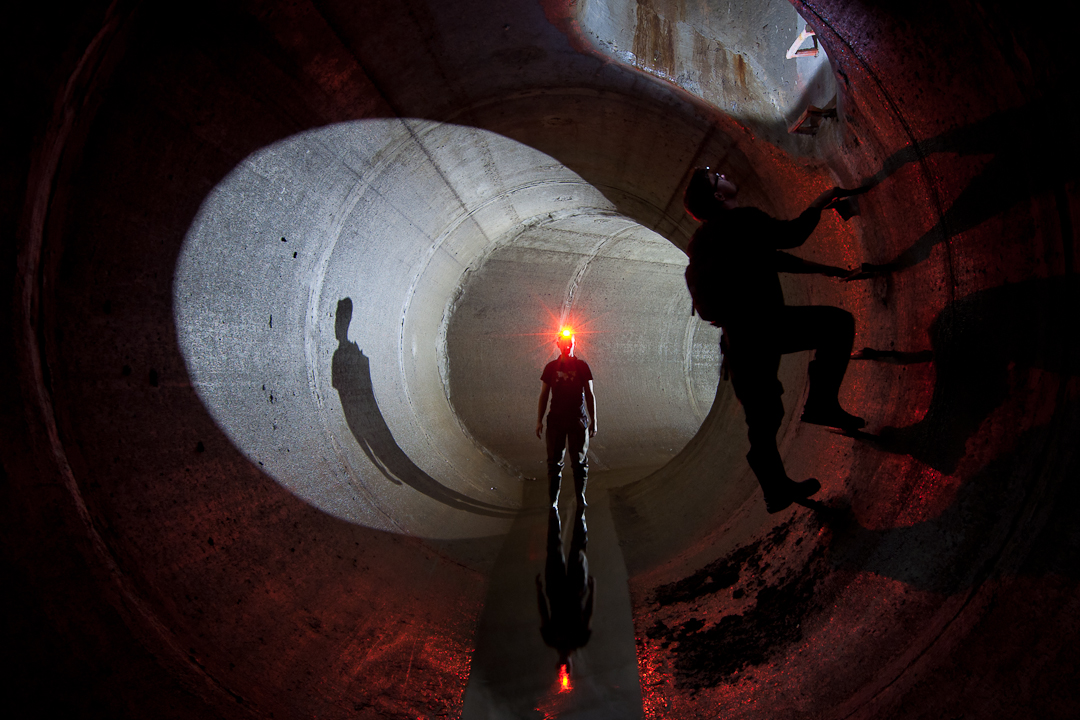
Our final stop, in the suburbs on the way out of town, was a massive drain we found in Google Earth. Our friend Aurelie Curie kindly informed us it was called Red Run while we were en route. I loved Red Run and for reasons known only to himself, Marc despised it and refused to photograph it. Upon reflection, after 4 days in Detroit, sleeping in ruins and walking through endless derelict properties (16 in all) in our quest to find something else, we were both probably more than a little frustrated, despite the successes of the Farwell Building and Broderick Tower. Of course, we had also just knocked out 1 city with 5 more to go on the trip, so maybe Explo was just reserving his superpowers for the upcoming win in the Twin Cities. Stay tuned to find out.

Legends

On to Chicago

Our trip to Detroit, for me, exceeded expectations. Of course, the most important aspect of place hacking is the exploration itself and no photograph can adequately identify the origins for Detroit’s contemporary ruination; all it can represent is the spectacular wreckage left behind in the present. Dan Austin, editor of the architecture information site Buildings of Detroit notes that artists and photographers from all over the world have contacted him to act as their guide to Detroit’s ruins, help for quick photo and art projects. He writes that these “parachuters” leave Detroit just as quickly as they arrived, contributing little but to the city’s image of decay. We did what we could to give Detroit a chance to show it’s true colours to us and eventually it did. It’s not a place I could live but I certainly left with a different image of the place than when I arrived. Even though our time there was relatively short, we folded ourselves into the city, exploiting weak points in the urban armour to get into, and then under, the skin. I will always contend this is the best way to actually get to know a place.

The rest of what we found in Detroit, the other stories behind the photos, are of course ours to keep. Perhaps you could pry them out of us over a beer. But if you want to know what The D is about bad enough, like Marc and I did, you will start pinning that map and make your move. Godspeed explorers!

_____________________

The art of living well and the art of dying well are one.
Epicurus

Share
Tags : , , , , , , , , , , , , , , , , , , , , , , , , , , , , | 13 comments

The first episode of Crack the Surface, a series of documentaries on the culture of urban exploration.

Produced in association with

Silent UK
Sub Urban

Share
Tags : , , , , , , | 1 comment

Knowing is not enough; we must apply. Willing is not enough; we must do.
– Goethe

Dear British Transport Police,

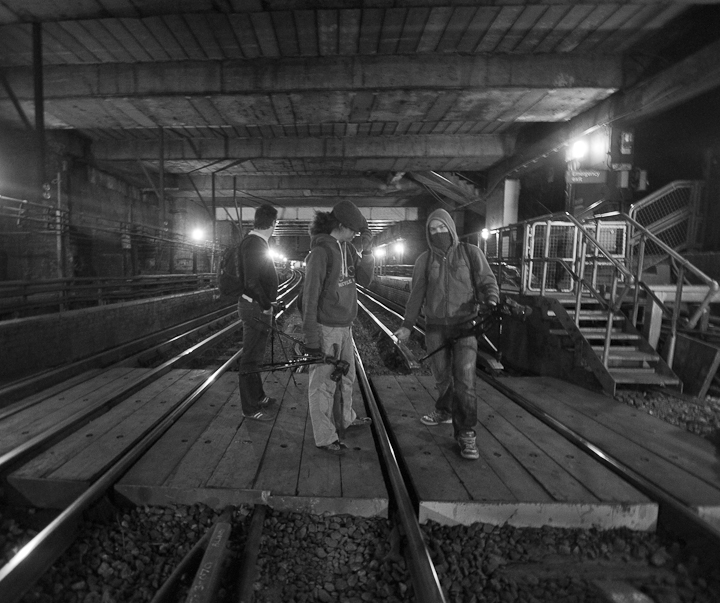
I hear that in a recent police interview, you produced 91 pages of Place Hacking you had apparently printed out from a high quality laserjet. Firstly, let me just say that I am delighted you used so much toner working toward a better understanding of how urban exploration functions as a critical spatial practice to unveil hidden parts of the city and activate little moments of urban orgasmic wonder in an age rendered increasingly banal by forces of securitisation (no offence intended). We always suspected that only you guys, and maybe some of the TFL track workers, could ever understand the depths of our tube and train fetish. Do you like to stand in tunnels and record clips like this too?

I knew it! So listen guys, just between fellow train pornographers, you arrested some of us on Easter. It was a clean bust, we got a little silly there for a few weeks running around on live lines and everything and you were pretty cool about it. But the thing is, you forced your way into my flat while I wasn’t there and you’ve been holding computers, cameras and hard drives in your offices under some sort of vague “terrorism” authority for 3 months now. I never gave you permission to come in my house and the whole thing, if I’m being frank with you, is beginning to reek of a civil rights violation. Now I’m not trying to be cheeky here but we all know that you understood within 10 minutes of talking to us that we’re just train geeks with expensive cameras. I mean Howard Stern even said we’re like Dungeons and Dragons ubernerds that took our adventures into real life. Which is pretty accurate.

Bigger

Nerds

So given all the cuts going through a wide swath of UK society at the moment, you will understand if I suggest that the funds diverted for this “investigation” are being rather ill-invested. You see, in contrast to, let’s say, Lambrini chav chicks screaming on trains which apparently happens every day, we cause far less trouble for BTP. I mean 98% of the time you didn’t even know we were in there. We were also very forthcoming when you caught us, we played fair. Tell me, have you learned anything new looking through our hard drives full of porn and pictures of trains and cranes? I didn’t think so. And in terms of the acts of “terror” you apparently think we are involved with, well the only terror we inspire is the kind that makes you think about your life and how you’ve wasted it working at a boring office job when you could have been running around in TFL tunnels with that warm, brakedust-laced air swishing around you, getting all in your teeth and jumping over the 3rd rail running from the worktrains at 3am, diving into the Japanese knotweed they never clear up. It’s not any more terrorful than, let’s say yarn bombing or throwing magnetic lights on buildings or skateboarding. Though I suppose you might consider those activities big “social scourges” as well eh?

Let bygones

Be bygones

Look, I am just going to lay it out here for you BTP. We make the city more fun. We do this because we love it, not because we want to make your life difficult. Honestly, it would be better for all parties involved if you just ignored it. We aren’t doing anyone harm. In fact, it could be argued that we actually make the city safer by exposing flaws in your transportation network that a bunch of kids with bulky tripods and backpacks can sneak into – no telling what someone who was really motivated could do. Tell you what, we promise that if we ever see a “terrorist” down there we’ll brain them with a tripod okay? In the end, we are, I am sure you realise at this point, basically model citizens: active, aware, careful, well-dressed and *ahem* well-educated – not to mention the fact we’ve been running citizen patrols in the tunnels we pay to maintain (and pay you to police) for 3 years now without ever asking for a dime!

And so, in the spirit of reconciliation, taking into account all I have outlined above (as well as my many publications on the topic you also undoubtedly printed off on that crisp laserjet and enjoyed with a nice scotch), I have prepared an invoice for the work we have done exposing your network’s security flaws. I will CC another copy to your office but would appreciate prompt payment on this, given you have everything we own and we need to buy some new ropes, harnesses and bolt croppers.

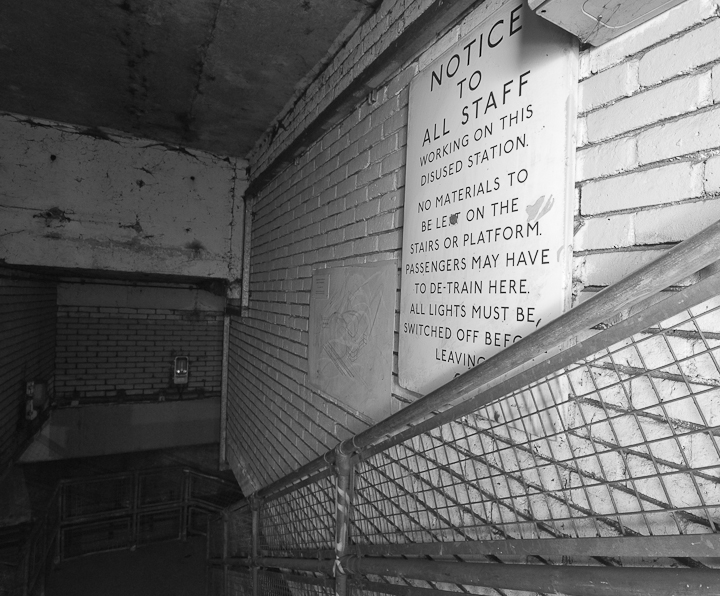
Anyway, I hope you guys are having a good summer. Mine is pretty boring, just writing about all the disused Tube stations we explored and stuff. Cool thing is though, at the end of it I get a PhD. Now that, my friends, is public money well invested! Please let me know if you have any questions.

Sincerely,

The Goblinmerchant

PS. You guys should try exploring everything, it’s awesome!

Share
Tags : , , , , , , , , , , , , , | 34 comments

For every prohibition you create you also create an underground.
– Jello Baifra (Dead Kennedys)

As urban explorers, we often confine our adventures to those places which are, by and large, empty. That is not to say that other people – drug users, graffiti artist, geocachers, squatters, film crews, security guards or troupes of children looking for imaginative play space – don’t also use what appear to be places largely absent from human presence, but that the places we often explore are not generally utilized as shelter or housing. When we do encounter people, we usually leave with an apology. Fuck that, I say bring on the meld.

Liminal

In our explorations of the ruins of Eastern Europe between 2008 and 2010, myself, Winch, Statler, “Gary” and Silent Motion took guilty pleasure in locating and camping in the remains of the failed Soviet Union and Nazi Germany. The experience left us in a distinctly different psychological state than ruin exploration in the United Kingdom. The reverence for actual state failure, rather than imagined post-capitalist social or site-specific industry failure, made our explorations both more poignant and more guilt-ridden. If, as Dylan Trigg writes in The Aesthetics of Decay, a derelict factory testifies to a failed past, what then does the ruin of a failed state say to us?

Failed (Vogelsang, Berlin 2009)

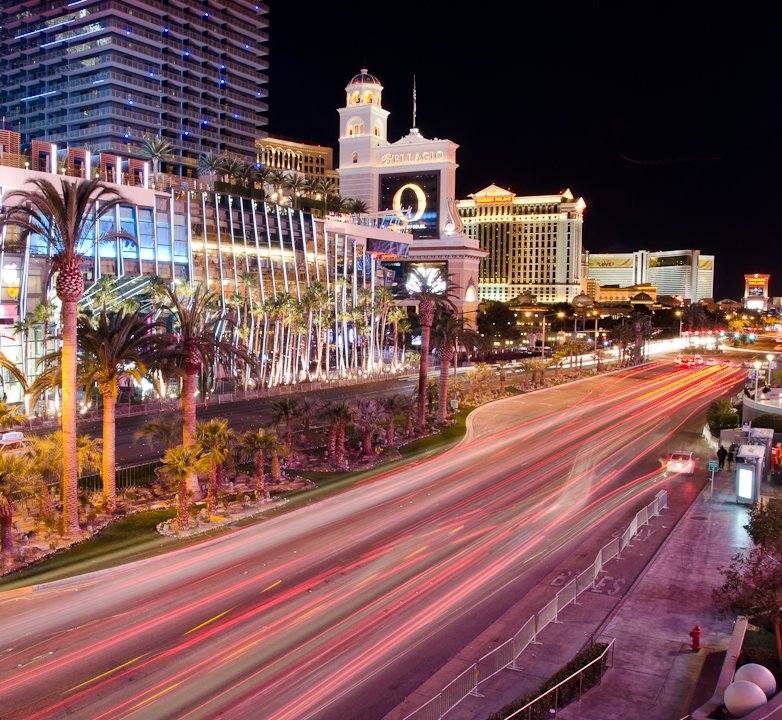
And failing (The Strip, Las Vegas, 2010)

As Dsankt once pointed out to me, there are very few people involved in urban exploration that are economically disadvantaged. Obviously, in order to be able to create the opportunity for these sorts of engagements with the city, one must be secure enough financially and with enough free time that putting in the necessary hours to research and explore sites can be accomplished. More importantly, one also,  as I pointed out above, has to view these spaces as primarily areas for play and creative practice rather than potential housing.

Privileged

As we found in our exploration of economically disadvantaged areas as far away as Poland, our relative affluence became readily apparent. At one point, we were all stunned to find someone living inside the Soviet Military base Vogelsang, dozens of miles in an East German forest. We all mused in the car driving away about whether that person had consciously chosen to live in that hacked up shell of a building in a peaceful forest next to the derelict nuclear launch pads outside Berlin or whether they were, perhaps, running from something. As we set up our temporary camp there the night before, we all discussed how we could just choose to stay as whoever that was did. Winch later wrote that “the fact we could sleep there, build fires and do whatever we liked turned it into an environment that was absolutely ours – the geography of isolation turned it from being a ruin into our ruin.” And isn’t the what place is all about? Did that tramp living there feel the same?

In 1923, Chicago sociologist Nels Anderson and anarchist Ben Reitman developed the general condition of vagrancy, divided into three main classes: bums, tramps and hobos. He writes, a tramp is a man who doesn’t work, who apparently doesn’t want to work, who lives without working and who is constantly travelling. A hobo is a non-skilled, non-employed laborer without money, looking for work. A bum is a man who hangs around a low class saloon and begs or earns a few pennies a day in order to obtain drink. It is an interesting notion that one can have different motivations for being homelessly mobile and where (if?) we exist on that scale, as temporary spatial hijackers. I will return to that later.

Living in ruins, Soviet edition

Living in drain, American edition

As I have found recently in my explorations of the Las Vegas storm drains, we don’t have to travel as far as Poland to see people living in derelict space and infrastructure. As David Runiman writes in the April 2011 issue of the London Review of Books, since 1974, the share of national income of the top 0.1 per cent of Americans has grown from 2.7 to 12.3 per cent of the total, a truly mind-boggling level of redistribution from the have-nots to the haves. Las Vegas unemployment, meanwhile, breaking new records, has been marked at 15% one year ago, it now stands at 13.7%. However, as Joshua Ellis, the writer who runs Zen Archery pointed out to me over coffee last week, those numbers include only those who apply and are accepted for unemployment benefits. He reckons the reality of unemployment (not to mention underemployment) in this dusty city is closer to 25%. Still, amidst the glitz of the strip, constant televisual pundit banter about inevitable economic recovery (Osama is dead, the price of gold is skyrocketing!), not to mention flash weddings of vegan casino moguls, it is hard to argue that economic conditions aren’t “recovering”. Until you slip into Las Vegas drain.

As Matthew O’Brien, author of the book Beneath the Neon: Life and Death in the Tunnels of Las Vegas writes, the strip, of course, provided a stunning contrast to the storm drain. How could these two worlds so closely co-exist..? Then again, how could they not? In America, poverty always bows at the feet of corporate wealth. The question I find interesting here is whether these people have arrived, following Anderson’s definitions, by choice or circumstance. Matthew is one person who can answer that question.

Intersections

Matthew has spent a good part of the last 10 years exploring the Las Vegas drain system, systems that are not monitored. There are no rules. There are no heroes. And, oh yeah, they can fill a foot per minute with floodwater. Along with Ellis, they were the first to break what has become an international story about the living conditions of over 300 people residing in the drain system here.

More than temporary

When I arrived in Las Vegas, I knew I would not be able to resist my explorer urge to see the drains for myself, but I also wanted to hear the stories from the only two who dared to venture into that system first, having no idea what to expect. What follows is a short interview with Matthew reflecting on the impact of the book and his future plans.

BLG: Given that it has been 5 years since the publication of Beneath the Neon, perhaps you could just give us an update on your work in the Las Vegas storm drains. Are more people living there since the economy tanked? How has the publication of the book affected both you and them?

MO: The main thing that has changed in the drains since Beneath the Neon was published in 2007 is that many of the people living in them have a chance to get out. In March 2009, I founded a community project called Shine a Light, a collaboration with local charity organization HELP of Southern Nevada. Basically, I escort their social workers into the drains and they offer assistance to the people we encounter. In two years of work, they’ve helped hundreds of people with stuff like getting ID and prescription glasses and they’ve actually housed maybe 80 or 90 people. It’s, by far, the best thing to come out of the book and my explorations of the tunnels.

Following on from that, if you could go through the whole experience again, would you change anything? For instance, you mentioned to me previously that you felt a bit reluctant about giving away detailed information on locations and using people’s real names.

There’s little I would change about Beneath the Neon and my experiences in the drains. I mean, there are minor things I would add to or take out of the book, since I feel like I’ve matured as a person and a writer, but it’s who I was and where I was at the time, and I’m cool with that.

In the book, I use only the first names of the people I interviewed and tried to be vague about the location of the tunnels, while giving the reader enough info to hold onto. There are times when I think I should’ve been more vague about the location of the drains, but, really, few people are seeking them out and venturing into them. And those who do—mostly urban explorers and bored teenagers—probably would’ve found the inlets and outlets without my assistance. If you’re determined to find the drains, there are ways to do it.

In the book, you make a few references to urban exploration but it’s obvious that your motivations for exploring the drain, as a journalist, were quite different from the perhaps more selfish motivations of urban explorers. Is there an urban exploration scene in Vegas? If so, do you feel like you are a part of it?

As far as I can tell, there isn’t much of an urban exploring scene in Las Vegas. The city isn’t really suited for it. There aren’t many bridges, abandoned buildings, train tunnels and old interesting ruins here. And the stuff like that that is here tends to be secure and hard to access. (Most property owners in Vegas take trespassing quite seriously.)

There are, however, a lot of stalled, half-built hotel-casino projects on and around the Strip. They would be interesting to explore, I think—viewing the skeletons and innards before they’re concealed by a glitzy facade.

But I’m probably not the man to do it. There’s too much risk (fines, injuries, etc.) and too little reward. Plus, I assume there are no people, besides asshole security guards, in these areas. Part of what made the drains interesting to me is that you could encounter graffiti artists, madmen, public-works employees, squatters and others, which added to the intrigue and context of the setting.

I am very interested in the politics behind Beneath the Neon. This is a hard city to live in, a place with very conservative values that offer little help to those in need. It seems obvious from your book that on some level, the authorities in Las Vegas were quiet happy to have their homeless problem “disappear” underground. Of course, you have now made it all public. Has there been much of a reaction to that from authorities and policy-makers?

There really hasn’t been much of a reaction from local authorities and politicians to the book and the media coverage of the tunnels, which is good and bad, I think. One of my biggest fears was that the police would sweep the people out of the tunnels after the book was published. Fortunately, that didn’t happen. But politicians and city and county employees, as far as I can tell, didn’t try to do anything to help the people, either. That’s part of the reason I founded Shine a Light.

If the Mob was still running the town, I’m sure I would’ve received a none-too-subtle message to drop the subject. But the corporate Mob just seems to ignore the subject entirely.

Finally, tell me about what you are up to now. Are you interested in exploring different types of subterranean spaces in the future such as the London sewers or Paris Catacombs (quarries)?

I recently published another book, which I’m excited about. It’s titled My Week at the Blue Angel: And Other Stories from the Storm Drains, Strip Clubs, and Trailer Parks of Las Vegas. It’s a collection of creative-nonfiction stories set in off-the-beaten-path Vegas and it includes the original storm-drain stories Josh Ellis and I co-wrote for Las Vegas CityLife. Also, I checked into one of the seedier weekly motels in town (and that’s saying a lot!), stayed a week and wrote a diary about my experiences. I wrote a personal story about living in a historic, past-its-prime apartment complex in the shadow the Strip. Stuff like that.

I am interested in exploring subterranean spaces in other cities, but not necessarily writing about them. I’m a bit of a Vegas specialist, so writing about the drains here made sense. However, I’m probably not as qualified to write extensively about the Shanghai Tunnels of Portland, the catacombs of Rome or the quarries of Paris. They’d just be fun places to visit, as a way to balance out the more touristy stuff. I don’t totally geek out or get off on exploring underground spaces. I’ve just developed an interest in them and urban exploring through my experiences in the underground flood channels of Las Vegas.

Hard knocks

Not shocked

After conducting this interview with Matthew, I showed him a photograph I had taken of a drain next to a notable landmark, a photo which, in our parlance “exposed access details”. He asked me not to publish it. I was heartbroken, given I though the photo had turned out beautifully, but had to defer on the side of Matthew’s sympathy as one who knew intimately about the conditions of living here, rather than my ego as a photographer of the largely unseen and unpopulated. I mean, if I was living in there and some asshole posted the photo of my front door on Place Hacking, I would be pissed. Just kidding, I’d go steal more drinks and wait for the party to erupt.

Space

Invaders

Eschewing

Waders

A larger question here for the urban exploration community lingers; it has always been the elephant in the room. At what point do our exploration cease to be an adventure in creative practice and boundary subversion and begin to impact those less fortunate than us in a negative way? Is urban exploration, in fact, a victimless crime when we disturb people while exploring? And maybe more importantly – at what point might we begin, as Matthew has, to move past urban exploration to begin working for the rights of those less fortunate than us, to use our media influence to actually improve the lives of others? Do we actually care about that, or just about ticking our list of explored locations?

Explored

On the other hand, these people are living in public space (as much as taxpayer funded infrastructure is public space) and most of the people I met so far in drains here could give a shit whether I was walking around in there, they just wanted to know if they could bum a smoke or hit me up for a dollar. Given that our crew has now started squatting space in London, are we really all that different? And if we are bridging the gap between urban explorers and hobos, tramps and bums, following Anderson, what are we? Does that dreaded monstrosity the prohobo – the hobo that chooses to be homeless yet retains the ability to photograph, blog and scam the internet for money as well as picking pockets and robbing Liddle for fixtures to BBQ vegetables looted from the skip actually exist? Is this Donna Haraway’s cyborg, neither nature nor culture, human nor computer,  neither employed nor homeless? Are we becoming as liminal as the spaces we increasingly reside in? Are we finally getting close to the meld? I hope so, cause I can’t wait to pop.

Don't ask

For much

Just desire

And such

In fact, as Matthew spun the stories of encounter in his book, one after another, it became obvious that with a few rare exceptions, most of the people in the drains were there by choice. They had chosen to stop contributing to the system, chosen to gamble their lives away, chosen meth or heroin over family and stability and chosen the freedom and danger of living off the grid, scamming tourists and casinos by silver mining (hunting machines for left over credits). They choose to get high till the day cools off and then crawl out of the drains, all sloppy and hungover, delighted to go dick around in this Mad Max plasticland for another night. In short, many people have chosen this life in Las Vegas Undercity. That is not to say that we shouldn’t offer a helping hand where it’s needed, and bless Matthew for also doing so, but it is to say that maybe pity is wrongly placed here. As Harold, one of the drain dwellers that Matthew encounters says, quite proudly we dwell in the subterranean world, man. We dwell in the subterranean world. Harold goes on to tell Matthew that it was an economic choice, and he is saving mad cash living in the drains. Maybe Harold knows something we don’t, maybe he is braver than us. Maybe homelessness is preferable to the mental vacancy you inhabit at work everyday. The Situationists thought that where material poverty had been eradicated, the biggest threat to life was boredom. Maybe Harold already figured that out and just decided to subvert that whole nightmare before he got there.

Braver

Or just lost

Challenged

Or just tossed?

Perhaps the other side of this issue is a question of why people don’t live in ruins and infrastructure in London and Paris. Perhaps it’s a fundamental difference in economic distribution, social programs or access to charity. Or maybe it’s just a matter of pride or social conformity. In any case, the Las Vegas Undercity, the only feature of Las Vegas that may interest the intrepid urban explorer, is also, consequently, the true face of a city built on nothing but wealth and decadence and doesn’t look a thing like anyplace else. I suppose, in that light, maybe everybody should see the Vegas drains, maybe then they would understand the true cost of this wonderland. I am pretty sure this is a good indication of what happens when we hack the system into an open source OS: here’s your free market fuckers.

As anyone who knows me will testify, I have always had a deep love for Las Vegas, and particularly for the Mojave Desert. But my recent experiences here, seeing the Las Vegas Undercity, has made me want to leave and never return. Nowhere in the United States is the chasm between rich and poor deeper or more upsetting, nowhere is the barbarity of American free market capitalism more evident. But you know, this is just what’s happening out there, in the real world, in real time. If you want to see if it for yourself, or even move yourself in, that’s your call I guess. When Las Vegas is just another Old West ghost town –boom and then bust! – these reinforced concrete boxes will be buried beneath the desert. They’re our preservation areas. Our art galleries. Our time capsules. They’re also our homeless shelters. As for myself, I am going to take the lessons learned here back to London, that’s when this scene is going to get really raw. What an age in which we dwell. Now let’s drill down into the meld.

Snapped

Thanks to Katie Draper and Erika Sigvardsdotter for exploring drains here with me and Joshua Ellis and Matthew O’Brien for making me feel at home in a city full of drugs and scary clowns.

Be Monstrous. Explore Everything.


Share
Tags : , , , , , , , , , , , , , , , , , , , , , , , , , , , , , , , , , , , , , , , | 15 comments