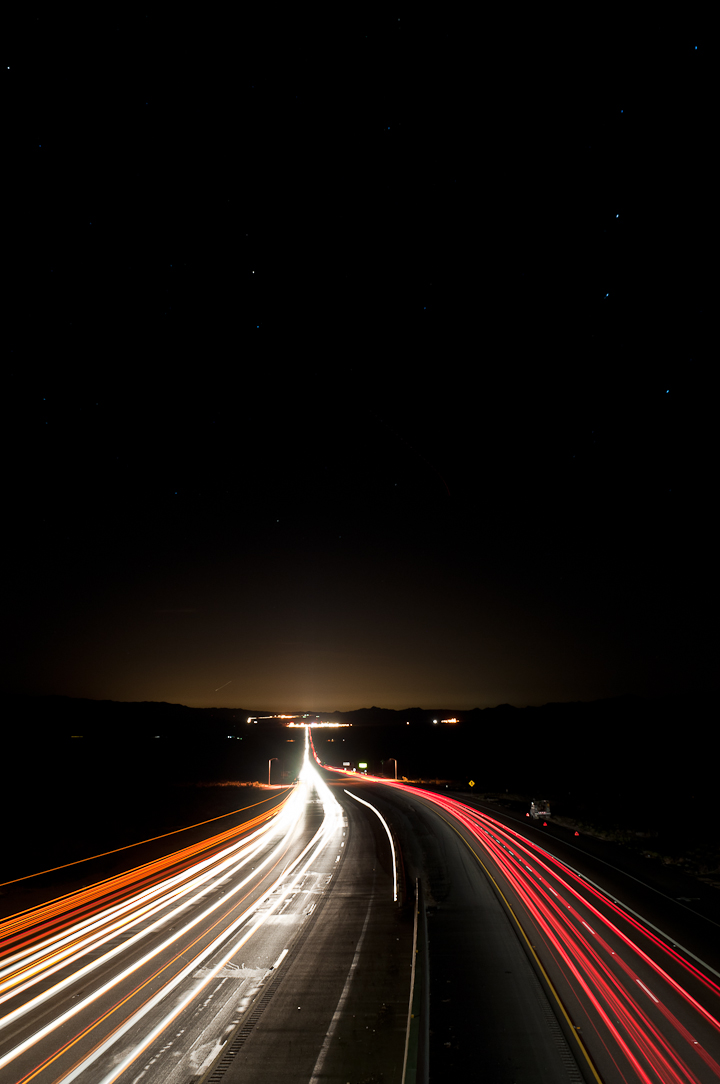
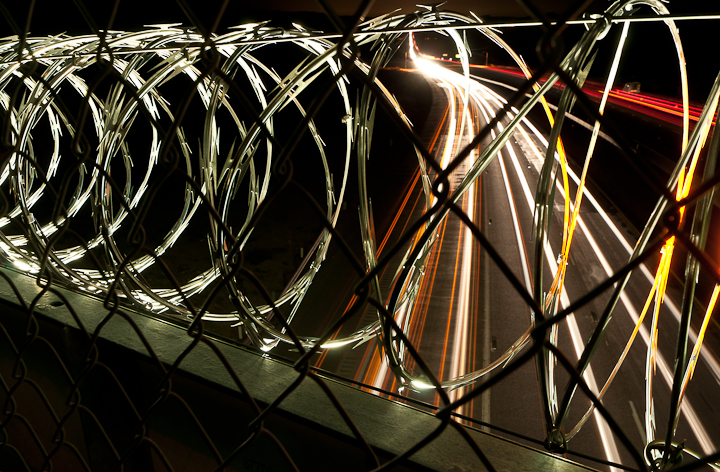
The voyeurism isn’t just gawking at the old buildings; it’s gawking at the possibility and the danger of death.
Kyle Chayka

Momento mori

Detroit’s reputation as a destination for encounters with epic industrial ruins, burned-out residential blocks, dead bodies frozen in ice and hard pipe-hitting thugs ready to elbow you in the face and abscond with your camera gear is internationally gelled in the urban exploration community. When Marc Explo and I started planning our trip to The D, we wanted all that action. But we were also interested in getting beyond stereotypical post-industrial tourism to see what Detroit could offer in terms of live infiltration. Surely, we figured, a city now saddled with a perpetual (and seemingly unshakable) image of crime and desolation wouldn’t mind if we preferred to climb some of their hot new construction projects and wade around in their massive new storm drains. So Marc flew from London, I flew from Las Vegas and we met in the middle of the United States to begin the 2011 Midwest Powerslide.

Powerslide

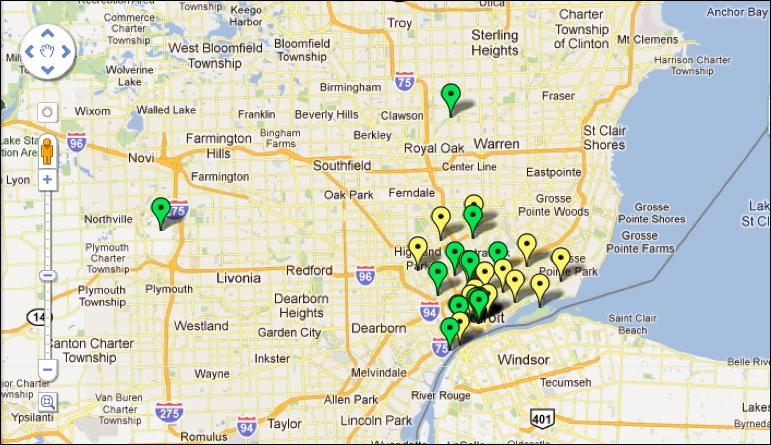
The queasy feeling in my stomach while I was on the plane to The D told me we were on the right track. I hadn’t seen Marc in 4 months, enraptured as I was by the ceaseless stream of verbiage and audio/visual fornications that were spilling out of my Vegas retreat, where I wrote the bulk of my PhD over the Spring. Truth be told, I was looking forward to seeing the bald Frenchman. As exploration partners, Marc and I seem to create something like a bilateral energy arc that spews sparks of tesla typhoons capable of disabling security cameras and shocking guards into limp-kneed awe. I couldn’t wait to tear the city up with him again and neither of us had ever been to Detroit (minus my failed Canadian road trip nightmare last December which I’ve burned from my memory – a renewed middle finger to the Ontario Provincial Police by the way). After three weeks of scouting in Google Earth for drains, construction projects and derelict industrial areas, unabashedly pillaging leads from the best US explorer blogs and taking a few wild guesses that had the possibility of ending badly, the map we were working off of was so littered with pins for our 4 day trip we could barely see it anymore.
Pin Porn

Our first stop was a no-brainer. Michigan Central Station is one of the largest and most beautiful ruins in North America, an icon of Detroit, even in death, much like Battersea Power Station in London. As Leary writes, Michigan Central Station appears to be a potent symbol of decline and the inevitable cycles of capitalist booms and busts. As a result there is a continual stream of tourists idling their rental cars in front to stare up at the monolith through the barbed wire fence. We sped past them in our red Dodge Charger, parked the car and unceremoniously squeezed through a kicked out piece of plywood under a railway in the back. Sneaking through a network of decaying corridors, we made our way to the main building and started climbing. Up top, we got our first taste of the Detroit skyline, only hours after landing. We were immediately impressed. Later, while we were running around playing on the roof, we were slightly shocked when three other explorers clamoured out of the stairwell and greeted us, two from Paris and one from Melbourne. Later, we tried to entice them to squeeze under a fence into the old school building across the street where they found a body of a homeless man frozen in the ice last Winter but they gave it a miss and we went on without them. George, if you read this, I hope you three had an amazing trip!

Stasis

Seared

Lacking any plans for sleeping (of course!), we decided Michigan Central Station was as good a place as any to kip and rolled out our sleeping bags in the main hall. In the morning, we were greeted by two swaggering kids wielding tall cans of cheap beer and 2x4s who had clearly been drinking until 7am. One of them, stumbling and dragging his weapon as we sat up in quickly our sleeping bags and prepared to tackle him, said he was really sorry to tell us that we didn’t look very homeless. We quickly gathered these kids were cool, just a bit hammered and scared – nevertheless we decided it was high time to pack up and start working on tracing our pins. So we bailed from central station and sped off into the suburbs.

Perspective

Activated

I won’t lie, Detroit was shocking. I have a hard time imagining such an economically depressed city existing in the United States. However, everywhere we went, the people of The D were candid and kind, even in what might be considered the worst neighbourhoods, waving at us as we drove down their street and laughing at us when we explained our mission to hobo our way through the American Midwest for the whole summer. Although I’ll try to avoid celebrating the economic devastation the city has experienced, I have to say I felt the place was sizzling with creative energy that somewhere like Los Angeles could never dream of. Monstrous art projects, weird games, quirky cafes and spontaneous happenings were in abundance. At one point, we even randomly found a house covered in stuffed animals that I found out later was part of Tyree Guyton’s Heidelberg Project. That kind of shit is weird and wonderful, the world needs more of it and, well, I just can’t imagining it happening anywhere else in quite that way. I think that’s also the reason why urban exploration has taken off so much in Detroit. Yes, ruins are everywhere, but the city also has a really raw “if you want it, go for it” attitude that I find refreshing. Artistic liberation always seems to flourish where capitalism takes a fatal dive.

Toxic

We knocked out the sites on the outskirts of the city pretty rapidly, finding them satisfyingly sketchy and yet feeling increasingly guilty about our ‘targets’. We knew we wanted to see the remains of Detroit’s automotive empire, I mean, leaving the city without seeing it would have been a travesty, but every place we entered was either very clearly a crack den or homeless shelter, incredibly sombre, or filled with other people wielding cameras and spray cans. Everything was trashed. We took the pictures we wanted to get, saw the places we wanted to see, but I couldn’t help feeling that I just was not that interested in ruins any more. It was clear to me, as it has been for the past few months, that exploration is all about the adrenaline rush for me now, the history of places is an afterthought. It’s part of the inevitable fragmentation of being involved in this practice on a more-than-casual basis. Some of us become graffers, squatters or proper artists. Others settle down and quietly slip away. In any case, I don’t think any of us with any common sense or critical thinking skills can abide the hunger for derelict places and photography for more than a few years, it’s got to evolve into something.

Bones of industry

Shells and husks

What's left

Bereft

Of lust

However, later in the trip, we rolled into a suburb to relocate an abandoned church. Sneaking in through a back door ripped off the hinges, the place appeared to be trashed. My shoulders slumped until we walked up to the first floor and were greeted with this incredible sight. The Woodward Avenue Church brought the energy right back up.

Sacred space

Relocated

We spent the night on top of an abandoned port building called Boblo overlooking the Ambassador Bridge to Canada. Earlier on in the day, in the middle of a pretty rough neighbourhood where we were trying to break into a Leer plant, I fell off a fence and sprained my hand, broke a rib and smacked my head pretty hard on the concrete. It was a stupid move that would haunt me for the next 5 weeks and damn near killed me sleeping on the rocky roof of Boblo Port that night.

Just add water

Wishbone

Passed out

On day three, Marc and I needed an adrenaline shot so we drove downtown and started scoping infiltration locations. One of the first places we had a look at was the Farwell Building and after a pint in the Detroit Beer Co. (we love you guys!). We decided to give it a crack in the middle of the day. The fire escape was a nightmare, some hellish rusty hunk of shit ripping itself out of the brick under it’s own weight. We ran down the alley and scurried up it, having no idea whether it would hold and, if it did, whether we would run into a swarm of crackheads inside once we wiggled through the broken window on the third floor.

Surreal

Instead of crackheads, we were rewarded with a surreal central hall that seemed right on the verge of structural collapse. Checking out the adjoining corridors, I felt a wind blowing through a boarded up door and ripped off the plywood to reveal another fire escape, this one leading to the roof. Up top, when it started pouring rain unexpectedly, I stripped of my clothes and danced in the rain (hey, it had been three days without a shower at this point!). Figuring no one was watching during the shower, a stepped onto the ledge of the roof and stared down at the street. As I did, I saw a woman with a stroller look straight at me as she popped her umbrella. Pointing, she yelled, “Oh my god, that little white boy’s gonna jump!” Two minutes later we heard the sirens coming from every direction and scrambled down the building as the police blocked off the street, waiting for the jumper. As we were hanging off the fire escape, trying to get out of the building before they sent cops up to the roof, a police cruiser stopped at the end of the alley. Marc hissed “freeze!” and we hung, the rusty bolts of the fire escape slowly ripping out of the brick. I knew we were busted. And then, miraculously, the cruiser drove off. I still don’t know whether we were seen and dismissed or whether the cops seriously missed us hanging off that fire escape, but as I stood minutes later with Detroit’s finest staring up at the Farwell Building, waiting for my naked self to jump and listening to the cops laughing about “that twisted tweaker that called it in”, I knew I loved Detroit.

As it turned out, Paul McCartney was playing downtown that night so we had free reign in the city while the cops spent their time directing middle class white people into the stadium and reassuring them there were no Muslims there. We went nuts. At 2am we climbed on top of an Italian restaurant and squeezed though an open window to ascend Broderick Tower, the best view we got of Detroit. It was stunning and really gave us a sense of Detroit as a light, bright, vibrant, beautiful place, in contrast to all the archetypal dereliction we had been seeing.

Veg rock

For the love

It occurred to me at this point, staring out over the city, that Detroit was in fact far from derelict and we had succeeded at breaking the mould. Ruination is, of course, a large component of the urban landscape now after years of corporate corruption, economic destitution and mass population exodus. However, the city remains full of life, events, cool people, great places to go out and a plethora of sites ripe for infiltration that are largely ignored by tight-jeaned camera-toting dereliction fetishists and local explorers unwilling to carve their own path.

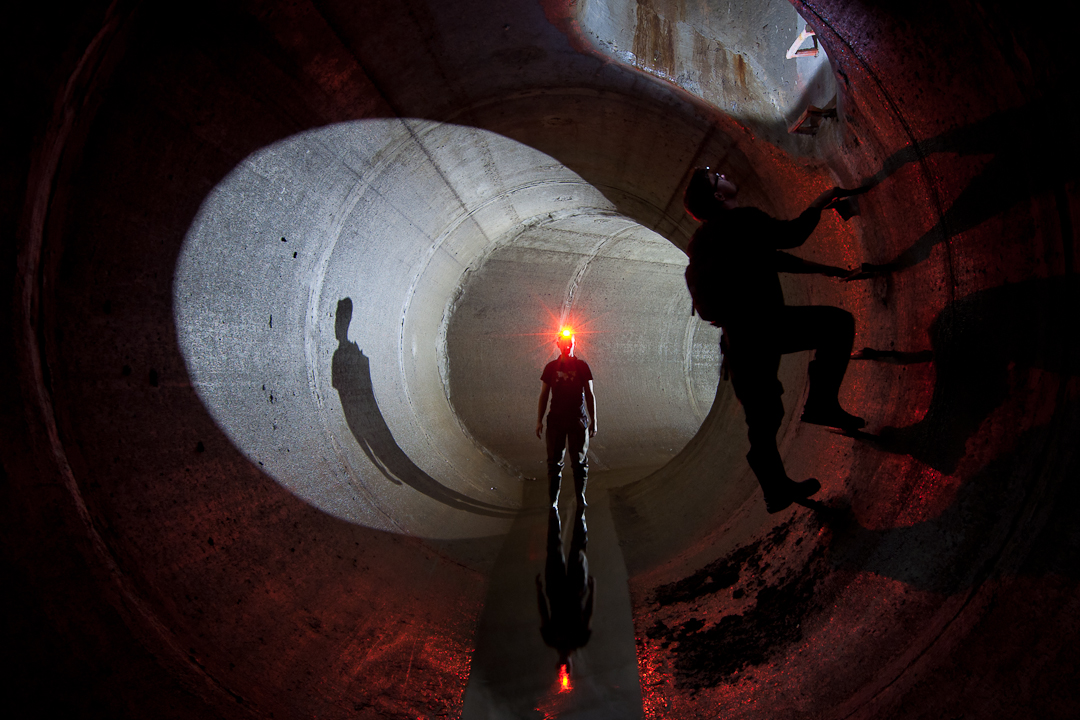
Our final stop, in the suburbs on the way out of town, was a massive drain we found in Google Earth. Our friend Aurelie Curie kindly informed us it was called Red Run while we were en route. I loved Red Run and for reasons known only to himself, Marc despised it and refused to photograph it. Upon reflection, after 4 days in Detroit, sleeping in ruins and walking through endless derelict properties (16 in all) in our quest to find something else, we were both probably more than a little frustrated, despite the successes of the Farwell Building and Broderick Tower. Of course, we had also just knocked out 1 city with 5 more to go on the trip, so maybe Explo was just reserving his superpowers for the upcoming win in the Twin Cities. Stay tuned to find out.
Legends

On to Chicago

Our trip to Detroit, for me, exceeded expectations. Of course, the most important aspect of place hacking is the exploration itself and no photograph can adequately identify the origins for Detroit’s contemporary ruination; all it can represent is the spectacular wreckage left behind in the present. Dan Austin, editor of the architecture information site Buildings of Detroit notes that artists and photographers from all over the world have contacted him to act as their guide to Detroit’s ruins, help for quick photo and art projects. He writes that these “parachuters” leave Detroit just as quickly as they arrived, contributing little but to the city’s image of decay. We did what we could to give Detroit a chance to show it’s true colours to us and eventually it did. It’s not a place I could live but I certainly left with a different image of the place than when I arrived. Even though our time there was relatively short, we folded ourselves into the city, exploiting weak points in the urban armour to get into, and then under, the skin. I will always contend this is the best way to actually get to know a place.

The rest of what we found in Detroit, the other stories behind the photos, are of course ours to keep. Perhaps you could pry them out of us over a beer. But if you want to know what The D is about bad enough, like Marc and I did, you will start pinning that map and make your move. Godspeed explorers!

_____________________

The art of living well and the art of dying well are one.
Epicurus
Share
Tags : , , , , , , , , , , , , , , , , , , , , , , , , , , , , | 13 comments

This film cost $31 million. With that kind of money I could have invaded some country.
– Clint Eastwood

Silent Motion and Statler on the road

Hobohemia was a series of three trips in 2009 and 2010 organised by The Winch into continental Europe. As an experiment in raw living and in an effort to experience something new, we began sleeping in the ruins we were exploring, eventually making it as far East as Poland on our final journey. I filmed each of the trips, work that was incredibly difficult given the conditions we were travelling under. The result is the Hobohemia Triptych, a series of 3 films that compose this ethnography in its rawest form. It is dirty, shaky, visceral footage that speaks to the excitement, exhaustion and eventual deliriousness that travelling in this way induces. I hope you find them inspirational.

On to new adventures. Explore everything!

Share
Tags : , , , , , , , , , , , , , , , , , , | 3 comments

For every prohibition you create you also create an underground.
– Jello Baifra (Dead Kennedys)

As urban explorers, we often confine our adventures to those places which are, by and large, empty. That is not to say that other people – drug users, graffiti artist, geocachers, squatters, film crews, security guards or troupes of children looking for imaginative play space – don’t also use what appear to be places largely absent from human presence, but that the places we often explore are not generally utilized as shelter or housing. When we do encounter people, we usually leave with an apology. Fuck that, I say bring on the meld.

Liminal

In our explorations of the ruins of Eastern Europe between 2008 and 2010, myself, Winch, Statler, “Gary” and Silent Motion took guilty pleasure in locating and camping in the remains of the failed Soviet Union and Nazi Germany. The experience left us in a distinctly different psychological state than ruin exploration in the United Kingdom. The reverence for actual state failure, rather than imagined post-capitalist social or site-specific industry failure, made our explorations both more poignant and more guilt-ridden. If, as Dylan Trigg writes in The Aesthetics of Decay, a derelict factory testifies to a failed past, what then does the ruin of a failed state say to us?
Failed (Vogelsang, Berlin 2009)

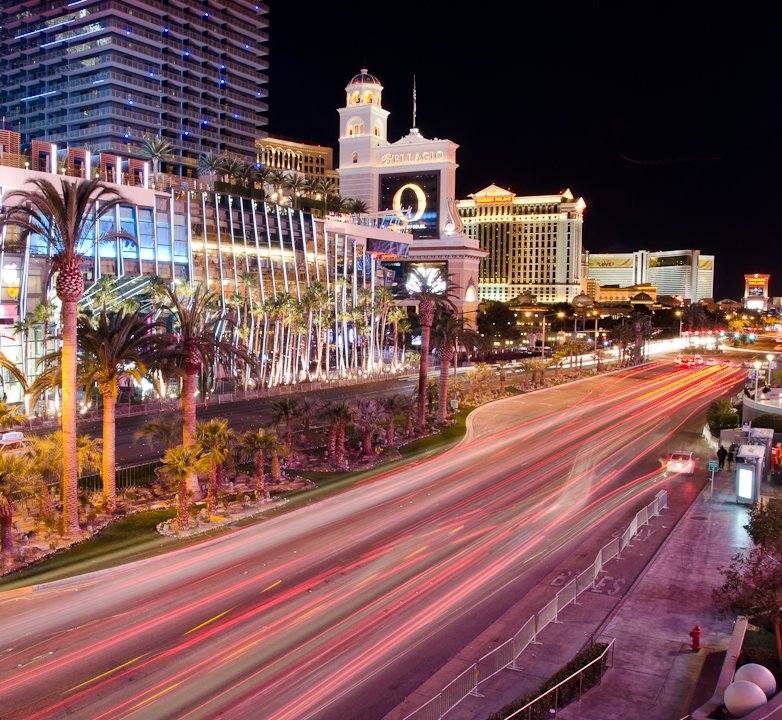
And failing (The Strip, Las Vegas, 2010)

As Dsankt once pointed out to me, there are very few people involved in urban exploration that are economically disadvantaged. Obviously, in order to be able to create the opportunity for these sorts of engagements with the city, one must be secure enough financially and with enough free time that putting in the necessary hours to research and explore sites can be accomplished. More importantly, one also,  as I pointed out above, has to view these spaces as primarily areas for play and creative practice rather than potential housing.

Privileged

As we found in our exploration of economically disadvantaged areas as far away as Poland, our relative affluence became readily apparent. At one point, we were all stunned to find someone living inside the Soviet Military base Vogelsang, dozens of miles in an East German forest. We all mused in the car driving away about whether that person had consciously chosen to live in that hacked up shell of a building in a peaceful forest next to the derelict nuclear launch pads outside Berlin or whether they were, perhaps, running from something. As we set up our temporary camp there the night before, we all discussed how we could just choose to stay as whoever that was did. Winch later wrote that “the fact we could sleep there, build fires and do whatever we liked turned it into an environment that was absolutely ours – the geography of isolation turned it from being a ruin into our ruin.” And isn’t the what place is all about? Did that tramp living there feel the same?

In 1923, Chicago sociologist Nels Anderson and anarchist Ben Reitman developed the general condition of vagrancy, divided into three main classes: bums, tramps and hobos. He writes, a tramp is a man who doesn’t work, who apparently doesn’t want to work, who lives without working and who is constantly travelling. A hobo is a non-skilled, non-employed laborer without money, looking for work. A bum is a man who hangs around a low class saloon and begs or earns a few pennies a day in order to obtain drink. It is an interesting notion that one can have different motivations for being homelessly mobile and where (if?) we exist on that scale, as temporary spatial hijackers. I will return to that later.

Living in ruins, Soviet edition

Living in drain, American edition

As I have found recently in my explorations of the Las Vegas storm drains, we don’t have to travel as far as Poland to see people living in derelict space and infrastructure. As David Runiman writes in the April 2011 issue of the London Review of Books, since 1974, the share of national income of the top 0.1 per cent of Americans has grown from 2.7 to 12.3 per cent of the total, a truly mind-boggling level of redistribution from the have-nots to the haves. Las Vegas unemployment, meanwhile, breaking new records, has been marked at 15% one year ago, it now stands at 13.7%. However, as Joshua Ellis, the writer who runs Zen Archery pointed out to me over coffee last week, those numbers include only those who apply and are accepted for unemployment benefits. He reckons the reality of unemployment (not to mention underemployment) in this dusty city is closer to 25%. Still, amidst the glitz of the strip, constant televisual pundit banter about inevitable economic recovery (Osama is dead, the price of gold is skyrocketing!), not to mention flash weddings of vegan casino moguls, it is hard to argue that economic conditions aren’t “recovering”. Until you slip into Las Vegas drain.

As Matthew O’Brien, author of the book Beneath the Neon: Life and Death in the Tunnels of Las Vegas writes, the strip, of course, provided a stunning contrast to the storm drain. How could these two worlds so closely co-exist..? Then again, how could they not? In America, poverty always bows at the feet of corporate wealth. The question I find interesting here is whether these people have arrived, following Anderson’s definitions, by choice or circumstance. Matthew is one person who can answer that question.

Intersections

Matthew has spent a good part of the last 10 years exploring the Las Vegas drain system, systems that are not monitored. There are no rules. There are no heroes. And, oh yeah, they can fill a foot per minute with floodwater. Along with Ellis, they were the first to break what has become an international story about the living conditions of over 300 people residing in the drain system here.

More than temporary

When I arrived in Las Vegas, I knew I would not be able to resist my explorer urge to see the drains for myself, but I also wanted to hear the stories from the only two who dared to venture into that system first, having no idea what to expect. What follows is a short interview with Matthew reflecting on the impact of the book and his future plans.

BLG: Given that it has been 5 years since the publication of Beneath the Neon, perhaps you could just give us an update on your work in the Las Vegas storm drains. Are more people living there since the economy tanked? How has the publication of the book affected both you and them?

MO: The main thing that has changed in the drains since Beneath the Neon was published in 2007 is that many of the people living in them have a chance to get out. In March 2009, I founded a community project called Shine a Light, a collaboration with local charity organization HELP of Southern Nevada. Basically, I escort their social workers into the drains and they offer assistance to the people we encounter. In two years of work, they’ve helped hundreds of people with stuff like getting ID and prescription glasses and they’ve actually housed maybe 80 or 90 people. It’s, by far, the best thing to come out of the book and my explorations of the tunnels.

Following on from that, if you could go through the whole experience again, would you change anything? For instance, you mentioned to me previously that you felt a bit reluctant about giving away detailed information on locations and using people’s real names.

There’s little I would change about Beneath the Neon and my experiences in the drains. I mean, there are minor things I would add to or take out of the book, since I feel like I’ve matured as a person and a writer, but it’s who I was and where I was at the time, and I’m cool with that.

In the book, I use only the first names of the people I interviewed and tried to be vague about the location of the tunnels, while giving the reader enough info to hold onto. There are times when I think I should’ve been more vague about the location of the drains, but, really, few people are seeking them out and venturing into them. And those who do—mostly urban explorers and bored teenagers—probably would’ve found the inlets and outlets without my assistance. If you’re determined to find the drains, there are ways to do it.

In the book, you make a few references to urban exploration but it’s obvious that your motivations for exploring the drain, as a journalist, were quite different from the perhaps more selfish motivations of urban explorers. Is there an urban exploration scene in Vegas? If so, do you feel like you are a part of it?

As far as I can tell, there isn’t much of an urban exploring scene in Las Vegas. The city isn’t really suited for it. There aren’t many bridges, abandoned buildings, train tunnels and old interesting ruins here. And the stuff like that that is here tends to be secure and hard to access. (Most property owners in Vegas take trespassing quite seriously.)

There are, however, a lot of stalled, half-built hotel-casino projects on and around the Strip. They would be interesting to explore, I think—viewing the skeletons and innards before they’re concealed by a glitzy facade.

But I’m probably not the man to do it. There’s too much risk (fines, injuries, etc.) and too little reward. Plus, I assume there are no people, besides asshole security guards, in these areas. Part of what made the drains interesting to me is that you could encounter graffiti artists, madmen, public-works employees, squatters and others, which added to the intrigue and context of the setting.

I am very interested in the politics behind Beneath the Neon. This is a hard city to live in, a place with very conservative values that offer little help to those in need. It seems obvious from your book that on some level, the authorities in Las Vegas were quiet happy to have their homeless problem “disappear” underground. Of course, you have now made it all public. Has there been much of a reaction to that from authorities and policy-makers?

There really hasn’t been much of a reaction from local authorities and politicians to the book and the media coverage of the tunnels, which is good and bad, I think. One of my biggest fears was that the police would sweep the people out of the tunnels after the book was published. Fortunately, that didn’t happen. But politicians and city and county employees, as far as I can tell, didn’t try to do anything to help the people, either. That’s part of the reason I founded Shine a Light.

If the Mob was still running the town, I’m sure I would’ve received a none-too-subtle message to drop the subject. But the corporate Mob just seems to ignore the subject entirely.

Finally, tell me about what you are up to now. Are you interested in exploring different types of subterranean spaces in the future such as the London sewers or Paris Catacombs (quarries)?

I recently published another book, which I’m excited about. It’s titled My Week at the Blue Angel: And Other Stories from the Storm Drains, Strip Clubs, and Trailer Parks of Las Vegas. It’s a collection of creative-nonfiction stories set in off-the-beaten-path Vegas and it includes the original storm-drain stories Josh Ellis and I co-wrote for Las Vegas CityLife. Also, I checked into one of the seedier weekly motels in town (and that’s saying a lot!), stayed a week and wrote a diary about my experiences. I wrote a personal story about living in a historic, past-its-prime apartment complex in the shadow the Strip. Stuff like that.

I am interested in exploring subterranean spaces in other cities, but not necessarily writing about them. I’m a bit of a Vegas specialist, so writing about the drains here made sense. However, I’m probably not as qualified to write extensively about the Shanghai Tunnels of Portland, the catacombs of Rome or the quarries of Paris. They’d just be fun places to visit, as a way to balance out the more touristy stuff. I don’t totally geek out or get off on exploring underground spaces. I’ve just developed an interest in them and urban exploring through my experiences in the underground flood channels of Las Vegas.

Hard knocks

Not shocked

After conducting this interview with Matthew, I showed him a photograph I had taken of a drain next to a notable landmark, a photo which, in our parlance “exposed access details”. He asked me not to publish it. I was heartbroken, given I though the photo had turned out beautifully, but had to defer on the side of Matthew’s sympathy as one who knew intimately about the conditions of living here, rather than my ego as a photographer of the largely unseen and unpopulated. I mean, if I was living in there and some asshole posted the photo of my front door on Place Hacking, I would be pissed. Just kidding, I’d go steal more drinks and wait for the party to erupt.

Space

Invaders

Eschewing

Waders

A larger question here for the urban exploration community lingers; it has always been the elephant in the room. At what point do our exploration cease to be an adventure in creative practice and boundary subversion and begin to impact those less fortunate than us in a negative way? Is urban exploration, in fact, a victimless crime when we disturb people while exploring? And maybe more importantly – at what point might we begin, as Matthew has, to move past urban exploration to begin working for the rights of those less fortunate than us, to use our media influence to actually improve the lives of others? Do we actually care about that, or just about ticking our list of explored locations?

Explored

On the other hand, these people are living in public space (as much as taxpayer funded infrastructure is public space) and most of the people I met so far in drains here could give a shit whether I was walking around in there, they just wanted to know if they could bum a smoke or hit me up for a dollar. Given that our crew has now started squatting space in London, are we really all that different? And if we are bridging the gap between urban explorers and hobos, tramps and bums, following Anderson, what are we? Does that dreaded monstrosity the prohobo – the hobo that chooses to be homeless yet retains the ability to photograph, blog and scam the internet for money as well as picking pockets and robbing Liddle for fixtures to BBQ vegetables looted from the skip actually exist? Is this Donna Haraway’s cyborg, neither nature nor culture, human nor computer,  neither employed nor homeless? Are we becoming as liminal as the spaces we increasingly reside in? Are we finally getting close to the meld? I hope so, cause I can’t wait to pop.

Don't ask

For much

Just desire

And such

In fact, as Matthew spun the stories of encounter in his book, one after another, it became obvious that with a few rare exceptions, most of the people in the drains were there by choice. They had chosen to stop contributing to the system, chosen to gamble their lives away, chosen meth or heroin over family and stability and chosen the freedom and danger of living off the grid, scamming tourists and casinos by silver mining (hunting machines for left over credits). They choose to get high till the day cools off and then crawl out of the drains, all sloppy and hungover, delighted to go dick around in this Mad Max plasticland for another night. In short, many people have chosen this life in Las Vegas Undercity. That is not to say that we shouldn’t offer a helping hand where it’s needed, and bless Matthew for also doing so, but it is to say that maybe pity is wrongly placed here. As Harold, one of the drain dwellers that Matthew encounters says, quite proudly we dwell in the subterranean world, man. We dwell in the subterranean world. Harold goes on to tell Matthew that it was an economic choice, and he is saving mad cash living in the drains. Maybe Harold knows something we don’t, maybe he is braver than us. Maybe homelessness is preferable to the mental vacancy you inhabit at work everyday. The Situationists thought that where material poverty had been eradicated, the biggest threat to life was boredom. Maybe Harold already figured that out and just decided to subvert that whole nightmare before he got there.

Braver

Or just lost

Challenged

Or just tossed?

Perhaps the other side of this issue is a question of why people don’t live in ruins and infrastructure in London and Paris. Perhaps it’s a fundamental difference in economic distribution, social programs or access to charity. Or maybe it’s just a matter of pride or social conformity. In any case, the Las Vegas Undercity, the only feature of Las Vegas that may interest the intrepid urban explorer, is also, consequently, the true face of a city built on nothing but wealth and decadence and doesn’t look a thing like anyplace else. I suppose, in that light, maybe everybody should see the Vegas drains, maybe then they would understand the true cost of this wonderland. I am pretty sure this is a good indication of what happens when we hack the system into an open source OS: here’s your free market fuckers.

As anyone who knows me will testify, I have always had a deep love for Las Vegas, and particularly for the Mojave Desert. But my recent experiences here, seeing the Las Vegas Undercity, has made me want to leave and never return. Nowhere in the United States is the chasm between rich and poor deeper or more upsetting, nowhere is the barbarity of American free market capitalism more evident. But you know, this is just what’s happening out there, in the real world, in real time. If you want to see if it for yourself, or even move yourself in, that’s your call I guess. When Las Vegas is just another Old West ghost town –boom and then bust! – these reinforced concrete boxes will be buried beneath the desert. They’re our preservation areas. Our art galleries. Our time capsules. They’re also our homeless shelters. As for myself, I am going to take the lessons learned here back to London, that’s when this scene is going to get really raw. What an age in which we dwell. Now let’s drill down into the meld.

Snapped

Thanks to Katie Draper and Erika Sigvardsdotter for exploring drains here with me and Joshua Ellis and Matthew O’Brien for making me feel at home in a city full of drugs and scary clowns.

Be Monstrous. Explore Everything.


Share
Tags : , , , , , , , , , , , , , , , , , , , , , , , , , , , , , , , , , , , , , , , | 15 comments

Although born in a prosperous realm, we did not believe that its boundaries should limit our knowledge.
-Montesquieu

Crushing boundaries

The tales of urban exploration behind the London Consolidation Crew take three forms. The first are the ubiquitous locations that we all know and love, sites like Battersea Power Station, which we blow out in public every time we sneak in, sometimes just hours later, laughing in front of our laptop screens at 4am as we plaster the photos on Flickr, daring the security to up their measures, chiding them to pick up their game. After a few weeks, we go back to these sites of serial trespass to see how security has done trying to stop us after we embarrassed them in public yet again. Inevitably, the security measures will have been changed (if not necessarily tightened) and we find (make?) new ways in. The cat and mouse game we play with the private security companies is part of the fun and we almost always win that game. I am pretty sure they enjoy it to, based on those smirks they have while calling the police on the rare occasions that they actually catch us.

We win

The second kind of location we explore can never be written about. An intimate nocturnal spatial blowout will end with a pow-wow where blood oaths are taken that “these pictures will never go public”. Although these are sometimes the most interesting sites, the consequences of revealing our presence there would likely have repercussions far more negative than positive. Marc Explo and I, walking though Clapham Common one rainy day a few months ago, had a talk about this type of adventure and he looked at me, completely stone-faced, and said “Brad, this is the only type of exploration I am interested in any more.” I couldn’t agree with Marc more, but I was concerned, given that these sites remain always “inside” the community, that our drive to undertake these explorations had become entirely selfish, narcissistic or even solipsistic. Was not the purpose of urban exploration to post, share and encourage the “dumb fuckin retards up top” (Siologen) to try something new? Wasn’t it always my contention that the purpose of urban exploration was to reconfigure geographical imaginations by visibly reconfiguring and crushing boundaries? If this remained the case, where do these sites fit into that story, given even the group’s ethnographer (that’s me folks!) will never write about them? I will return to this point – first, let me take a moment to outline our third type of infiltrated space story form.

Thirdspace

Rediscovered

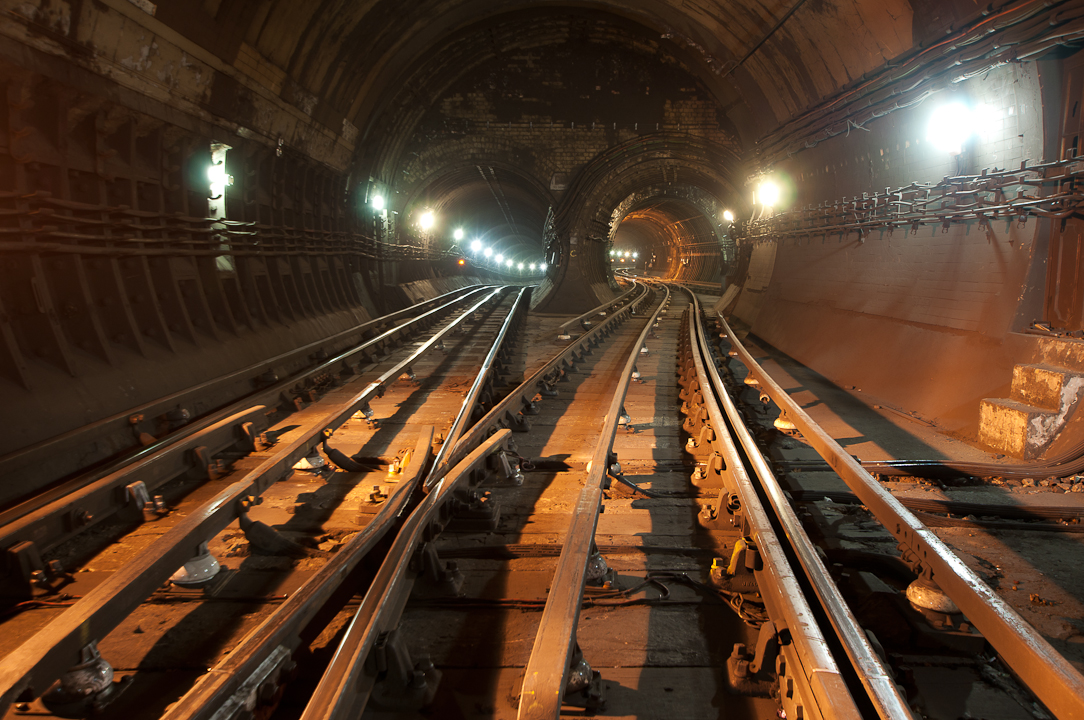
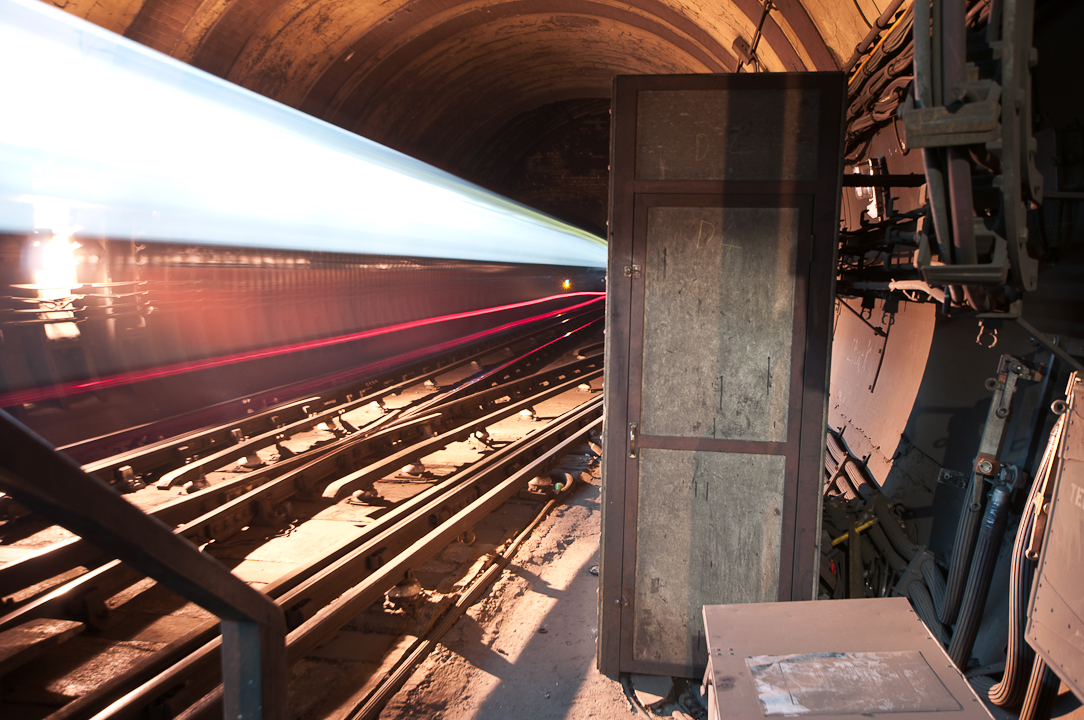
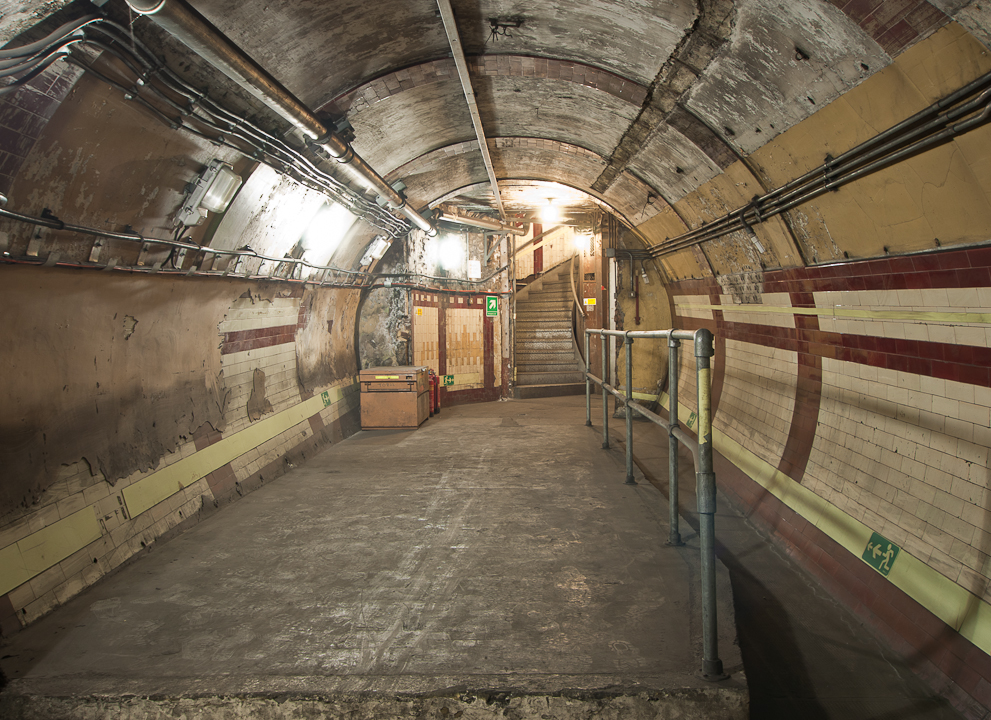
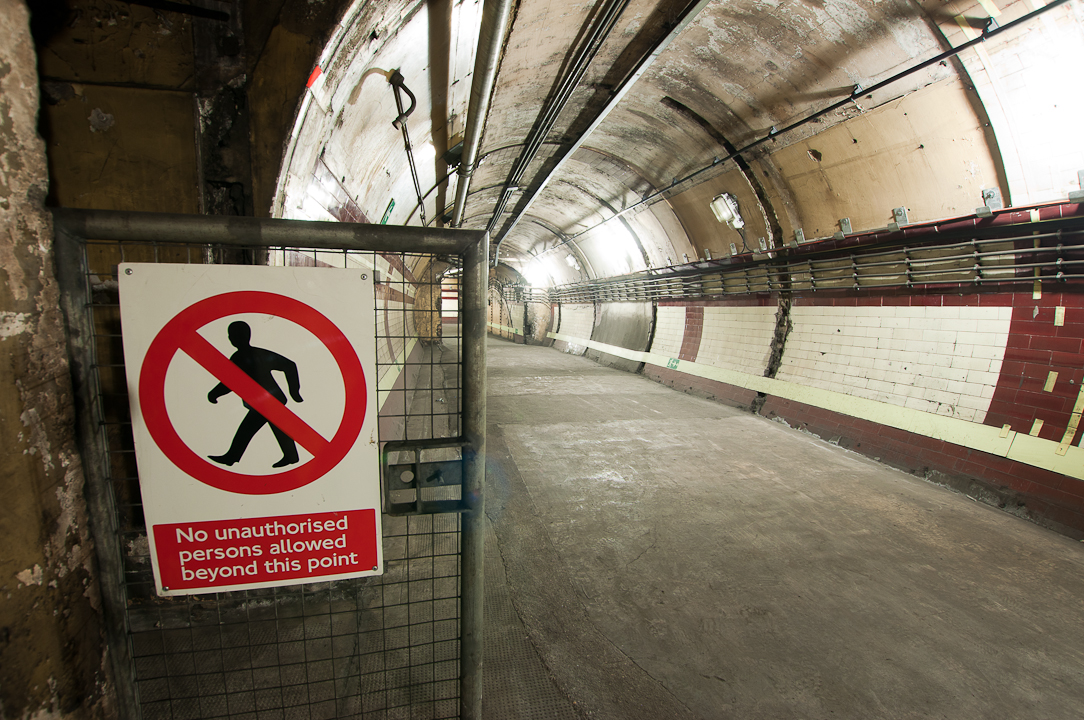
The last type of site is what you are staring at here – the Down Street Disused Tube Station. These are sites we have done but not spoken of and let me assure you, the list is pretty long. We wait patiently for anyone with the gumption to complete them before posting them. The list of those with the courage to follow us into these spaces is contrastadly short. Sometimes (as in this case) we don’t discuss the fact that we found a way to wiggle in through the cracks for months, the challenge waving in the air for all to see. Sadly, few took up the challenge here and they should have – Down Street is truly something to rave about.

The 21st of May, 1932 was the last time a train stopped at here and in 1938 the station was converted into the subterranean headquarters Railway Executive Committee (REC), set up by the Ministry of Transport. Wikipedia says this was Churchill‘s war bunker – then again, Wikipedia says that about every subterranean space in London so… meh. Since that time though, we can say definitively that this station has been seen in person by very few people in London. We are now among them. For the full stories, you will of course want to see Silent UK and The Winch, your one-stop shops for all things epic on the London scene.

Old Timey

Wiggle room

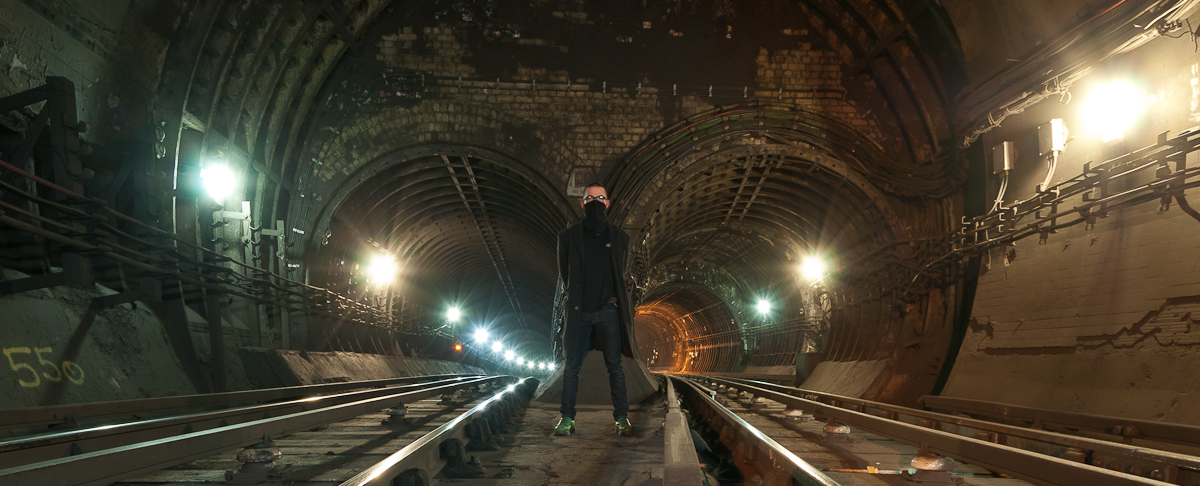
It wasn’t long ago that Team B cut our teeth on Mark Lane. It was the first disused tube station that many of us had done, despite the fact that Siologen and others on Team A had already explored a number of areas in the network. I think it’s fair to say that some of us feared Mark Lane while others revelled in it. Those of us who lapped up the adrenaline rush and became tube infiltration junkies were, and are, quite openly obsessed and as Statler once said “when you become obsessed with pushing these boundaries, you move from urban exploration to infiltration… Then it’s hard to go back.” It was the London Underground, not the sewers, that made us an infiltration crew. When we did Lords and ran the tracks up to the connecting stations soon after Mark Lane, it became clear to those of us who began taking greater risks that not only were there greater rewards to be had but that there was a possibility of a holy grail at the end – the completion of the entirety of the disused parts of the system. We had moved from exploring “sites” to exploring complete infrastructural networks.

Veering toward completion

The creation of the Consolidation Crew, the sensational collapse of the London teams between 2010 and 2011, made the completion of the goal that much more realistic. I won’t say whether we completed all of the disused stations before I left London but I will say that they are all of the third kind of tales of urban exploration – tales that will one day be told. One day the world will know that the Consolidation Crew were the first to do what no urban explorer thought possible; we reconfigured all the boundaries of London Underground exploration. As Otter writes about our cracking of Down Street, once we decide something will be done these days, the unconquerable is conquered. And as Brickman so gracefully added last night, TFL would fill their pants if they came across what we get up to on any given night. I also like to think they would respect it immensely. Only they could understand the depths of our Tube and train fetish.

A slight addiction

The truth of the matter, whether we have or haven’t completed the entire system at this point, is that we know more about the London Tube network though illegal infiltration than most of the workers in the system. We probably know their working hours better than they do. As Patch recently told me “if I’d filled my head with knowledge that’s actually useful rather than endless information about the Tube then maybe I’d have come up with an amazing idea or business model and become a millionaire by now.” I have been asked why, given how much epic shit we have been banging out, we haven’t published a photo book. The answer is simple – we are still too busy doing it!

Mark Lane happened and

It got raw

Now before this post gets too descriptive and forgets it’s on Place Hacking, let me build on our relationship with the Tube through infiltration of it’s porous boundaries by making an important connection to the work of my mentor Tim Cresswell who writes that although being ‘out of place’ is logically secondary to ‘in place’, it may come first existentially. That is to say, we may have to experience geographical transgression before we realize that a boundary even existed. And, as Statler pointed out above, once we cross those boundaries, they are very difficult not to cross at every opportunity because those boundary crossings create a personal investment in places, even we are only passing through.

Although we might be tempted to make connections to transgressive mobilites like those undertaken by the American Beats, urban exploration, as well as being transgressively empowering, also creates a city full of people invested in the places they reside (that’s us!). Urban explorers know and love cities inside and out because in many cases they learn cities inside then out. One of the divergences then from the idea of boundary transgression is the notion that rather than directly resisting, urban explorers are investing through subversion, even if those moments of investment are indebted to the modern legacy of transgression, by their (at times) complete disregard to what is socially expected or acceptable. The libertarian impetus behind much of this edgework is not to be mistaken for nihilism. Again, Marc Explo makes the point when he says “I believe we are an apolitical movement. I would not like to associate for instance with a group who protests against the waste of empty space in prime locations. I don’t think we are against the system, we’re just pointing out its limits. And as soon as the authorities realise we do the boundaries evolve and that keeps it fresh.”

Boundaries!

In these situations we go beyond asserting “I did this” by intentionally implying “you could also choose to do this” and the political implications of this intentionality lie not just in the transgressive action itself, but in the resistance of the status of passive citizens. And passivity, in this context, goes beyond abiding to cultural, societal and spatial boundaries, it also applies to the complete abolition of them. Anarchism is just as lazy as conformity. The real work, work that reveals prizes worth obtaining, exists at the boundaries of infiltration which are ever-morphing, like a Brazilian Favela.

The transition into infiltration from ruin exploration is an organic progression. Those early explorations revealed a façade of urban spectacle that we came to see as an impotent utopia of pretentions and complicities. Urban exploration is nothing less than a rejection of our enforced pact with capital in the process of questing for sites of urban tenderness, flippantly exploiting those capital investments. In these spatial reintepretations, bonds, desires and the need to find deeper communal meaning in life take precedence over the ability to create profit or to produce something. What we produce, in each of these three types of mythmaking processes, are the tales of urban exploration – some to be blown out, some to be carefully doled out at appropriate moments defined by the community, others never to be written, only spoken.

So getting back to my earlier point, as the ethnographer for the group, I am, perhaps somewhat ironically, being taught the importance of the creation of oral histories that can only be transmitted as such – histories and myths made to be shared in person. Some stories are still too rich for social media. If you ever want to hear those stories, you know where to find me – I am the one in the corner of the pub, covered in Tube dust, writing the tales of urban exploration in a caffeinated haze. Pull me from the bubble, buy me a pint, and ask to hear the stories behind the scene. These will always be the ones most worth hearing.

Until then, go forth and adventure. Be fearless. Ignore limitations. Explore everything.

Permission Taken. Cheers Kids.


Share
Tags : , , , , , , , , , , , , , , , , , , , , , , , , , , , , | 36 comments

There he goes. One of God’s own prototypes. A high-powered mutant of some kind never even considered for mass production. Too weird to live, and too rare to die.
Raoul Duke

Intentions

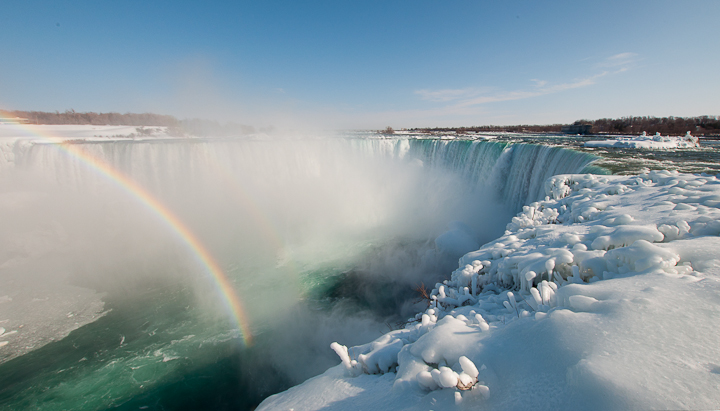
I arrived in Syracuse, NY and escaped as planned in my newly-acquired ’88 Dodge, speeding into the Canadian winter wonderland with every intention of sucking the life out of every moment that I encountered. Dressed in black, masked up, layering my thin California skin against the wrath of Persephone, I had every intention of doing what we do best – turning an idea, absurd, slippery and unmanageable, into resolute action with a resultant outcome of epicness. I know the formula. However, expressed in this way the “idea” is only an ideal problem, which in reality takes on an unsettling and radical complexity. The problem was, perhaps, in the way I had become accustomed to how our band operated; firstly in our interdependency and then in our relative immunity. Crossing the border into Canada, I screamed through like a drunk whirlwind, smoke from a California sage bundle pouring through the windows, blasting leftover dubstep which had fermented in a Tupperware container with the lid taped down so it wouldn’t spill, jumping around in the passenger seat, totally unaware that I was radically out of place. The topographical fractilisation finally evidenced itself when I pulled into Niagara Falls to stare at a tailrace now inaccessible. I have clearly underestimated the impact that seeing the Belly of the Beast sewn shut would have on my explorer constitution. Soberly drinking a very well made whiskey sour, I took a photo of Niagara falls with the other tourists and drove off to park in some farmers crop where I slept in the car, shivering and bored.

Fissure

It occurred to me in a frostbitten hallucination that the photos I took were not flatly captured do to any technical limitation but because of the lack of required investment in either meaningful human exchange at the moment of shutter release nor interesting endeavour toward the moment of acquisition. A determination as to which of these factors was leading to my disillusionment became a primary goal for the trip.

But the fear set in with the realization that the expectant fracturilisation had begun to make it’s move from spatial to psychological.  Mental processes began to take unrecognisable forms which, at times, could only be understood in moments of lucid dreaming or utopic drug visions. My PhD thesis began acting as a gravitational tractor beam, pulling me back to the mother ship as I continued to struggle toward the liberating slavery where my work could be completed in an appropriately manly fashion. This seemingly productive internal feedback loop taking me to ‘work’ however, in this context, led me to a constant sensual disenfranchisement that I had forgotten in London. The pinnacle came in Chatham, Ontario, where the car broke down and I was yanked from it by a thick-necked Canadian with a machine gun who told me I ‘had a mouth on me’. He seized the vehicle, called me in a ‘transient’, and left me standing in sub-zero temperatures with my roly suitcase. It was fucking cold.

Disillusioned

I left the burning, green fluid-spurting car with the police and escaped Canada on a boarder-hopping shuttle full of old people without event. I caught a plane from Detroit. My line of flight to Minnesota was not to be realised and I called Darlinclem from the airport, impossibly bitter. Sweet as ever, she agreed to reschedule our Subterranean Twin City rampage for the summer.

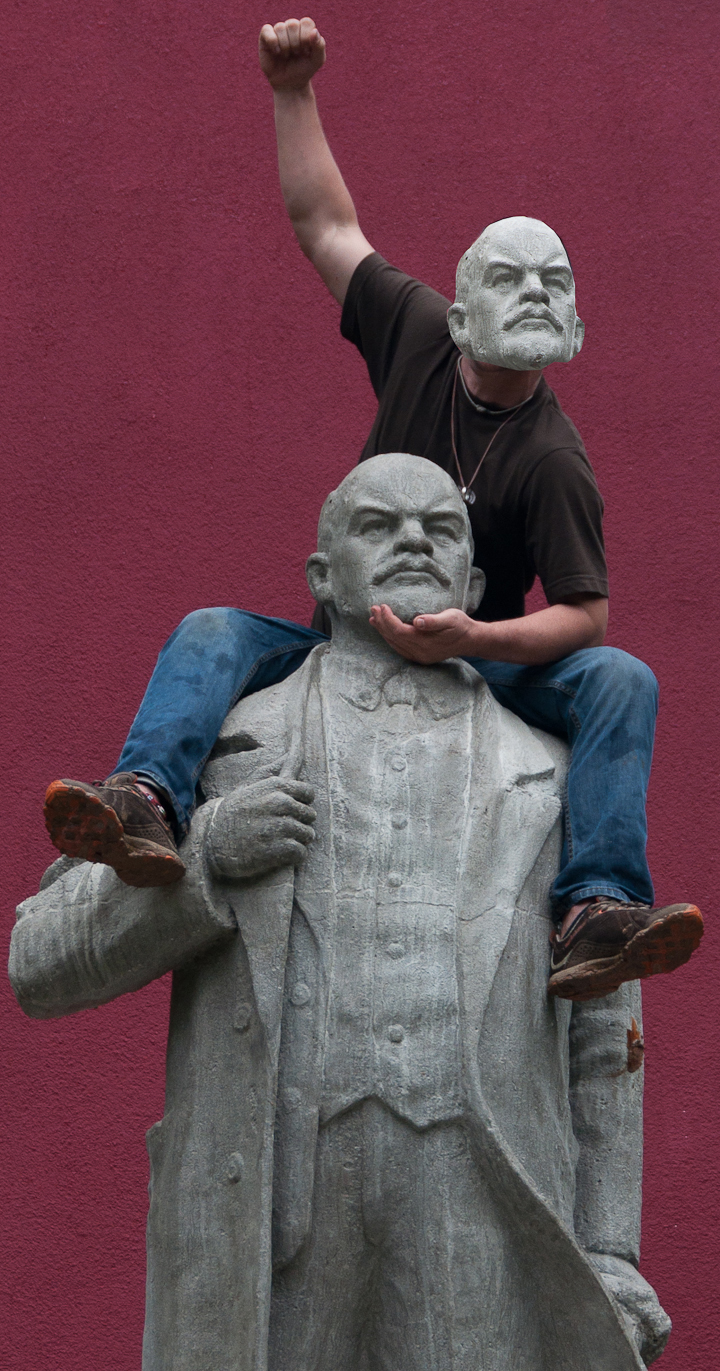
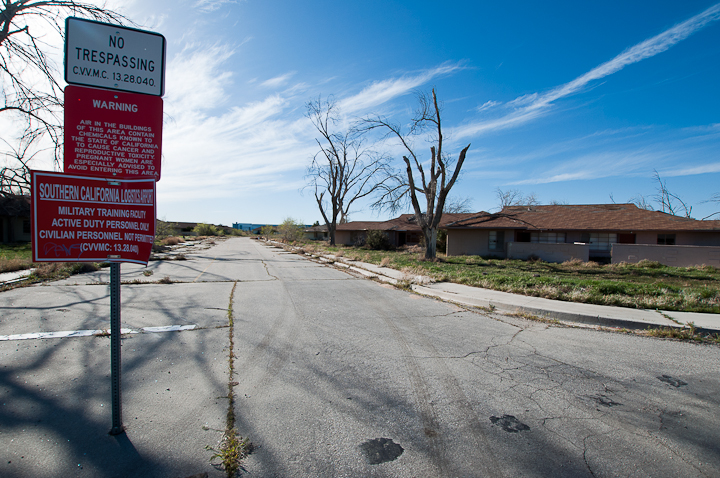
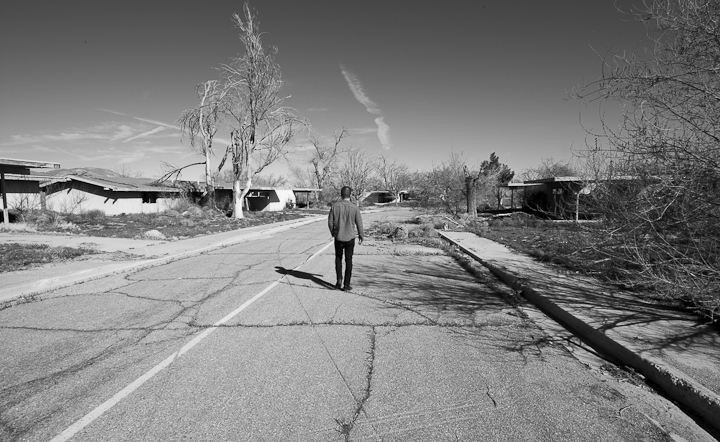
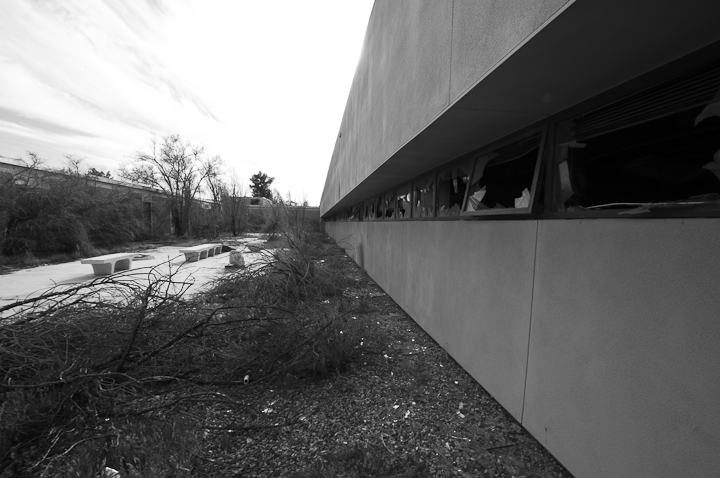
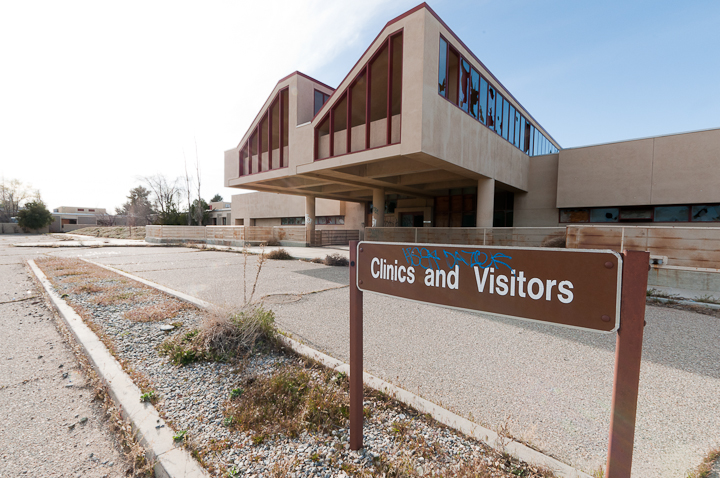
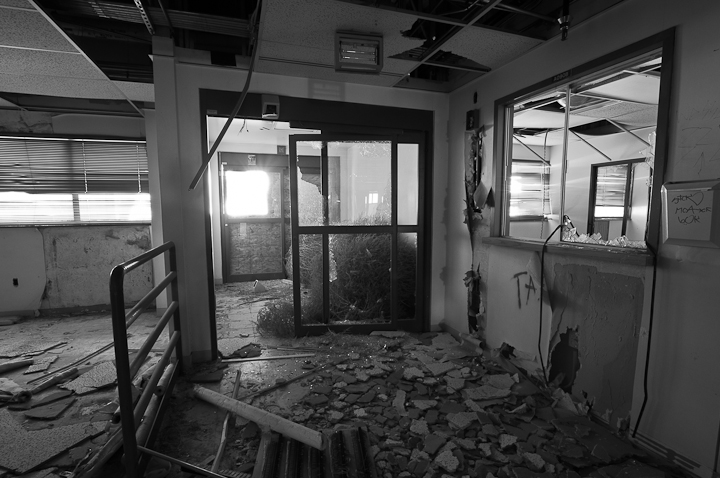
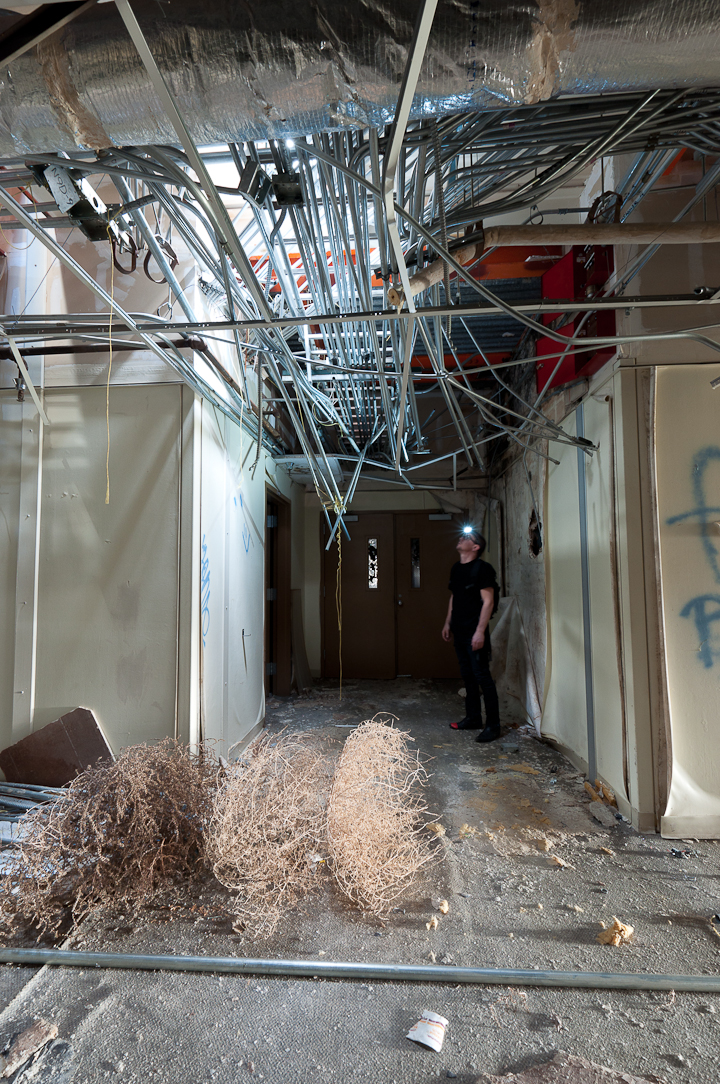
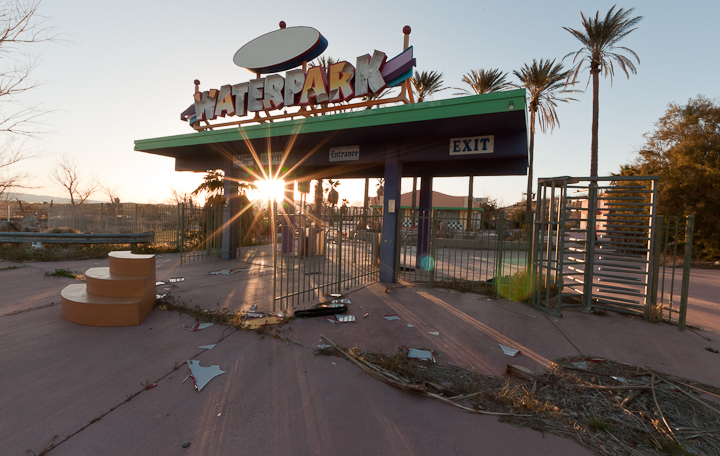
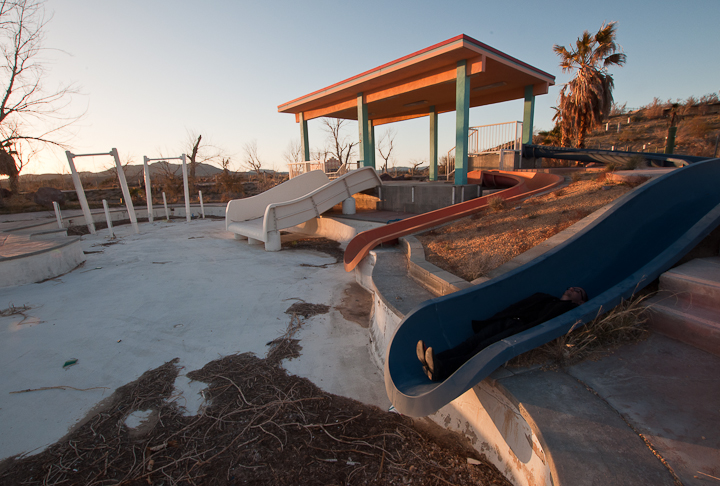
Upon arriving in Las Vegas, the suggested endpoint for my roadtrip that barely happened, it occurred to me that the required to remedy for the situation was some old school Place Hacking. A quick personal database query revealed an aircraft boneyard halfway to LA and I hit the road. Arrival revealed incomprehensible dereliction, dozens of square miles of dead planes, military housing, cinemas, shopping malls and a giant hospital now used for urban military training. All required sneaking around inside the defunct George Air Force Base, now the Southern California Logistics Airport. It felt a lot like an abandoned Soviet military base in Poland. Except for the tumbleweeds and sand. And paintball remnants. Well that and there weren’t statues of Lenin everywhere. I guess they weren’t really that similar.

Warning signs

Not that sneaky

Places

Not that freaky

I was relying on known variables here trying to rip space into time with my subtle knife, creating temporal amalgamations and fresh spatiotemporalexperiential concoctions with salt and lime. My own past was here somewhere, past the Canadian ice sheets and industrial ruins of Detroit, here in a desert full of tumbleweeds, sagebrush, jackrabbits, adobe and agave. This past had to retain it’s juvenile viscerality, that recognition that it’s articulation historically does not mean recognizing it ‘the way it really was’. It means appropriating a memory as it flashes up in a moment of danger. But the danger coalesced limply. Rather than London riot police attacking me with batons, I found overweight security guards easily converted though commiseration with their existential misery. I kept praying for military police to show up so Silent Motion would descend from a rooftop to take one in the eye with a ninja star while Patch kicked another through a wall with his famous swift boot. Everyone I encountered was so apathetic, they didn’t even care what my mission was, why I was wearing a giant cowboy hat covered in bodhi seeds or for what reason I was photographing their derelict hospital. The contrast between the furiousness of their illusions of control and the lacklustre enforcement of the stated boundaries was nothing short of disheartening. Freedom without boundaries is pointless.

I'm doing this

For no reason

Despite my misgivings, the moments of encounter between the present and the past, experienced through physically exploring abandoned architecture, uncovered that old embodied practice that mirrors the role of the archaeologist assaying surface material without deep excavation to analyse the character a place, as expected. It’s just that I undertook my surface survey of affectation by making connections more topologically than topographically these days. I successfully temporarily inhabited those sites of material history and constructed assemblages of emotional and memorial attachments that melded pluritemporal geographic, historical and experiential imagination, perhaps one day subject to nostalgic romanticism and that was sort of satisfying. But they remained, in my mind, the product of a life left behind, each composition an infantile regression. As such, I revisited those sites of old from my research, a babe suckling a solipsistic personal history missing all my favourite characters.

Still rotting

Despite it all

The only thing, as always, that remained of interest was those impossible-to-ignore topographic characteristics, those moments when I felt London was in the desert in me and that my crew could feel the Mojave through our tingling warder bond. These are the singular incorporeal constellations which belong to natural and human history, and at the same time escape them by a thousand lines of flight. I arrived in the desert where I will write our stories and found that here the radio crackles and hums with talk of evacuation zones and potassium iodide. I’m sitting here picking at my fingernails and refreshing news pages over and over to the faint scent of burning plastic and I’m in Fukushima. It is heavenly in it’s apocalyptic serenity, useless it is ineffectual attempt at human connectivity, terrible in it’s aftermath.

Lines of flight

In the end, it is the decentralization of disruptive energy created by my need to tug my thread into the desert that is causing the angst behind it all. I need it. I know that. At the same time, the media connectivity feeding me streams of information from the home I left, knowing that I am here to produce a theoretical contribution that neither I, or anyone I have come to respect by now cares much about also lingers. But more than that, it is the realisation that the dream of freedom I was taught as a child is a sham. The United States is not the land of the free, it is the land of the subjugated, the apathetic and the weak while the fight rages on in Europe and North Africa for the future world we will inhabit. My throat is dry while the deserts of the Middle East run red with the blood of a desire the population in this derelict desert has forgotten is theirs to take. And so I write.

Feels like this

______________________

Explode Everything


Share
Tags : , , , , , , , , , , , , , , , , , , , , , , , , , | 4 comments