Scattershot

Posted by Bradley L. Garrett on Saturday Jun 11, 2011 Under Academia, Cultural Geography, Ethnography, Film, Geography, Spatial Politics, Urban Exploration

I’ve got a great ambition to die of exhaustion rather than boredom.
-Thomas Carlyle
Time is a rubbery thing

The last few months, I’ve been rather entrenched in writing my PhD. With 5 chapters now done and under review, things are well on their way. However, this time for reflection during my self-imposed exile here in the Mojave Desert has also been fruitful for other writing projects, including 2 book chapters, 5 journal articles and 3 web publications. This work has pulled my attention from Place Hacking for the moment. However, I thought it might be worth rounding up what’s gone down lately in this scattershot update.

First, I was invited to write an op-ed piece for the Domus architecture and design magazine on the fragmentation of urban exploration. Essentially the article is about how an unlikely mix of media attention and marketing exploitation threatens to polarize an otherwise apolitical practice. The article can be found here. Immediately after publication, Control from the LTV Squad in New York City posted a great response which has sparked renewed discussion about the social and political salience of urban exploration as a practice. That can be found here.

In a more academic context, a few weeks ago Luke Bennett published an article in Environment & Planning D: Society and Space entitled Bunkerology – a case study in the theory and practice of urban exploration. Stuart Elden and Deborah Cowen were kind enough to allow me to respond to the article on the Society and Space blog. That response can be found here. Bennett then replies in an excellent post which is here.

Finally, Otter at SilentUK has uploaded a trailer for the film “Crack the Surface” which myself and JD at sub-urban are co-producing with him. More exciting than tinfoil in the microwave.

All and all, it’s been a heavy few months for urban exploration but I am heartened by the new debates and discussions sparking everywhere about the practical and theoretical issues around the practice. As I wrote recently to Snappel, I think that it’s really vital those of us who are willing to engage with our practice on more than a superficial level do so and, as such, I am really encouraged by the thoughtful responses from both Control and Bennett.

Urban exploration is at a crossroads right now and it is up to us which path we take. As it should be clear from these publications, I for one am not content to allow herds of ruin fetishists, bitter armchair commentators or corporations define what history will see us as. Urban exploration seethes with potential as a critical spatial practice at a time when space is rapidly constricting under the control of pseudo-apocalyptic forces manufacturing fear and distraction daily to keep desire and dissent at bay. It is my hope that through these publications and exchanges, the potential for urban exploration to sap those illusions is slowly being unleashed.

It’s time fellow earthlings. Smash and grab it. Explore everything.
With love from Sin City, USA

Share
Tags : , , , , , , , , , , , , , , | 1 comment

Paris Questing

Posted by Bradley L. Garrett on Wednesday Feb 2, 2011 Under Cultural Geography, Film, Geography, Infiltration, Infrastructure, Urban Exploration

As I make my slow pilgrimage through the world, a certain sense of beautiful mystery seems to gather and grow.
-A.C. Benson

Otter at Silent UK put together this really lovely video of our recent trip to Paris. Enjoy!

Share
Tags : , , , , , , , , , , , , , , , , | 1 comment

Sewers enjoy a special place in the pantheon of urban mythology.

-Matthew Gandy

Photo by Otter at Silent UK

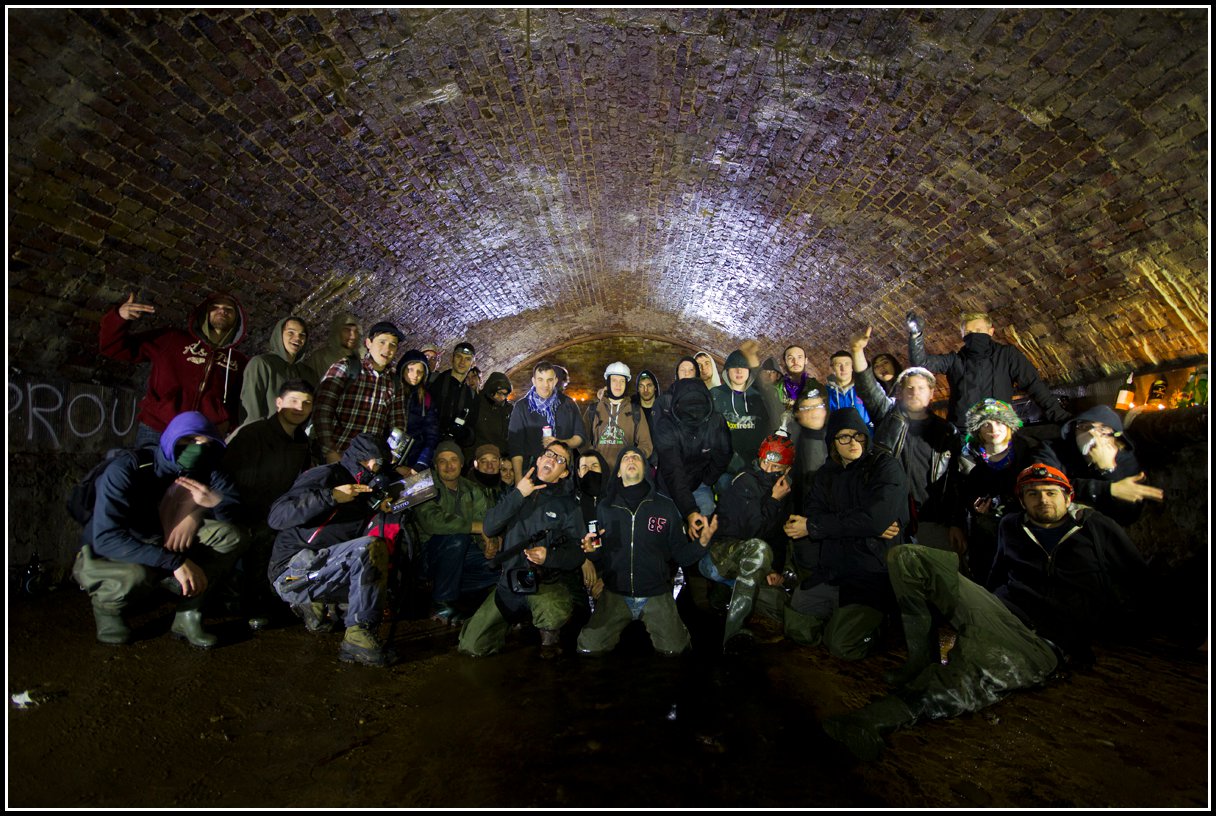
The first big event of 2011 already went down. Literally. This year’s International Drain Meet (IDM) was hosted by London, organized by Otter at Silent UK. It was the largest meeting of the international draining community in London’s history with over 50 people from 6 countries in a large overflow chamber under Knightsbridge. We had drainers from the UK, Sweden, Italy, France, USA and Australia, including the UE Kingz, Brescia Underground and the Cave Clan. We also had a heavy contingent of the massively fun Manchester drainer contingent.

We also seem to have finally melded the two top London crews at this meet through Siologen’s powers of healing oration (see below). By the end of the night, Jon Doe, the King of UK draining, conjured himself out of thin air in the middle of the party to the delight of everyone in attendance. It was, by all accounts, one of the best gatherings in London urban explorer history. A full write up can be found on Winch’s blog.

Otter was kind enough to ask me to film the event since he was busy organizing all night. Here is my contribution – it is best viewed on full screen with the volume turned up loud enough to assault your neighbours.

As always, explore everything.

Share
Tags : , , , , , , , , , , , , , , , , , , , , , , , , , , , , , , , | 9 comments

I am pleased to announce a call for papers for the 2011 Royal Geographical Society (with the Institute of British Geographers) annual meeting, 31st August to 2nd September 2011, London, England.

Moving Geographies: Film and Video as Research Method

Organised by
Katherine Brickell (Royal Holloway, University of London)
Bradley L. Garrett (Royal Holloway, University of London)
Jessica Jacobs (Royal Holloway, University of London)

Sponsored by
Developing Areas Research Group
Participatory Geographies Research Group
Social and Cultural Geography Research Group
Women and Geography Study Group
_________________________________________

Geography’s relationship with film, like anthropology, began in earnest in the 1920s when J.B. Noel filmed the Royal Geographical Society-sponsored 1922 ascent of Everest – roughly the same time that anthropologist Robert Flaherty produced Nanook of the North in Canada. Yet while Flaherty’s study of Inuit culture spurred 80 years of anthropological film development into what we now know as the discipline of visual anthropology, the Everest footage was archived and geography instead turned its focus to cinematic analysis.

In recent years, however, partly helped by technological advances offering easier and more direct access to video and production software, geographers across the discipline are beginning to use audio-visual methods in greater numbers. Yet while it is claimed that the geographical analysis of film has ‘come of age’ (Aitken and Dixon 2006) the same cannot yet be said of geography’s theoretical engagement with their value as a research methodology.

This session is looking for contributions from geographers who use film and video as a research method in any capacity, and who are also beginning to critically theorise their contribution to this exciting field. We are interested in the use of video and film in any area of geography and for any reason, whether it is part of a participatory ethnography, a tool for data analysis or activism, or a reflexive exploration of new and creative methodologies. Abstracts that incorporate an interdisciplinary approach will also be welcomed.

Possible contributions to the session could include (but are not limited to):

*Relationships between text and film
*Audio-visual methods and data analysis/collection
*Activist and collaborative filmmaking
*Participatory filmmaking
*Ethnographies of place in film and video
*Psychogeographies and film and video
*Videographic publication
*Situating the geographical film

Selected papers are expected to include a screening of the audio-visual output (max 10 mins). We aim to accommodate longer pieces of work through an exhibitive screening (on a continuous loop) elsewhere at the RGS.

Please submit a title, abstract, and any links to your film/video work to me by January 15th 2011.

Share
Tags : , , , , , , , , , , , , , , , , , , , | Comments Off on Moving Geographies: Film and Video as Research Method

Video and geography

Posted by Bradley L. Garrett on Tuesday Dec 7, 2010 Under Academia, Cultural Geography, Film, Visual Ethnography

I am pleased to announce the publication of my new article in the journal Progress in Human Geography on video and geography. Thank you to everyone who supported me in writing this article.

I would also like to announce that at next year’s Royal Geographical Society annual conference, I will be running a session with Dr. Katherine Brickell and Dr. Jessica Jacobs on this very topic. More details will be provided as they become available.

Share
Tags : , , , | Comments Off on Video and geography