Knowing is not enough; we must apply. Willing is not enough; we must do.
– Goethe

Dear British Transport Police,

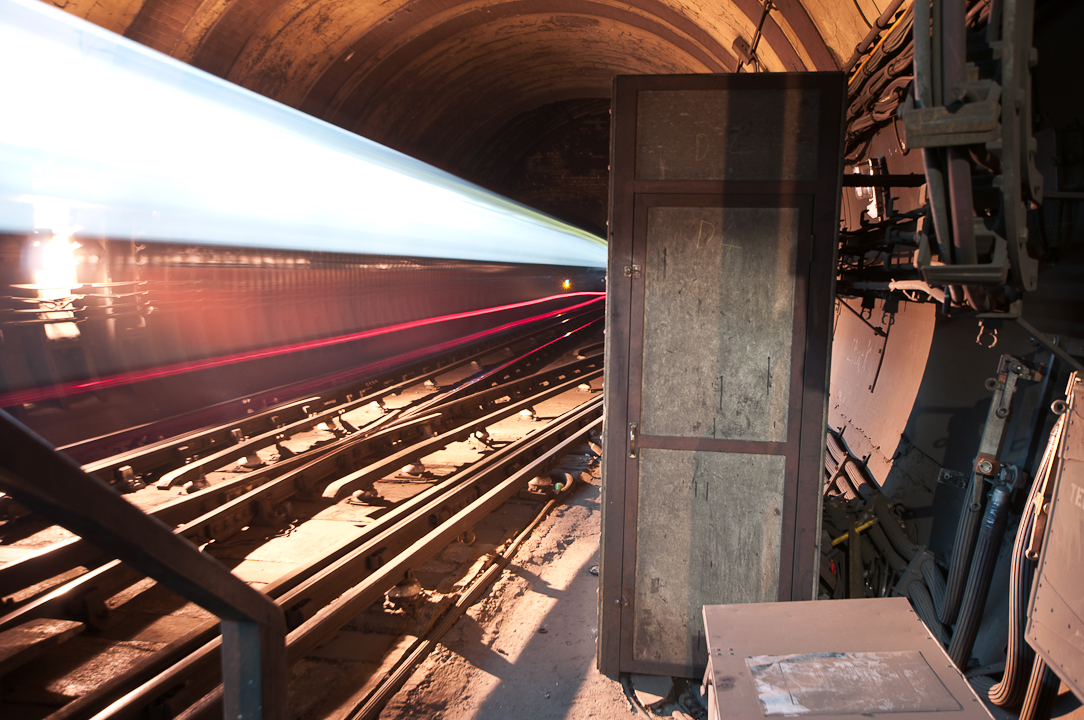
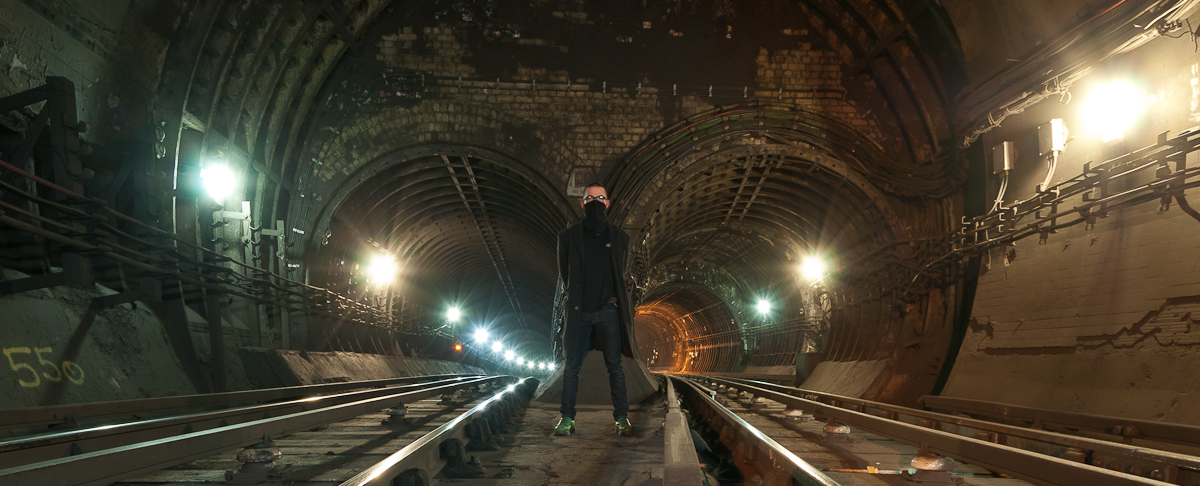
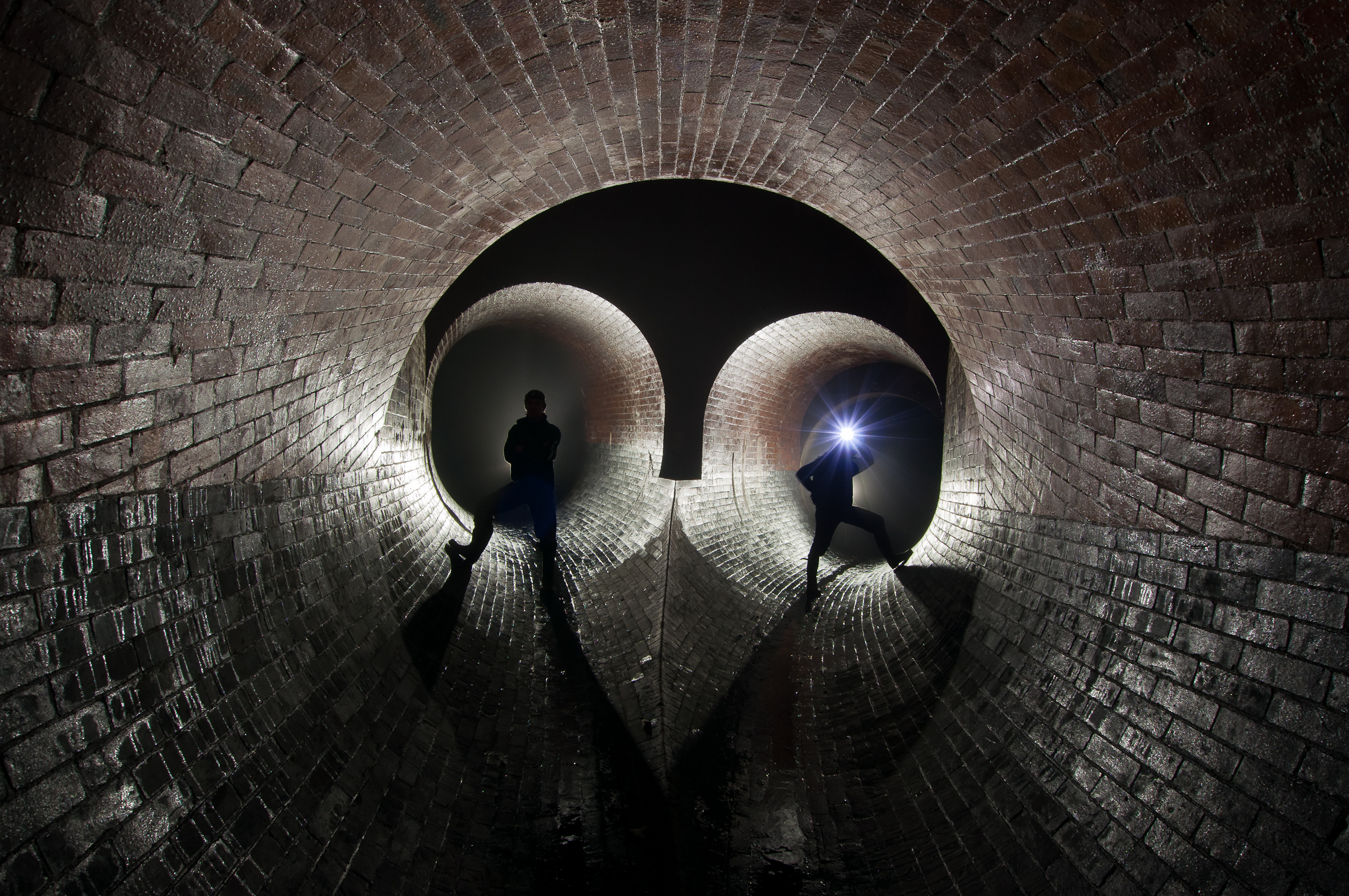
I hear that in a recent police interview, you produced 91 pages of Place Hacking you had apparently printed out from a high quality laserjet. Firstly, let me just say that I am delighted you used so much toner working toward a better understanding of how urban exploration functions as a critical spatial practice to unveil hidden parts of the city and activate little moments of urban orgasmic wonder in an age rendered increasingly banal by forces of securitisation (no offence intended). We always suspected that only you guys, and maybe some of the TFL track workers, could ever understand the depths of our tube and train fetish. Do you like to stand in tunnels and record clips like this too?

I knew it! So listen guys, just between fellow train pornographers, you arrested some of us on Easter. It was a clean bust, we got a little silly there for a few weeks running around on live lines and everything and you were pretty cool about it. But the thing is, you forced your way into my flat while I wasn’t there and you’ve been holding computers, cameras and hard drives in your offices under some sort of vague “terrorism” authority for 3 months now. I never gave you permission to come in my house and the whole thing, if I’m being frank with you, is beginning to reek of a civil rights violation. Now I’m not trying to be cheeky here but we all know that you understood within 10 minutes of talking to us that we’re just train geeks with expensive cameras. I mean Howard Stern even said we’re like Dungeons and Dragons ubernerds that took our adventures into real life. Which is pretty accurate.

Bigger

Nerds

So given all the cuts going through a wide swath of UK society at the moment, you will understand if I suggest that the funds diverted for this “investigation” are being rather ill-invested. You see, in contrast to, let’s say, Lambrini chav chicks screaming on trains which apparently happens every day, we cause far less trouble for BTP. I mean 98% of the time you didn’t even know we were in there. We were also very forthcoming when you caught us, we played fair. Tell me, have you learned anything new looking through our hard drives full of porn and pictures of trains and cranes? I didn’t think so. And in terms of the acts of “terror” you apparently think we are involved with, well the only terror we inspire is the kind that makes you think about your life and how you’ve wasted it working at a boring office job when you could have been running around in TFL tunnels with that warm, brakedust-laced air swishing around you, getting all in your teeth and jumping over the 3rd rail running from the worktrains at 3am, diving into the Japanese knotweed they never clear up. It’s not any more terrorful than, let’s say yarn bombing or throwing magnetic lights on buildings or skateboarding. Though I suppose you might consider those activities big “social scourges” as well eh?

Let bygones

Be bygones

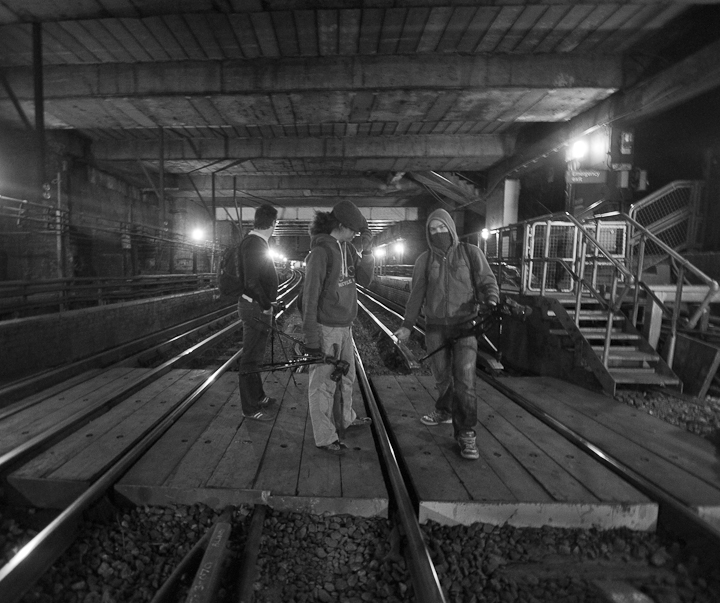
Look, I am just going to lay it out here for you BTP. We make the city more fun. We do this because we love it, not because we want to make your life difficult. Honestly, it would be better for all parties involved if you just ignored it. We aren’t doing anyone harm. In fact, it could be argued that we actually make the city safer by exposing flaws in your transportation network that a bunch of kids with bulky tripods and backpacks can sneak into – no telling what someone who was really motivated could do. Tell you what, we promise that if we ever see a “terrorist” down there we’ll brain them with a tripod okay? In the end, we are, I am sure you realise at this point, basically model citizens: active, aware, careful, well-dressed and *ahem* well-educated – not to mention the fact we’ve been running citizen patrols in the tunnels we pay to maintain (and pay you to police) for 3 years now without ever asking for a dime!

And so, in the spirit of reconciliation, taking into account all I have outlined above (as well as my many publications on the topic you also undoubtedly printed off on that crisp laserjet and enjoyed with a nice scotch), I have prepared an invoice for the work we have done exposing your network’s security flaws. I will CC another copy to your office but would appreciate prompt payment on this, given you have everything we own and we need to buy some new ropes, harnesses and bolt croppers.

Anyway, I hope you guys are having a good summer. Mine is pretty boring, just writing about all the disused Tube stations we explored and stuff. Cool thing is though, at the end of it I get a PhD. Now that, my friends, is public money well invested! Please let me know if you have any questions.

Sincerely,

The Goblinmerchant

PS. You guys should try exploring everything, it’s awesome!

Share
Tags : , , , , , , , , , , , , , | 34 comments

Although born in a prosperous realm, we did not believe that its boundaries should limit our knowledge.
-Montesquieu

Crushing boundaries

The tales of urban exploration behind the London Consolidation Crew take three forms. The first are the ubiquitous locations that we all know and love, sites like Battersea Power Station, which we blow out in public every time we sneak in, sometimes just hours later, laughing in front of our laptop screens at 4am as we plaster the photos on Flickr, daring the security to up their measures, chiding them to pick up their game. After a few weeks, we go back to these sites of serial trespass to see how security has done trying to stop us after we embarrassed them in public yet again. Inevitably, the security measures will have been changed (if not necessarily tightened) and we find (make?) new ways in. The cat and mouse game we play with the private security companies is part of the fun and we almost always win that game. I am pretty sure they enjoy it to, based on those smirks they have while calling the police on the rare occasions that they actually catch us.

We win

The second kind of location we explore can never be written about. An intimate nocturnal spatial blowout will end with a pow-wow where blood oaths are taken that “these pictures will never go public”. Although these are sometimes the most interesting sites, the consequences of revealing our presence there would likely have repercussions far more negative than positive. Marc Explo and I, walking though Clapham Common one rainy day a few months ago, had a talk about this type of adventure and he looked at me, completely stone-faced, and said “Brad, this is the only type of exploration I am interested in any more.” I couldn’t agree with Marc more, but I was concerned, given that these sites remain always “inside” the community, that our drive to undertake these explorations had become entirely selfish, narcissistic or even solipsistic. Was not the purpose of urban exploration to post, share and encourage the “dumb fuckin retards up top” (Siologen) to try something new? Wasn’t it always my contention that the purpose of urban exploration was to reconfigure geographical imaginations by visibly reconfiguring and crushing boundaries? If this remained the case, where do these sites fit into that story, given even the group’s ethnographer (that’s me folks!) will never write about them? I will return to this point – first, let me take a moment to outline our third type of infiltrated space story form.

Thirdspace

Rediscovered

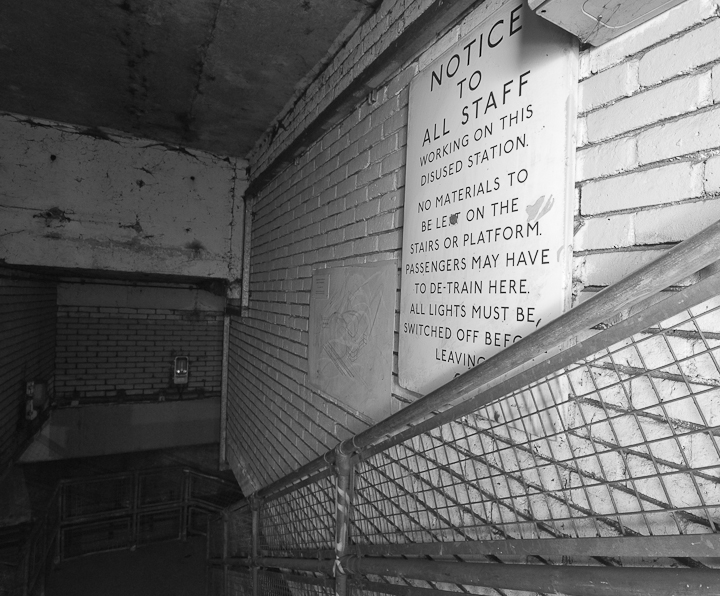
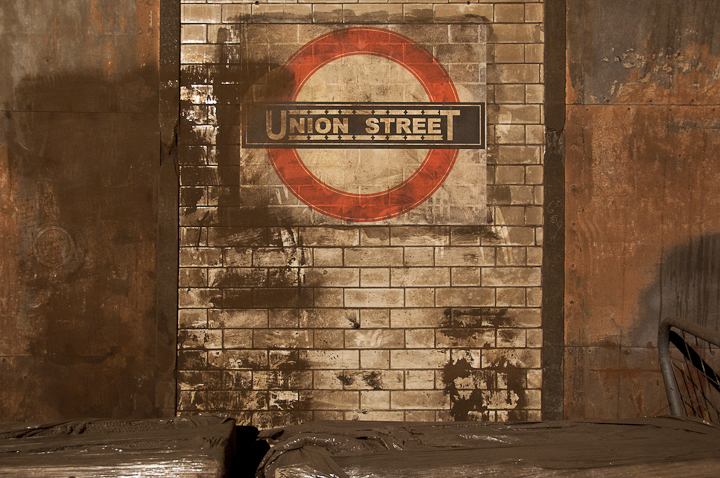
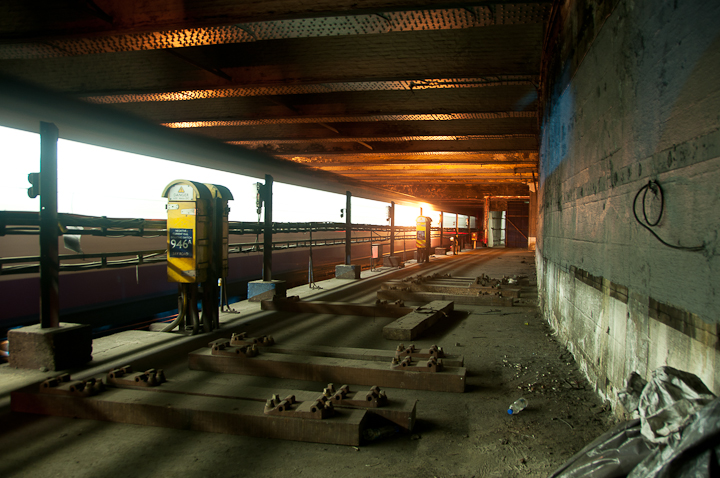
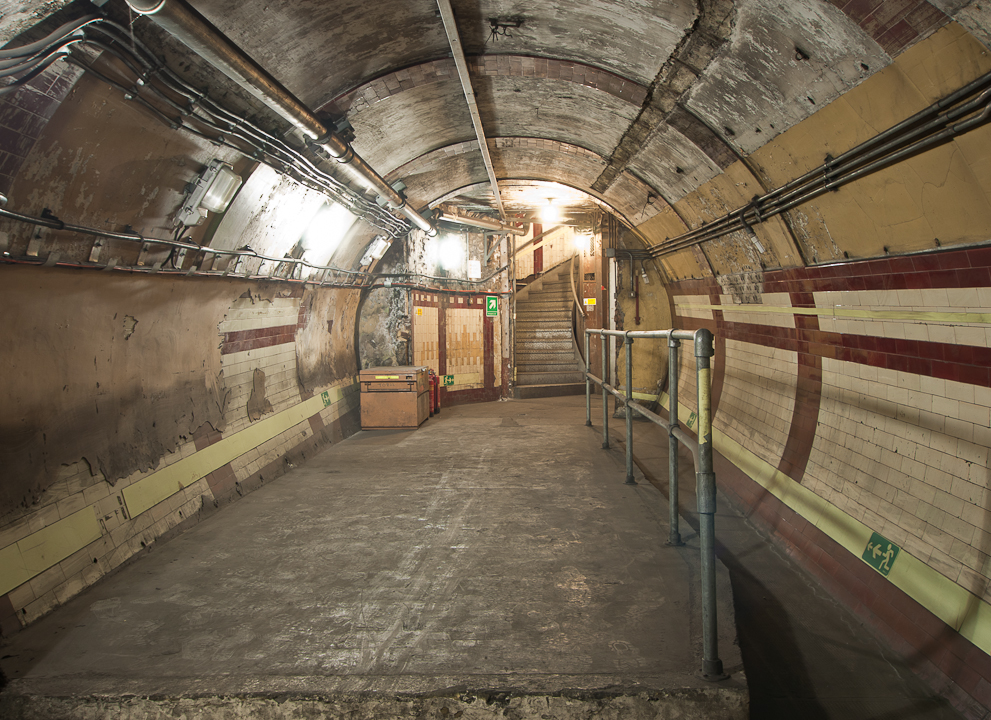
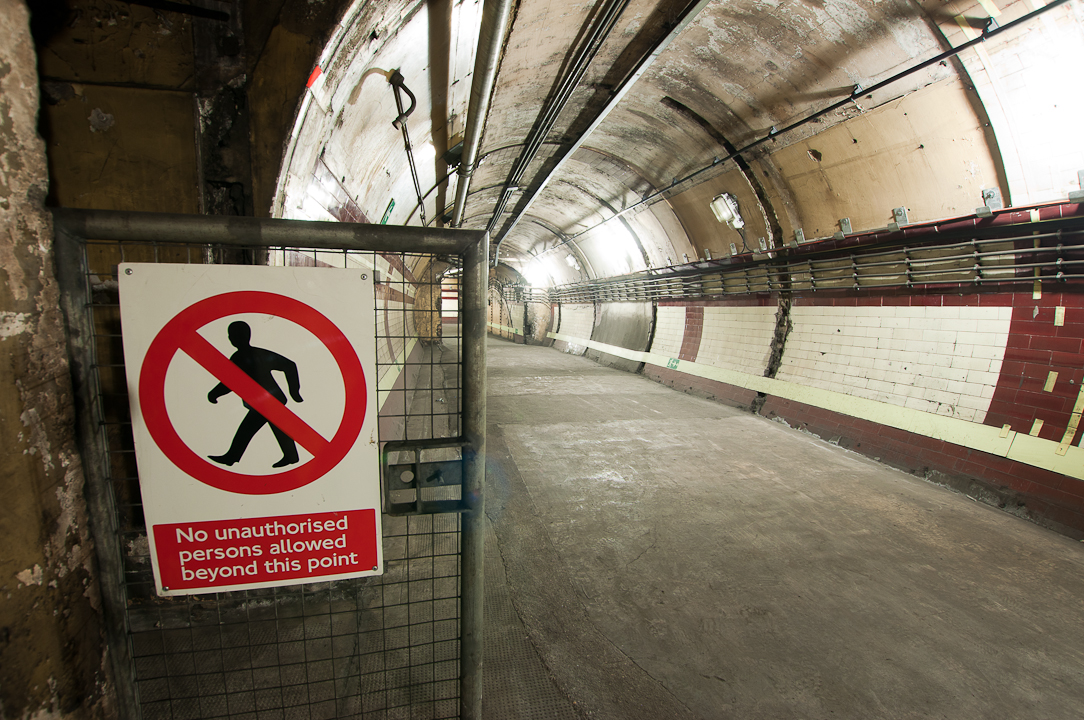
The last type of site is what you are staring at here – the Down Street Disused Tube Station. These are sites we have done but not spoken of and let me assure you, the list is pretty long. We wait patiently for anyone with the gumption to complete them before posting them. The list of those with the courage to follow us into these spaces is contrastadly short. Sometimes (as in this case) we don’t discuss the fact that we found a way to wiggle in through the cracks for months, the challenge waving in the air for all to see. Sadly, few took up the challenge here and they should have – Down Street is truly something to rave about.

The 21st of May, 1932 was the last time a train stopped at here and in 1938 the station was converted into the subterranean headquarters Railway Executive Committee (REC), set up by the Ministry of Transport. Wikipedia says this was Churchill‘s war bunker – then again, Wikipedia says that about every subterranean space in London so… meh. Since that time though, we can say definitively that this station has been seen in person by very few people in London. We are now among them. For the full stories, you will of course want to see Silent UK and The Winch, your one-stop shops for all things epic on the London scene.

Old Timey

Wiggle room

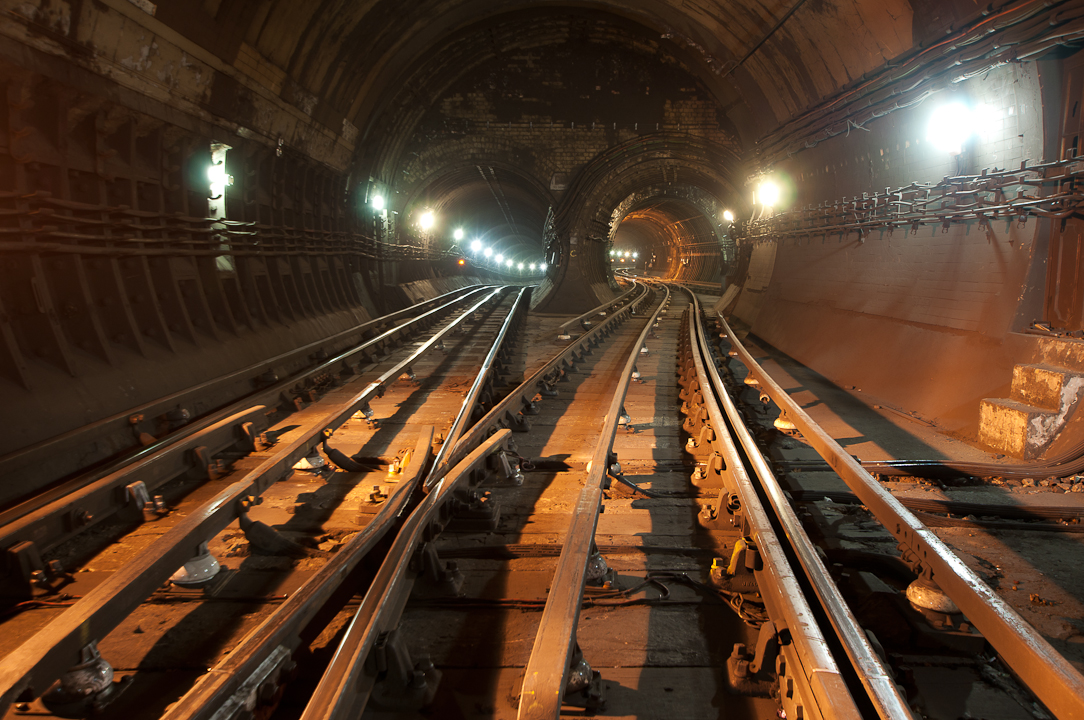
It wasn’t long ago that Team B cut our teeth on Mark Lane. It was the first disused tube station that many of us had done, despite the fact that Siologen and others on Team A had already explored a number of areas in the network. I think it’s fair to say that some of us feared Mark Lane while others revelled in it. Those of us who lapped up the adrenaline rush and became tube infiltration junkies were, and are, quite openly obsessed and as Statler once said “when you become obsessed with pushing these boundaries, you move from urban exploration to infiltration… Then it’s hard to go back.” It was the London Underground, not the sewers, that made us an infiltration crew. When we did Lords and ran the tracks up to the connecting stations soon after Mark Lane, it became clear to those of us who began taking greater risks that not only were there greater rewards to be had but that there was a possibility of a holy grail at the end – the completion of the entirety of the disused parts of the system. We had moved from exploring “sites” to exploring complete infrastructural networks.

Veering toward completion

The creation of the Consolidation Crew, the sensational collapse of the London teams between 2010 and 2011, made the completion of the goal that much more realistic. I won’t say whether we completed all of the disused stations before I left London but I will say that they are all of the third kind of tales of urban exploration – tales that will one day be told. One day the world will know that the Consolidation Crew were the first to do what no urban explorer thought possible; we reconfigured all the boundaries of London Underground exploration. As Otter writes about our cracking of Down Street, once we decide something will be done these days, the unconquerable is conquered. And as Brickman so gracefully added last night, TFL would fill their pants if they came across what we get up to on any given night. I also like to think they would respect it immensely. Only they could understand the depths of our Tube and train fetish.

A slight addiction

The truth of the matter, whether we have or haven’t completed the entire system at this point, is that we know more about the London Tube network though illegal infiltration than most of the workers in the system. We probably know their working hours better than they do. As Patch recently told me “if I’d filled my head with knowledge that’s actually useful rather than endless information about the Tube then maybe I’d have come up with an amazing idea or business model and become a millionaire by now.” I have been asked why, given how much epic shit we have been banging out, we haven’t published a photo book. The answer is simple – we are still too busy doing it!

Mark Lane happened and

It got raw

Now before this post gets too descriptive and forgets it’s on Place Hacking, let me build on our relationship with the Tube through infiltration of it’s porous boundaries by making an important connection to the work of my mentor Tim Cresswell who writes that although being ‘out of place’ is logically secondary to ‘in place’, it may come first existentially. That is to say, we may have to experience geographical transgression before we realize that a boundary even existed. And, as Statler pointed out above, once we cross those boundaries, they are very difficult not to cross at every opportunity because those boundary crossings create a personal investment in places, even we are only passing through.

Although we might be tempted to make connections to transgressive mobilites like those undertaken by the American Beats, urban exploration, as well as being transgressively empowering, also creates a city full of people invested in the places they reside (that’s us!). Urban explorers know and love cities inside and out because in many cases they learn cities inside then out. One of the divergences then from the idea of boundary transgression is the notion that rather than directly resisting, urban explorers are investing through subversion, even if those moments of investment are indebted to the modern legacy of transgression, by their (at times) complete disregard to what is socially expected or acceptable. The libertarian impetus behind much of this edgework is not to be mistaken for nihilism. Again, Marc Explo makes the point when he says “I believe we are an apolitical movement. I would not like to associate for instance with a group who protests against the waste of empty space in prime locations. I don’t think we are against the system, we’re just pointing out its limits. And as soon as the authorities realise we do the boundaries evolve and that keeps it fresh.”

Boundaries!

In these situations we go beyond asserting “I did this” by intentionally implying “you could also choose to do this” and the political implications of this intentionality lie not just in the transgressive action itself, but in the resistance of the status of passive citizens. And passivity, in this context, goes beyond abiding to cultural, societal and spatial boundaries, it also applies to the complete abolition of them. Anarchism is just as lazy as conformity. The real work, work that reveals prizes worth obtaining, exists at the boundaries of infiltration which are ever-morphing, like a Brazilian Favela.

The transition into infiltration from ruin exploration is an organic progression. Those early explorations revealed a façade of urban spectacle that we came to see as an impotent utopia of pretentions and complicities. Urban exploration is nothing less than a rejection of our enforced pact with capital in the process of questing for sites of urban tenderness, flippantly exploiting those capital investments. In these spatial reintepretations, bonds, desires and the need to find deeper communal meaning in life take precedence over the ability to create profit or to produce something. What we produce, in each of these three types of mythmaking processes, are the tales of urban exploration – some to be blown out, some to be carefully doled out at appropriate moments defined by the community, others never to be written, only spoken.

So getting back to my earlier point, as the ethnographer for the group, I am, perhaps somewhat ironically, being taught the importance of the creation of oral histories that can only be transmitted as such – histories and myths made to be shared in person. Some stories are still too rich for social media. If you ever want to hear those stories, you know where to find me – I am the one in the corner of the pub, covered in Tube dust, writing the tales of urban exploration in a caffeinated haze. Pull me from the bubble, buy me a pint, and ask to hear the stories behind the scene. These will always be the ones most worth hearing.

Until then, go forth and adventure. Be fearless. Ignore limitations. Explore everything.

Permission Taken. Cheers Kids.


Share
Tags : , , , , , , , , , , , , , , , , , , , , , , , , , , , , | 36 comments

There he goes. One of God’s own prototypes. A high-powered mutant of some kind never even considered for mass production. Too weird to live, and too rare to die.
Raoul Duke

Intentions

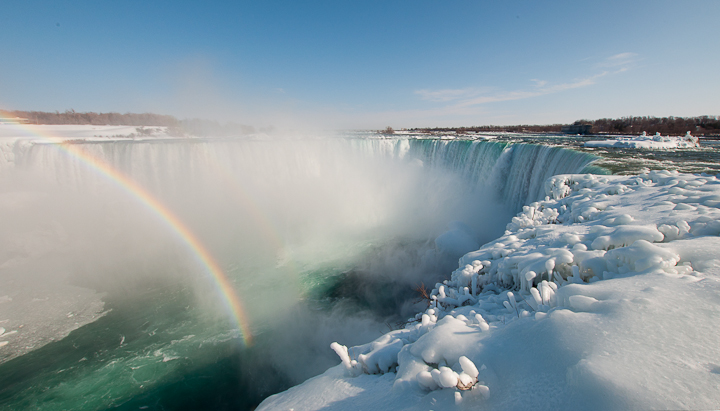
I arrived in Syracuse, NY and escaped as planned in my newly-acquired ’88 Dodge, speeding into the Canadian winter wonderland with every intention of sucking the life out of every moment that I encountered. Dressed in black, masked up, layering my thin California skin against the wrath of Persephone, I had every intention of doing what we do best – turning an idea, absurd, slippery and unmanageable, into resolute action with a resultant outcome of epicness. I know the formula. However, expressed in this way the “idea” is only an ideal problem, which in reality takes on an unsettling and radical complexity. The problem was, perhaps, in the way I had become accustomed to how our band operated; firstly in our interdependency and then in our relative immunity. Crossing the border into Canada, I screamed through like a drunk whirlwind, smoke from a California sage bundle pouring through the windows, blasting leftover dubstep which had fermented in a Tupperware container with the lid taped down so it wouldn’t spill, jumping around in the passenger seat, totally unaware that I was radically out of place. The topographical fractilisation finally evidenced itself when I pulled into Niagara Falls to stare at a tailrace now inaccessible. I have clearly underestimated the impact that seeing the Belly of the Beast sewn shut would have on my explorer constitution. Soberly drinking a very well made whiskey sour, I took a photo of Niagara falls with the other tourists and drove off to park in some farmers crop where I slept in the car, shivering and bored.

Fissure

It occurred to me in a frostbitten hallucination that the photos I took were not flatly captured do to any technical limitation but because of the lack of required investment in either meaningful human exchange at the moment of shutter release nor interesting endeavour toward the moment of acquisition. A determination as to which of these factors was leading to my disillusionment became a primary goal for the trip.

But the fear set in with the realization that the expectant fracturilisation had begun to make it’s move from spatial to psychological.  Mental processes began to take unrecognisable forms which, at times, could only be understood in moments of lucid dreaming or utopic drug visions. My PhD thesis began acting as a gravitational tractor beam, pulling me back to the mother ship as I continued to struggle toward the liberating slavery where my work could be completed in an appropriately manly fashion. This seemingly productive internal feedback loop taking me to ‘work’ however, in this context, led me to a constant sensual disenfranchisement that I had forgotten in London. The pinnacle came in Chatham, Ontario, where the car broke down and I was yanked from it by a thick-necked Canadian with a machine gun who told me I ‘had a mouth on me’. He seized the vehicle, called me in a ‘transient’, and left me standing in sub-zero temperatures with my roly suitcase. It was fucking cold.

Disillusioned

I left the burning, green fluid-spurting car with the police and escaped Canada on a boarder-hopping shuttle full of old people without event. I caught a plane from Detroit. My line of flight to Minnesota was not to be realised and I called Darlinclem from the airport, impossibly bitter. Sweet as ever, she agreed to reschedule our Subterranean Twin City rampage for the summer.

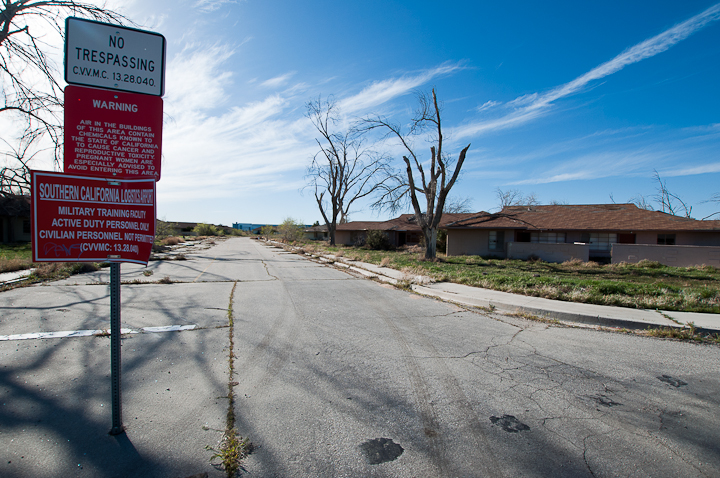
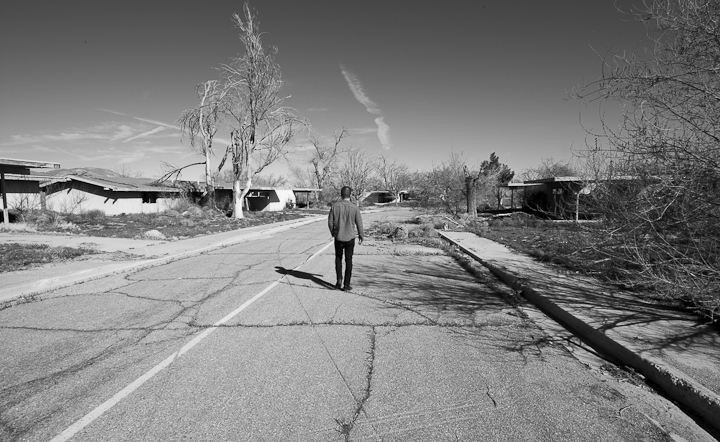
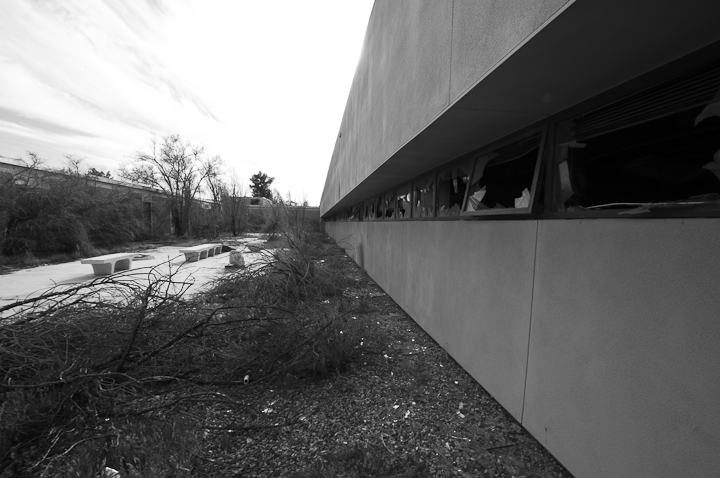
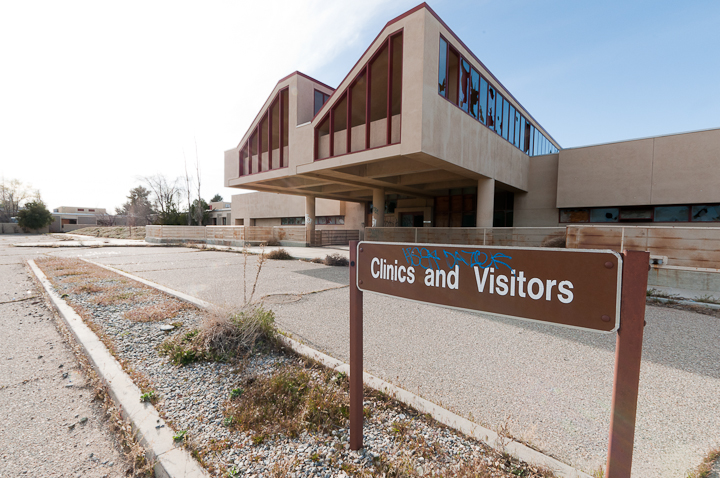
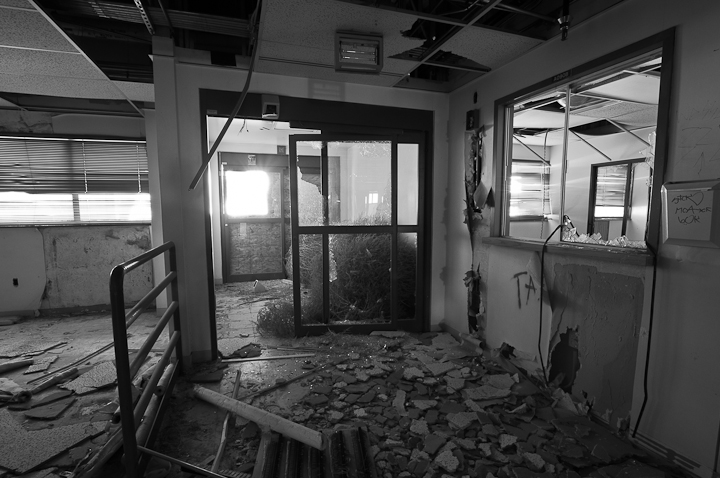
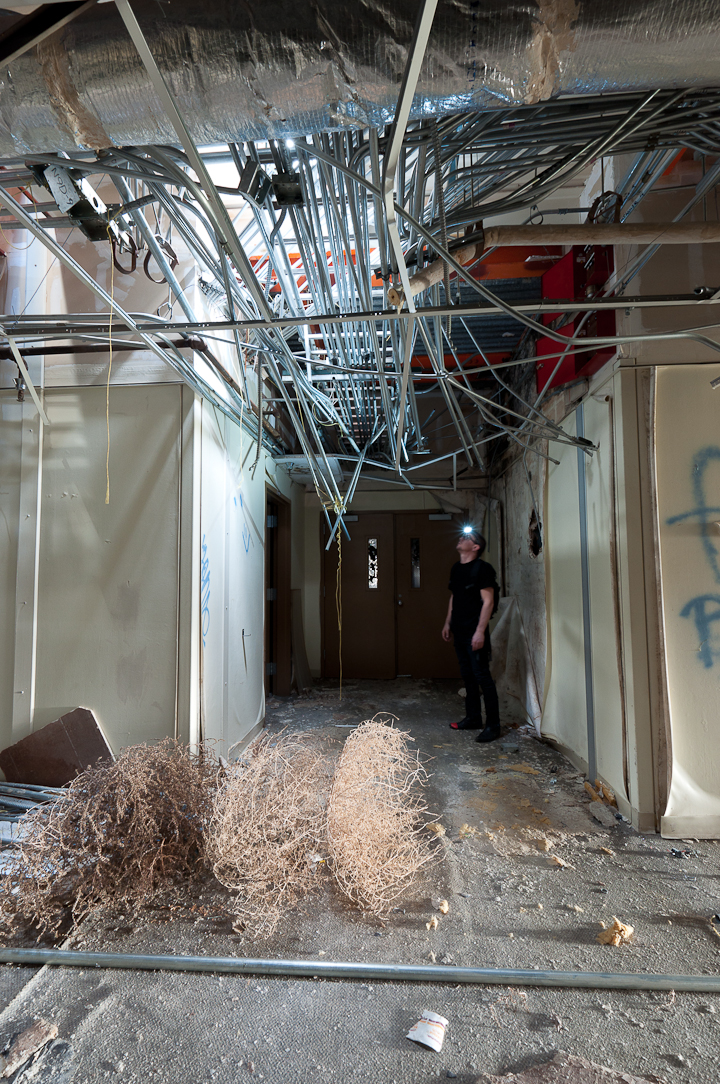
Upon arriving in Las Vegas, the suggested endpoint for my roadtrip that barely happened, it occurred to me that the required to remedy for the situation was some old school Place Hacking. A quick personal database query revealed an aircraft boneyard halfway to LA and I hit the road. Arrival revealed incomprehensible dereliction, dozens of square miles of dead planes, military housing, cinemas, shopping malls and a giant hospital now used for urban military training. All required sneaking around inside the defunct George Air Force Base, now the Southern California Logistics Airport. It felt a lot like an abandoned Soviet military base in Poland. Except for the tumbleweeds and sand. And paintball remnants. Well that and there weren’t statues of Lenin everywhere. I guess they weren’t really that similar.

Warning signs

Not that sneaky

Places

Not that freaky

I was relying on known variables here trying to rip space into time with my subtle knife, creating temporal amalgamations and fresh spatiotemporalexperiential concoctions with salt and lime. My own past was here somewhere, past the Canadian ice sheets and industrial ruins of Detroit, here in a desert full of tumbleweeds, sagebrush, jackrabbits, adobe and agave. This past had to retain it’s juvenile viscerality, that recognition that it’s articulation historically does not mean recognizing it ‘the way it really was’. It means appropriating a memory as it flashes up in a moment of danger. But the danger coalesced limply. Rather than London riot police attacking me with batons, I found overweight security guards easily converted though commiseration with their existential misery. I kept praying for military police to show up so Silent Motion would descend from a rooftop to take one in the eye with a ninja star while Patch kicked another through a wall with his famous swift boot. Everyone I encountered was so apathetic, they didn’t even care what my mission was, why I was wearing a giant cowboy hat covered in bodhi seeds or for what reason I was photographing their derelict hospital. The contrast between the furiousness of their illusions of control and the lacklustre enforcement of the stated boundaries was nothing short of disheartening. Freedom without boundaries is pointless.

I'm doing this

For no reason

Despite my misgivings, the moments of encounter between the present and the past, experienced through physically exploring abandoned architecture, uncovered that old embodied practice that mirrors the role of the archaeologist assaying surface material without deep excavation to analyse the character a place, as expected. It’s just that I undertook my surface survey of affectation by making connections more topologically than topographically these days. I successfully temporarily inhabited those sites of material history and constructed assemblages of emotional and memorial attachments that melded pluritemporal geographic, historical and experiential imagination, perhaps one day subject to nostalgic romanticism and that was sort of satisfying. But they remained, in my mind, the product of a life left behind, each composition an infantile regression. As such, I revisited those sites of old from my research, a babe suckling a solipsistic personal history missing all my favourite characters.

Still rotting

Despite it all

The only thing, as always, that remained of interest was those impossible-to-ignore topographic characteristics, those moments when I felt London was in the desert in me and that my crew could feel the Mojave through our tingling warder bond. These are the singular incorporeal constellations which belong to natural and human history, and at the same time escape them by a thousand lines of flight. I arrived in the desert where I will write our stories and found that here the radio crackles and hums with talk of evacuation zones and potassium iodide. I’m sitting here picking at my fingernails and refreshing news pages over and over to the faint scent of burning plastic and I’m in Fukushima. It is heavenly in it’s apocalyptic serenity, useless it is ineffectual attempt at human connectivity, terrible in it’s aftermath.

Lines of flight

In the end, it is the decentralization of disruptive energy created by my need to tug my thread into the desert that is causing the angst behind it all. I need it. I know that. At the same time, the media connectivity feeding me streams of information from the home I left, knowing that I am here to produce a theoretical contribution that neither I, or anyone I have come to respect by now cares much about also lingers. But more than that, it is the realisation that the dream of freedom I was taught as a child is a sham. The United States is not the land of the free, it is the land of the subjugated, the apathetic and the weak while the fight rages on in Europe and North Africa for the future world we will inhabit. My throat is dry while the deserts of the Middle East run red with the blood of a desire the population in this derelict desert has forgotten is theirs to take. And so I write.

Feels like this

______________________

Explode Everything


Share
Tags : , , , , , , , , , , , , , , , , , , , , , , , , , | 4 comments

“The city is made and made over into the simulacrum of the body, and the body, in its turn, is transformed, “citified”, urbanized…”
-Elizabeth Grosz, Bodies-Cities

Riding the stream

It’s not often that our explorations are more connected to people than places. However, on a recent trip into the Paris sewer system, we were chasing the ghost of the Parisian eccentric and urban photographer Félix Nadar. For urban explorers in London and Paris, the period between 1850 and 1870, when Nadar was doing his work, is a crucial one. During that time, both of the drain networks were built to the rough configuration in which they remain. This period was pwned by urban planners and engineers like Bazalgette and Haussmann; it was a time of radical urban reconfiguration. Nadar was fascinated by the changes and spent a great deal of time photographing the Paris catacombs and sewers (and taking aerial and erotic photos, but that’s another story), leading many urban explorers to think of Nadar, and his contemporary John Hollingshead in London, as the first drainers. The name Félix Nadar was even a pseudonym – clearly Nadar was part of our crew!

The story of four of us chasing down Nadar’s subterranean haunts last month has already been told by Otter at Silent UK – my particular interest in the man is our affinity with him as an individual interested in the intersections between the city and the body. What I mean to say is: Hollingshead, Nadar and the drainers of the world are cyborgs.

Cyborg drainer

The radical infrastructural urban transformations between 1850 and 1870 were largely due to a massive population spike that led to a Cholera epidemic. Due to long-perceived associations of subterranean space as unhealthy, unclean and evil, citizens held a multitude of beliefs that will engender an obsession with fissures, interstices and imperfect joinings [for] these are the sites of contact through which mephitic exhalations filter out.

Mephetic exhalation

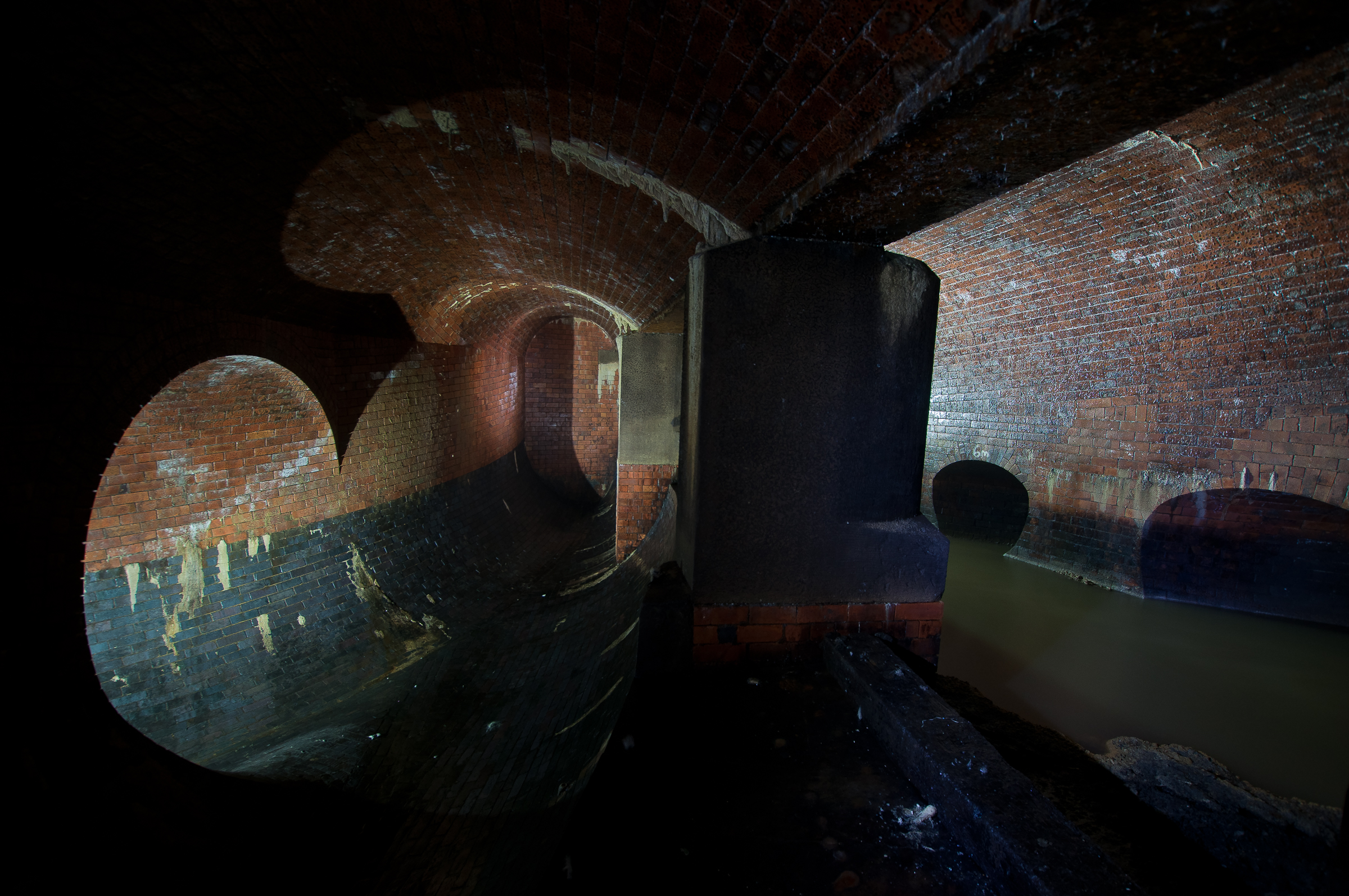
These imperfect joinings, when cracked open, were seen as analogous to a flesh wound, the broken skin now ripe for bidirectional infection, the urban body as host, the city’s innards a ripe contamination zone. John Hollingshead, whilst traversing London’s sewer system in 1861, noted that a piece of ordinary rust or of moist red brick is soon pictured as a trace of blood. The contemporary Canadian urban explorer Michael Cook is also obsessed with these pulsing interstitial nodes, though unlike the Victorians, he sees these cracks as opportunities. Cook writes on his site Vanishing Point that the built environment of the city has always been incomplete, by omission and necessity, and will remain so. Despite the visions of futurists, the work of our planners and cement-layers thankfully remains a fractured and discontinuous whole, an urban field riven with internal margins, pockmarked by decay, underlaid with secret waterways. Stepping outside our prearranged traffic patterns and established destinations, we find a city laced with liminality… We find a thousand vanishing points, each unique, each alive…

Cook’s writing hints at the possibility that the structure of the city doesn’t just “seem” alive, it is alive. If architecture and the built environment is a reflection of what we know, then it comes as no surprise that we have constructed our buildings, our cities, as corporal simulacra. At times, these similarities are rendered in front of even the casual observer. For instance, in J.G. Ballard’s novel High Rise, Mrs. Steele referred to the high-rise as if it were some kind of huge animate presence, brooding over them… There was something in this feeling — the elevators pumping up and down the long shafts resembled pistons in the chamber of a heart. The residents moving along the corridors were the cells in a network of arteries, the lights in their apartments the neurons of a brain. Mrs. Steele saw from the street in a fleeting glimpse that which is impossible to ignore once you enter urban infrastructure.

Descending into Cook’s ‘vanishing points’, we enter the city’s bloodstream and begin to witness our effects on the urban metabolism, melding body with machine. Mr. Hollingshead, our Victorian London drainer, had such an encounter while venturing into a drain under a house he once owned on the West End. He wrote that he felt as is the power had been granted me of opening a trap-door in my chest, to look upon the long-hidden machinery of my mysterious body. The connection between his own body and the drain that contained the contents of his body is no fortuitous correlation.

Bodily contents

Now, (stick with me here!) if cybernetics is, as Norbert Weiner declared, the revision of information through the exchange of information and the moments of encounter between our bodies and the urban infrastructure alter either physical structure or mental conceptions where “…the body (as a cultural product) transforms, reinscribes the urban landscape according to its changing (demographic, economic, and psychological) needs, extending the limits of the city, the sub-urban, then Matthew Gandy is right to assert that the emphasis of the cyborg on the material interface between the body and the city is perhaps most strikingly manifested in the physical infrastructure that links the human body to vast technological networks.

Older than us, but of us

Victor Hugo also wrote about Paris with the passion of one who had been it it’s bowels, leading him to declare that Paris has another Paris under herself; a Paris of sewers; which has its streets, its crossings, its squares, its blind alleys, its arteries, and its circulation, which is slime. Victor Hugo, like us, like Nadar, like Hollingshead was an inner space nanobot, a cyborg surfing the fresh.

Surfing the fresh

Sewers contain a steady stream of biological packets, full of data connecting nodes, throbbing veins, arterial chambers. The data bloodstream, like light-driven information packets, connect cyborgs, hybrid creature[s], composed of organism and machine. Beyond the designation of the cyborganism, it’s defining characteristic being a propensity to slip the net of a world structured by boundaries and enclosures to a world dominated, at every scale, by connections, networks, and flows, is a possibility for transplantation, a symbiotic bilateral exchange of potentiality. Here, the boundaries between the organic and the inorganic, blurred by cybernetic and bio-technologies, seem less sharp; the body, itself invaded and re-shaped by technology, invades and permeates the space outside, even as this space takes on dimensions that themselves confuse the inner and the outer, visually, mentally and physically where “thought-as-imagination’ departs from the actual, dips into the fractal abyss, then actualizes something new. What is it that is new here you ask? Well nothing more than an animation of the inanimate, a tangible hauntology, an acknowledgement that building forms spring out of historical contingencies – but, given enough time, they may create their own form of subjectivity. Drains are material manifestations of our dreams (including nightmares) but also regulators of our physical potentiality and protectors of the realm in glistening armour.

Draining subjectivity

Before the accusations of theoretical posturing ensue, let us reinforce the role of embodiment here, (under)grounding the theory. Bookmarked in each photo we snap are moments of not just conceptual but actual encounters that take place between urban bodies and urban infrastructures, leading to the designation of urban infrastructure as urban body. The result of those bodily encounters is the construction of those webs, flows, and exchanges that create communities, ideas and cyborganisms. The actual hand-wrought work of constructing and deconstructing that fabric reveals a physicality conjoined with virtuality that is anarchic [in it’s] non-identical proliferation, where the everyday urban inhabitant embeds personal investment into the infrastructural networks, inscribing places through place hacking. The city is a reflection then not only of the physical body but of the sprawl and limitations of human consciousness and ability, potential now augmented by the machines we have created. Urban infrastructure, although restricted by capital investment and spatial constraints, is also constrained and fortified by a human imagination of the deepest chaotic order, it’s operation and moments of rupture as fragmented as urbanity itself. If only we could imagine alien body infrastructure concocted under the influence of Burroughs’ Mugwump juice, then the monstrous resultant fragmentation might finally lead to the schizophrenia we need to proceed.

Elizabeth Grosz argued, in 1996, that computers would change the way the city was structured as we built infrastructural systems not modelled upon machinery but upon virtual systems. However, were not both mechanical functions (compare the piston and valves of the heart) and cybernetic circuitry (the CPU as brain) both modelled on the body? Does not the evolution of those artificial bodies influence our biological bodies (for instance, consider the effect of indoor plumbing on the body)? Does the beautiful conjunction of those bodies and spaces, industrial machines as appendages, computer hardware as corporal augmentation, not create new hybrid bodies which will influence the infrastructure of cities? Will those imperfect joinings that the Victorians feared infect and augment through their mephetic exhalation as promised? If Grosz is right, then the body’s limbs and organs will become interchangeable parts with the computer and with the technologicalization of production.

Bloodstream nanobots

The Paris catacombs are perhaps the best Western example of the meld to be expected – a place where humanity has become intricately interwoven into the subterranean infrastructural fabric. Paris culture would undoubtedly suffer with loss of access to those spaces, a co-addictive symbiotic relationship has been built there. The KTAs are proof that just as virtual social systems can be maintained by the multitude, so can physical space. The symbioses is even more profound in places like India where infrastructural space is living space, in Poland where we saw people moving into military ruins or in Cambodia where people are living in graves. Despite arguments of  deterritorialisation, the visual, aural, sensual representations created on explorations and residencies in those spaces creates a new emotional cache which can be tapped into for myth-making practices, practical application such as sabotage and, increasingly, simple imaginative stimuli that reterritorialise those spaces with a potential that feeds not only physical constructions but imaginations. As a result, the virtual and physical aspects of urban exploration are inseparable as one network depends on the other. Urban exploration, despite it’s weavings into the mythologies of the sublime, is not an escape from nor a transcendence of the physical, but a challenge to the very boundaries of substance dualisms.

Investment

The city is more like a sponge than a solid mass of paved streets and architecture, more like a body than a machine. There are sinkholes; the surface is porous. The conductive material urban fabric facilitates an emotional flow, the bloodstream becoming a conduit for sublime affectual registers in immeasurable doses. Overdose always being a possibility, we teeter on the brink, doing our edgework. We leave horribly hung over and come back again and again, our tolerance for exposure to the pain of the cyborg meld growing each time, our possibility for transcendence growing with each descent.

But what of the opposite exchange on the symbiosis? Returning to our colleague Félix Nadar – how did his photographs influence the function, form and representations of that Parisian bloodstream? How do the technological accelerations that allow myself, Winch, Otter, Marc Explo and countless other explorers to recreate Nadar’s work and spin replicative experiential simulacra, in distinct imbricating temporal iterations, begin to mutate those systems? We know it to be true and this is where the accusations of urban exploration being primarily a spectator sport fall flat. Urban exploration can never be purely representational or apolitical. Our work, just like those drainers of 150 years ago, create open systems where they once were closed. Urban explorers reveal the framework and recode the urban landscape daily. Drainers reveal not only the cracks and gaps that exist through the representations they produce but expand those cracks and gaps through repeated exploitation and exploration. Urban exploration and draining realises potentials for cyborgian conceptions of the city to emphasize the continuing political salience of the public realm. Predator’s call for public access to public works is a call for open source urban coding. Where the environment is written in closed code, we’ll hack it until it’s open source again.

Where do we go from here? If we think of urban infrastructure as a tangible network of cybernetic organs, we must then assume the evolution of the information city to be, increasingly, a body without organs, a cloud-computing bot. Inevitably then, if form follows function, human bodies will shed organs just as the city inevitably will. Instead of injecting ourselves into the bloodstream, we will collapse the veins, and our synthetic dreams, rather than our synthetic physicalities, will become the new sites of exploration. We must prepare to kill our darlings.

It's still sublime isn't it?

It is time. Explore everything. Blow the veins.

Share
Tags : , , , , , , , , , , , , , , , , , , , , , , , , , , , , , , , , , , , , , , , , , , , , , , | 3 comments

Your hearts know in silence the secrets of the days and nights. But your ears thirst for the sound of your heart’s knowledge. You would know in words that which you have always known in thought. You would touch with your fingers the naked body of your dreams.
The Prophet

Urban dreams

Part I

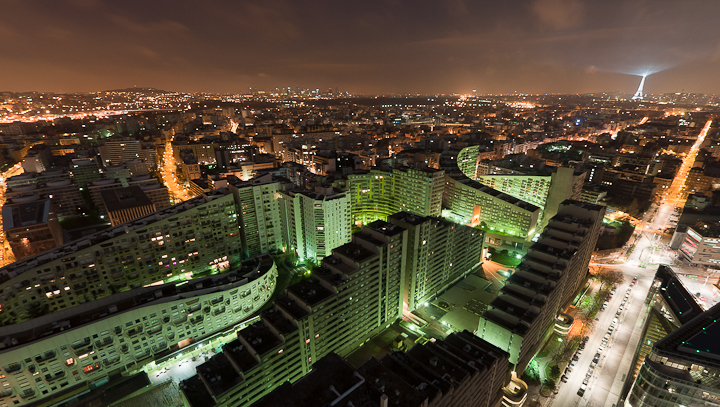
Desire was everywhere when we stepped of the plane at Charles de Gaulle. We nipped and yelped, scurrying into the city wearing rags and muddied bags, dragging tripods down the walls of Métro tunnels like Freddy Krueger. The thirst, after weeks of depraved scholarship, endless perverted workdays and inert meetings over coffee, had concretised into the force of a tsunami. The wave broke at times around tall objects, splitting and climbing for a moment before splashing down again in a liquid slump of ecstasy. At other junctions, it snaked into infrastructural gaps too small for bodies. We followed the water to find the glitches in the system, trying out various keys and tools for which the original intended purpose was never understood, lost artefacts from another time, rediscovered by our nomadic band of forgotten disciples. We bled and drank, crawling into our sleeping bags when we could smell the bread baking, the delicious olfactory beacon warning us the City of Light had switched on for the day.

Depraved

Everyday life is a life lived on the level of surging affects, impacts suffered or barely avoided. It takes everything we have. But it also spawns a series of little somethings dreamed up in the course of things. Exploited, those affects, glitches, errors in lines of code, paired to the desires to find them, become the preeminent domain of the urban explorer, the skateboarder, the street artist and all children while they are still conscious, before society rapes them into submission, huddled in the corner of an overcrowded classroom where they are forced to recite the national anthem over and over again.

Desire wasn’t purchased, nor did we try to sell it. At the same time, it was a profitable endeavour, an investment in the communication of the incommunicable, a necessary departure from direct economic production. Urbanity is codified by a set of rules which creates spirals of economic ‘prosperity’, where relentless velocity must be maintained to preserve the perpetual accumulation of wealth, resources and labour. The result is a system which reproduces itself in ceaseless iterations like a demonic fractal art project, even (or even especially) when those accumulations are superfluous or unnecessary, until it pops.

Juxtapositions

The result? An endless stacked stratigraphy of miscommunications, abortions and aberrations, interminable confusion about what could and should have been, sparkling smiles as the successful accumulation is directed into personal coffers, suicide from bridges where it does not. What sprawls all around us everyday, whether we are in London, Milan, Paris or Los Angeles is a capitalist monstrosity that regrows heads as you slice them off. Our only advantage against this unkillable and utterly beautiful beast is its immensity, for it is this very horrific attribute that allows us to run underneath unnoticed while it spews poison in the Siene.

Endlessly fractal

Part II

“Ah! Paris! What a beautiful city, don’t you think?”
“I don’t give a shit, what I wanted to do was ride the Métro.”
Zazie dans le métro

Rails

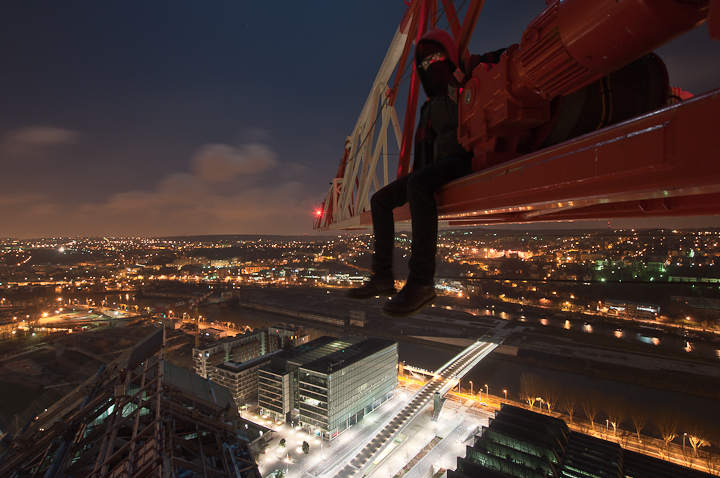
At its best, capitalism encourages a kind of generalised schizophrenia, a shatteringly intense fracturing of subjectivity. On the other hand, to survive it has to contain these effects through oppressive fictions like the nuclear family and psychiatry, which attempt to ‘reterritorialise’ desire: to put it safely back inside the home and to keep it there. Night after night in Paris, on this trip and others, we took the secret desires from home and mind into streets and practice. While the Marxists sit in Starbucks with their coffees crying for the overthrow of the system and the anarchists fight each other in squats, condemning comrades as sexists and fascists, we create desire. We are coercive machines that produce breaks and mobilise flows, nude in sewers, hanging from cranes, in love with the endless accelerations of material layering that keep cracking open underneath the weight of 6,869,652,772 human bodies.

We are the result of inevitable urbanic schizophrenia. While the dragon spews its poison, wagged by its own tail, we urinate on its leg, chuckling as our playfulness conjoins deterritorialised resources and temporarily appropriates the surplus from their reterritorialised conjunctions in nice little packages of pixels to print and mount illegally in the New York Metro. To each moment, we cling with all our heart, knowing it is unique and irreplaceable – and yet we wouldn’t lift a finger to prevent it from being annihilated.

Insert human here

As Dsankt told me while we wobbled toward each other in some subterranean dungeon, until you get over that initial dereliction fetish and prepare to let all things come and go, you haven’t found it yet. So as each sparkling moment expands toward the implosion we all know is coming, we feed the system. And when the engorged stomach lining finally tears, we will climb inside it’s dead body like Luke Skywalker penetrating his gutted Ton-ton and become enlightened.

Glitch

Each epoch not only dreams the next, but also, in dreaming, strives toward the moment of waking. It bears its end in itself and unfolds it with ruse. In the convulsions of the commodity economy we begin to recognize the monuments of the bourgeoisie as ruins even before they have crumbled. Now that it’s all over and I am back here stewing in my own filth writing this PhD thesis in a nostalgic dispassionate embrace, only one thing is certain: the spiral will start churning again; the unstoppable desire to take our love to the streets will build, little seeds of speculation will begin to sprout, phone calls will be made. And we will go again to slide into urbanity’s womb and fertilise unfathomable nightmares born from the passion of those tiny glimpses we are all so apt to ignore. We will play, in this form and others, in imaginative permutations of superhumanity that don’t yet exist, again and again, until we are dead.

When it's over

_______________________________

A thousand blessings to Marc Explo, our tireless host. Thank you also to Winch and Otter for your brotherly companionship all weekend and to Olivier, Kat, Dsankt and Mrs. Dsankt for the wonderful dinner and champagne, delightful conversation and company as we climbed through sewage to get to a bridge.

Share
Tags : , , , , , , , , , , , , , , , , , | 11 comments