You give a man his daily bread so that he can be creative and he just goes to sleep; victorious a conqueror grows soft, a magnanimous man turns miser as he gains in wealth.    -Antoine de Saint-Exupéry

Are we at the top of the ladder or at the bottom of a new ladder?    -Silent Motion

Saddle up for

On our recent ProHobo trip into Europe, lovingly (if in the end somewhat flippantly) referred to as 3.0: ProhoBohemia, we pulled back from the infrastructural infiltrations that have become our daily grind here in London and went looking for ruins again. Coming back to ruins was like returning to a pleasant dream.

Magical realism

In our hired car, which we intended to push 3300 miles into Poland, our most ambitious trip to date, we cut through the corner of France as we have twice before and headed into Belgium. After a brief climb up a notable public building in a major capital city, we crept into an old train yard to spend the night. As you do.

Industrial nights

We woke up early full of enthusiasm and over the next week, we moved through Europe like a storm with an efficiency built over the course of three trips to the continent over the past year. We knew the sites we wanted to hit, we knew how to avoid security where necessary, we knew what to pack and, more importantly, what not to. We had, in fact, taken being temporary nomadic vagabonds to a whole new level. During the trip, we read passages from Tim Cresswell’s book The Tramp in America where he discusses the work of homeless-turned-Chicago-School-sociologist Ben Anderson. As we came to the realization that we could all likely keep this nomadic lifestyle going for a very long time (if not forever) I couldn’t help but think that we were working the other way around – there was a real possibility, is a real possibility that we could in fact drop it all and live like this indefinitely.

Probo

Looking for

Pure living

But the further East we went, the heavier our bourgeois baggage became. As we crossed the border into Poland, the car was filled with excited cheers quickly followed by confused murmurs. While the landscape here offered what we have come to expect from Europe – endless ruins – we found ourselves confronted with a place in which the relationship to derelict space was entirely different.

Secular

Imaginaries

Remembered

Here ruins were spaces not of bounded exclusion but of potential utilization. After driving for hours through a forest hunting for a soviet base called Keszwca Lesla, we arrived at 10pm to find rows of buildings, clearly Soviet-built, surrounding an undecipherable war memorial that looked like our standard fare with the addition of satellite dishes hanging off the sides of buildings. It seemed the local population here had turned this place into a summer holiday encampment after the collapse of the USSR and the abandonment of the base. Gangs of teenagers roamed the streets late at night in track suits and mullets, running in and out of the derelict buildings and bunkers. Inhabited buildings looked derelict, folding them right into the fabric of a lived landscape. There were no fences or security to be found, no rules, boundaries or exclusionary practices in evidence. It should have been paradise for us. Except that things felt different here.

Clearly

Something else

To be found

As we moved on from this site, we became more brazen, braving the sullen stares of thick-necked Polish men who could clearly throw us across a room to run in Soviet concrete blocks, shutters snapping. But what we captured in these places looked less like the western notions of the aesthetic sublime than we were accustomed to encountering and more like the war-ravaged Chechnyan ruins depicted in The 3 Rooms of Melancholia.

USSR

Afloat

No more

Site after site, I kept feeling that something was different here, something was missing here, but I couldn’t pinpoint it. It was something missing beyond a buoyant economy and door frames.

And then it hit me. It was nostalgia. As David Lowenthal writes, ‘nostalgia is memory with the pain removed.’ There wasn’t a hint of nostalgia to be found here. No one cared about stripping soviet blocks of all they were worth because they were still in pain here. It was probably, rather, a delicious catharsis to smash out those windows and excavate the rusting hunks of artillery from the ground.In the same way that we, in London, feel a need to write our own stories of places and to define our own boundaries for space, the Polish people who lived under communist control probably felt a need to assert their rights to newly reclaimed space by destroying the remnants of control that the Soviet Union has exerted over them for so many years. Like Scipio Africanis at the end of the 3rd Punic war, the only thing that would satisfy the pain of generations of struggle is to do everything possible to erase the memory of that pain, razing the buildings and sewing the Earth with salt.

The heritage manager in me is terrified by these ideas but the anthropologist and geographer in me tells me I have no right to dictate how others should interpret and interact with their places. We can’t know their memories; we can’t know their pain.

Pain

Lived

There a was a particular guilt that came with exploring Poland.  I think that guilt came from the clashing of different value systems in regards to derelict space. Perhaps it is an indication of a larger clash between capitalism and communism. Where east meets west, desire meets utility, nostalgia meets future promise and mobility meets placemaking. We all knew we brought the West with us and we all knew, deep down, that the social conditioning that resides in those templates can never be erased.

While we didn’t necessary find the ruins we were looking for in Poland, we did find a meeting point on that shifting frontier of Western values that is pushing its way inexorably East, met not with open arms but with suspicious stares. After what Poland has been through over the last 100 years, who can blame them?

Easterly

Share
Tags : , , , , , , , , , , , , , , , , , , , , , , , , , , , , , , , , , | 1 comment

Lurking in the Shadows

Posted by Bradley L. Garrett on Sunday Jun 13, 2010 Under Academia, Cultural Geography, Film, Urban Exploration

My friend and colleague Alan Rapp who runs the excellent blog Critical Terrain has just finished his MFA in Design Criticism at School of Visual Arts in New York City. Alan wrote a wonderful thesis about urban exploration called The Esoteric City which I really hope he publishes soon. In the meantime, he recently gave a short presentation on his work (in which I make a few cameos!) that is really worth watching.

I am always amazed by how much overlap there is between Alan’s work and my own. Sometimes I feel like we are psychically quoting each other across the Atlantic Ocean. Telepathic communications aside, congratulations to Alan on completing the MFA program – I look forward to seeing what comes next!

While I am at it, I would also like to mention another friend, Shreen Ayob, recently put up 4-minute video on her blog Shreen Distracted shot entirely in the soon-to-be-demolished West Park Asylum that I really love. Between the Alan and Shreen, I have your evening viewing sorted for you!


http://vimeo.com/16638650

Share
Tags : , , , , , | 2 comments

Sewers are perhaps the most enigmatic of urban infrastructures. Most citizens of modern cities are aware of their existence, yet few could accurately describe their layout or appearance.
–Matthew Gandy

Clearly not accurate

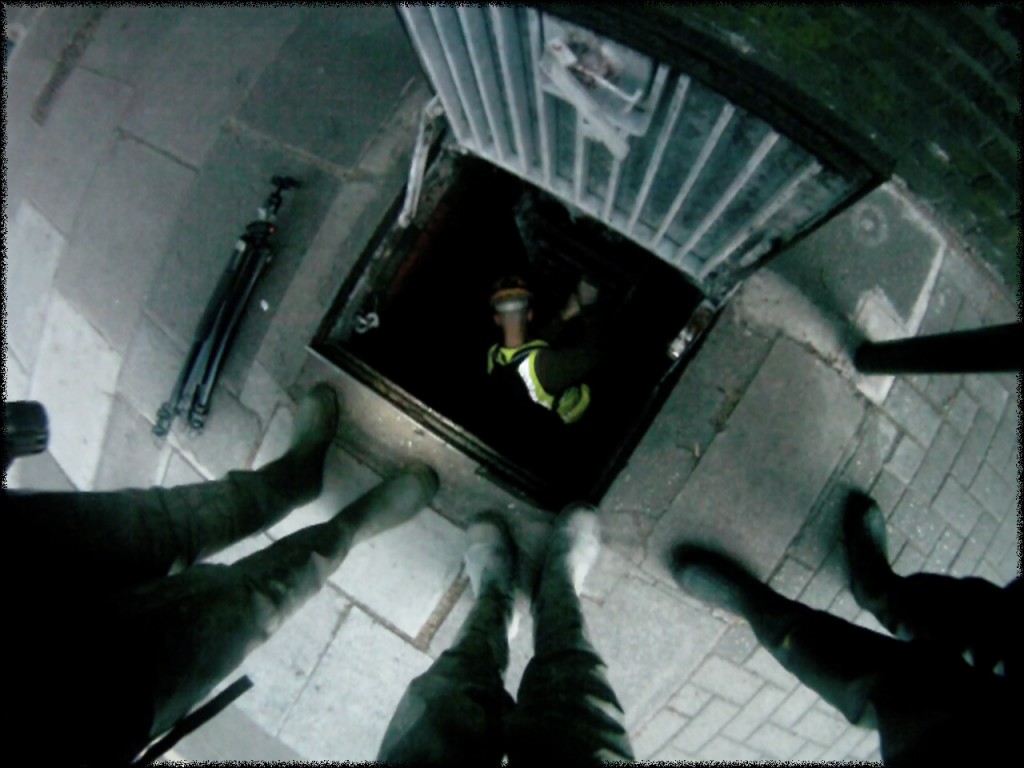
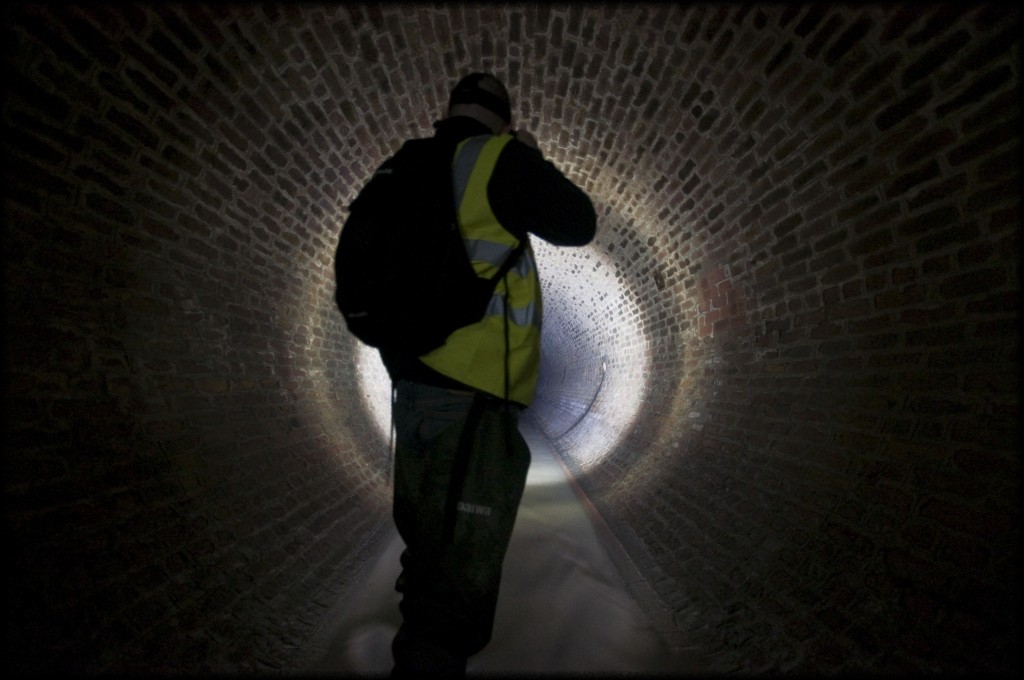
Above me, the heavy round metal doors into this underworld shake with a pinging metallic scream that reverbs down these watery tunnels, slowly fading into a seemingly endless succession of dull thuds that migrate down the street above us, some racing black cab speeding a jilted lover home from the pub after the last trains have stopped running. This overworld scenario interests me far more interpreted from below the undercarraige of the cab, little bits of shit-sticky mud dislodging themselves  from the freshly-pried manhole cover edges, plopping onto my bald head. Cue a shuddering shake, aural spell broken.

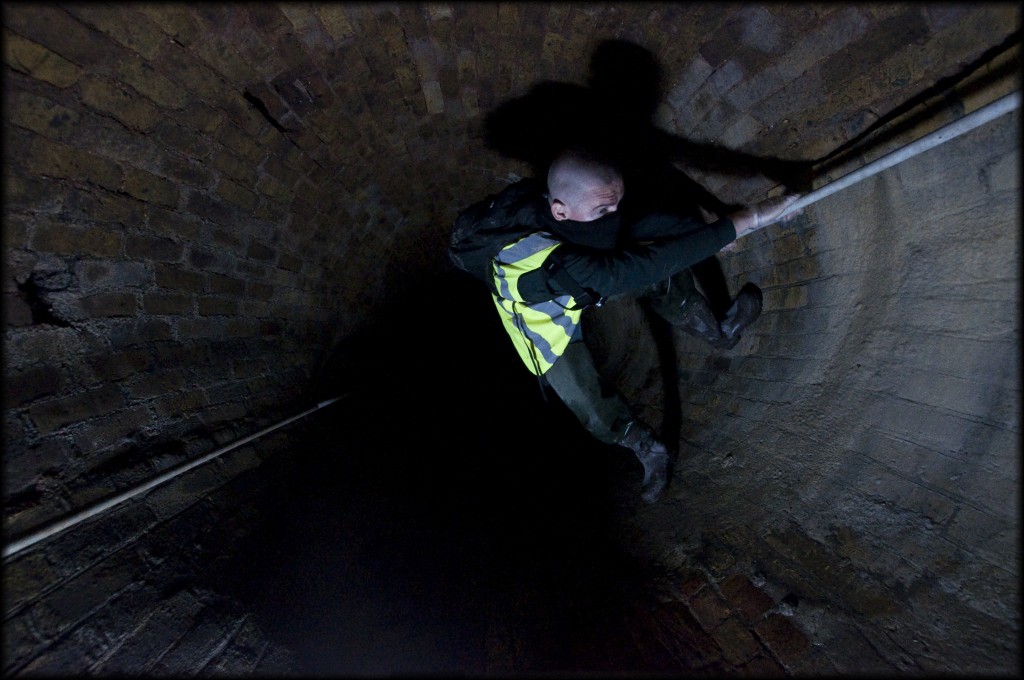
Water races around my feet faster than the cab, pinning my waders in a strange plastic comfort to my legs, little bits of used toilet paper and raw sewage which we lovingly call “the fresh” blocked by my PVC barrier, pushing around me angrily in an effort to make it down this old river and into the Thames like salmon swimming not toward their spawning ground but the river Styx where the boat will sink halfway across and they will float lazily to the bottom, never to move again. As drainers, we learn to love the waste just as we learn to love the trash left behind in the streets of London at 4am on a Friday night. It is the detritus of passion passion for life that staves off our impending deaths, as Michael Dibdin writes in Cosi Fan Tutti:

This place reeks of mortality.
I thought it reeked of rancid oil and bad drains.
It comes to the same thing in the end.

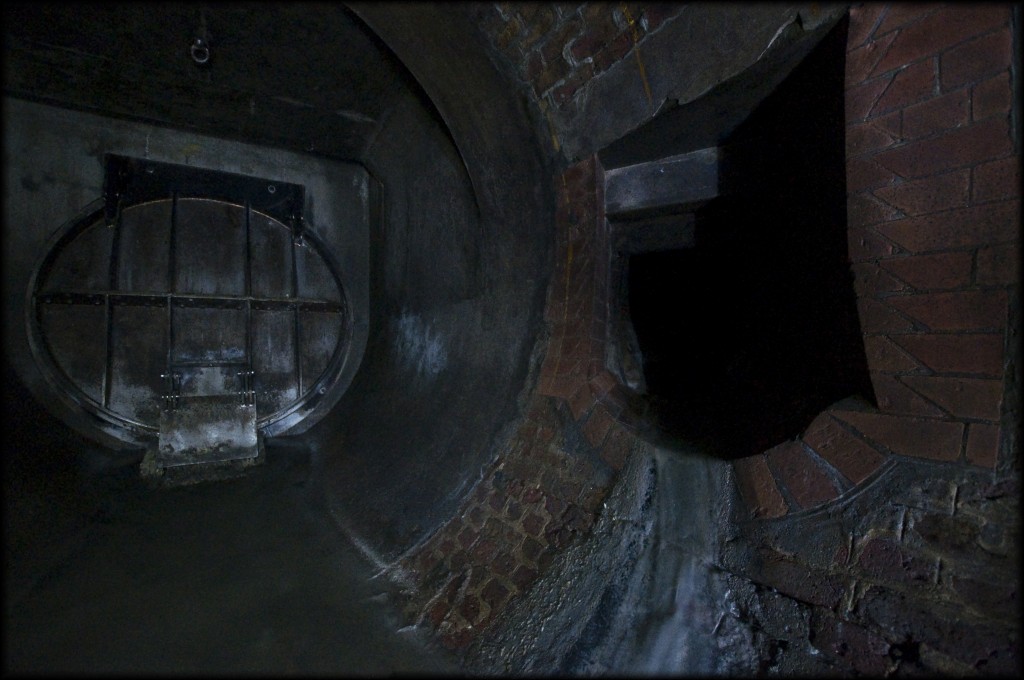
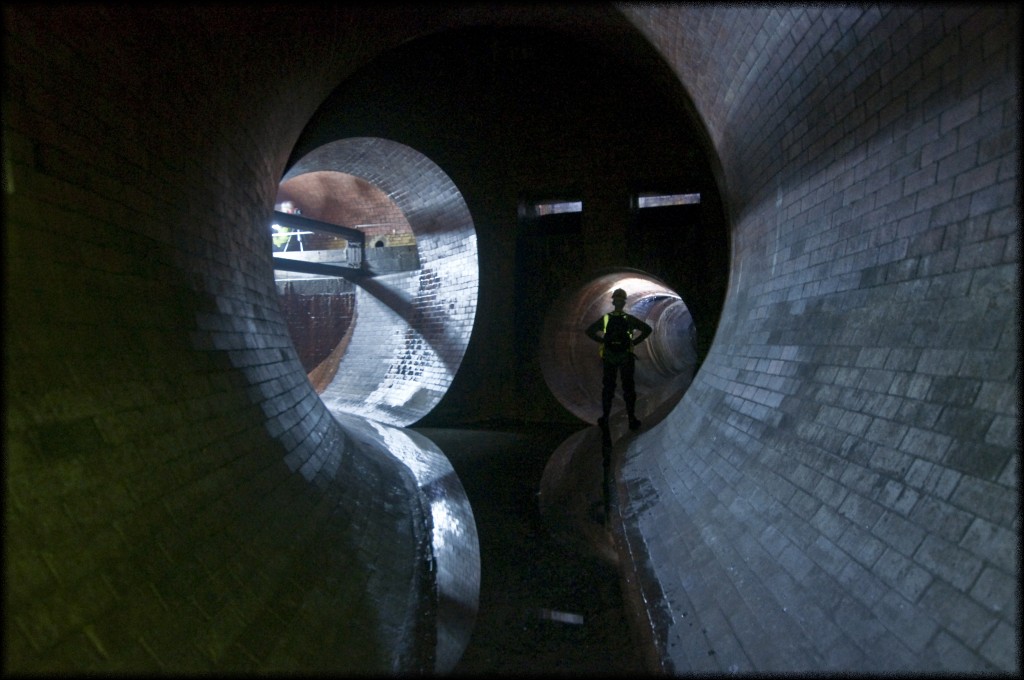
At some point in London’s Victorian Age, the separation between “river” and “sewer” became blurred. Technically, I am standing in the River Westbourne which no one but sewer workers and daring drainers have seen for a hundred and fifty years. Despite the fact that no one has drank the water from this river since the 1400s, it remains a vital waterway of this city, a throbbing vein of live humanness, rushing underneath our unknowing feet as we run to work on the pavement above. Seeing it is a reminder that, as Gay Hawkins writes, “our rituals of cleansing and disposal are enfolded with this landscape, our personal secrets are implicated in the public secret of sanitation.” This misadventure into the bureau of public secrets is the newest in our chain of London infiltrations, our most recent attempts to make sure that this city is documented from every possible angle through experience, fear and love. Just as I wouldn’t wipe the ass of somebody else’s baby, only London’s sewers interest me.

We view the stigma of what is flushes on these journeys both literally and socially. Our preferred mode of access to these hidden waterways is hiding in plain sight and the classism of London society works in our favour, with both police and the public ignoring everyone dressed in high-vis and a hard hat, benign foreign workers who make their living in places where no “respectable” Londoner would ever step foot. Our team of 4 digs into their toolbelts of large screwdriver, t-shaped keys and crowbars to break the seals into underdiscovered territory, finding what the city forgot existed, our brazen crew seemingly as hidden as this river when we actually look like we work for a living.

Cracked

Pull this bird

The addiction to infiltration does not lay in the adrenaline rush of the experience. Infiltration creates unwieldy complications, difficult mental junctions and moments of crises that confuse, inspire and complicate our existence. My second identity as the underclass, the role that I play to gain access to urban secrets, is slowly becoming my primary identity. My clothing, my language, my social class, all now defined by my behaviour “on the job.” Leaving this tunnel late on this night (early the next morning?), we were greeted by “real” workers at a tube station who tossed slight nods our direction, eyeing us with confused interest, suspicion, respect and likely some revulsion given we were covered in underground wetness that smelled even worse than the rank pub toilet across the street.

We have been systematically exploring London’s subterranean features for the last few months, cracking every stormdrain, abandoned railway, cable tunnel and sewer we can find in the city – elements of this urban environment that Steven Smith, in his book Underground London, calls “London’s best kept secrets.” We know why. Not only are they some of the most beautiful and surreal places in the city, they are also the most foul.

Pour your heart out

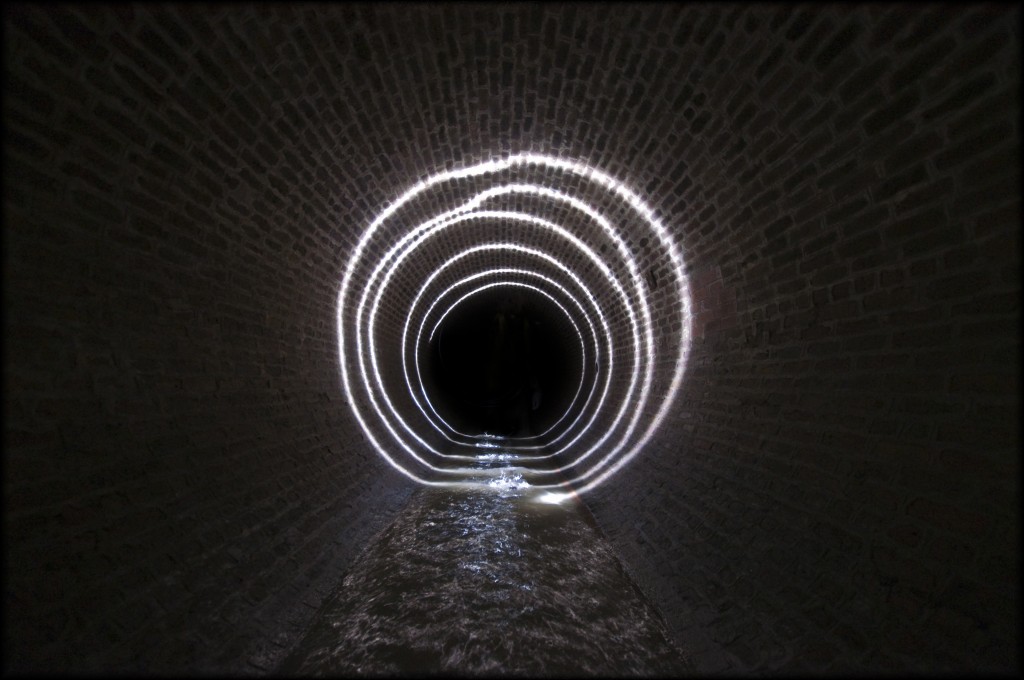
The sewer is a place for alterier cartography, a place where no one may reside but where one can pass through, cameras capturing endless angles of the oldly new, remapping our mental conceptions of where the verticality of the city begins and ends. Our embodied experiences move like the stinking water, shifting from one chamber to the next, chalk marks on walls marking our way home, level after level of underground run-off continually sinking into what we imagine to be an endless succession of metal grates covered in dried up cakes of unknown substances, unidentifiable pieces of fabric and scraps of food. Matthew Gandy, in his article The Paris sewers and the rationalization of urban space contends that “by tracing the history of water in urban space, we can begin to develop a fuller understanding of changing relations between the body and urban form under the impetus of capitalist urbanization.” Pretty sure he wrote that line from the Paris sewers.

Alterier chamber

We trace these cultural lines and flows, finding here that nature and culture drift at the same rate in an interdependent foulness. London’s legendary sewer rats are in full effect tonight, running from us in a terrified scamper, climbing the round slippery walls of the tunnel in inexplicable ways and disappearing into holes we can’t even see into. I want to explore what they can see. At one point, some sort of nest is disturbed and they came at our lights, their little claws feet screeching all around us. Staying in the middle of the slimy sticky mud, shit and runoff where the rats won’t swim was clearly our best option.

We spent 4 hours sliding around these chambers, building up our immune system with aching stomachs upon exit and mouth sores to come. As we emerged I felt, as I often have, that tonight was another attempt to document my own disappearance in the course of making the city reappear in alternative iterations. As I sink deeper into my PhD, I sink deeper in this city, still so in love that there isn’t even room for another human being. I can only hope that either I or the thesis emerges at the end of this torrid love affair, unsure I will survive the potential breakup. Until then.

Own the night.
Cherish these secrets.
Wield this power.
Love this life.

Explored

Beneath your pub crawl

More playful than righteous

________________________________________

This author’s endeavour should be to make the Past, the sense of all the dead Londons that have gone to the producing this child of all the ages, like a constant ground-bass beneath the higher notes of the Present.

-Ford Madox Ford, The Soul of London

Share
Tags : , , , , , , , , , , , , , , , , , , , , , , , , , , | 13 comments

Please support Scott Demuth

Posted by Bradley L. Garrett on Wednesday Jan 13, 2010 Under Academia, Animal rights, Anthropology, Cultural Geography, Uncategorized

I do not usually post things that do not directly relate to my research, but after following this story on my twitter feed and on facebook, I have decided that it warrants a full blog posting. This case is sickening and threatens the very heart of academic scholarship, please support Scott in any way you can.

On November 17, 2009, Scott DeMuth was jailed for contempt of court, since
he refused to answer questions posed to him by a federal grand jury in
Davenport, Iowa. They were interested in questioning him about his knowledge
of an unsolved Animal Liberation Front action in 2004 at the University of
Iowa. At the time, Scott was only 17 years old and was a resident of the
Twin Cities (Minnesota). Scott is a University of Minnesota graduate student
and Dakota language student whose research focuses on liberation struggles
and social movements in the U.S. and globally.  In his work, he has
researched and/or interviewed numerous activists from Native American
struggles for sovereignty and land, and environmental and animal liberation
movements in the U.S. The grand jury was interested in asking him to divulge
the names of activists, which would violate the confidentiality agreements
that he made with his research participants.

Scott took a principled stand against the grand jury’s fishing expedition,
and instead decided to go to jail rather than be party to what many
attorneys and the American Bar Association (ABA) view as a dangerous
practice that deprives people of basic constitutional freedoms. But it gets
worse. Two days later (November 19, 2009) Scott was charged with conspiracy
under the Animal Enterprise Terrorism Act (AETA) of 2006. This indictment
came just one day before the 5-year statute of limitations was to
expire.  Attorneys have speculated the indictment was rushed through to
freeze the statute of limitations, with the intent of buying them time to issue
a future indictment.   These legal maneuvers are indicative of an investigation that
has gone nowhere, and prosecutors who are desperate to locate members of the
Animal Liberation Front, no matter what legal acrobatics are required.

REGARDING GRAND JURIES:
The federal grand jury is a legal proceeding used to investigate possible
organized criminal activity rather than a specific crime. It is held in
secrecy, and does not grant rights to representation or the right to obtain
transcripts of the proceedings to those subpoenaed: those served with a
subpoena face only a federal prosecutor and 16-23 jurors who are not
screened for bias. Federal grand juries are used not to prove guilt, but to
coercively extract evidence without due process from third parties under
threat of imprisonment. They have a history of being used to intimidate and
suppress movements for social change.

REGARDING SCHOLARLY RIGHTS:
The American Sociological Association’s Code of Ethics states:

Section 11.01:
“Sociologists have an obligation to protect confidential information and not
allow information gained in confidence from being used in ways that would
unfairly compromise research participants, students, employees, clients, or
others.”

Section 11.06:
“Sociologists do not disclose confidential, personally identifiable
information concerning their research participants, other recipients of
their service which is obtained during the course of their work.”

This scholar-research participant confidentiality is the bedrock of academic
research and without it the public would lose trust in scholars seeking
important information (concerning, for example, social histories or
institutional discrimination practices), leading to the incalculable loss of
invaluable data for community preservation, public policy, and university
teaching purposes. Scott is being charged with conspiracy for invoking his
constitutional rights and heeding to professional codes of conduct.

REGARDING THE AETA:
More than 160 non-governmental organizations opposed the passage of the
AETA. The opposition includes such influential groups as the National
Lawyers Guild, American Civil Liberties Union (belatedly), New York City Bar
Association and other bar associations, Natural Resources Defense Council,
Humane Society of the U.S., and American Society for Prevention of Cruelty
to Animals (ASPCA).

The AETA:
– is excessively broad and vague and imposes disproportionately harsh
penalties

– brands animal advocates as “terrorists” and denies them equal protection
under the law

– brands civil disobedience as “terrorism” and imposes severe penalties

– has a chilling effect on all forms of protest by endangering free speech
and assembly

– interferes with investigation of federal law violations by animal
enterprises

– detracts from prosecution of real terrorism against the American people

The AETA is designed to punish actions that instill a reasonable fear in
employees of an animal enterprise, or their families. In its application,
AETA also criminalizes many First Amendment activities, such as picketing,
boycotts and undercover investigations of animal abuse if they interfere
with an animal enterprise by causing a loss of profits. It unnecessarily
expands punishments for crimes that existing federal laws already cover.
This law has created a chilling effect on constitutionally protected
activities and many activists, scholars, attorneys, and elected officials
believe that was the intention.

Our goals are simple and direct: we want the judge, prosecutor, and U.S.
attorney to dismiss all charges against Scott, protect academic freedom and
integrity, and denounce the Animal Enterprise Terrorism Act.

The newly formed Scholars for Academic Justice is developing a website and
we plan to roll it by this weekend at the latest. More on that soon.

In the meantime, here’s what you can do:

*write a statement of support for Scott (concerning the issue of academic
justice in relation to research ethics, grand juries, etc.) (in PDF format
please, send to [email protected])

*sign a petition supporting Scott:
http://www.ipetitions.com/petition/freescottdemuth/

*write letters to the editors of the MN Daily, the Pioneer Press, the
Star-Tribune, the Chicago Tribune, the Quad-City Times, New York Times, and
San Francisco Chronicle.

*write letters to the prosecutor, the U.S. Attorney, the judge, and
Representative Keith Ellison (see info below).

*Record a digital audio statement of support. We can help you do this via
skype, over the phone, or in-person if you are in the Twin Cities area. Just
let us know!

Please contact David Pellow at [email protected] for more information or to

send statements of support.

Please send polite letters to the following individuals requesting that they
work to dismiss all charges against Scott, protect academic freedom and
integrity, and denounce the Animal Enterprise Terrorism Act:

U.S. District Judge John A. Jarvey
United States Courthouse
131 East 4th Street
Davenport, Iowa 52801

U.S. Attorney Nicholas Klinefeldt
United States Courthouse
131 East 4th Street
Davenport, Iowa 52801

Assistant U.S. Attorney Cliff Cronk
United States Courthouse
131 East 4th Street
Davenport, Iowa 52801

Representative Keith Ellison
2100 Plymouth Avenue North
Minneapolis, MN 55411

Share
Tags : , , , , | Comments Off on Please support Scott Demuth