“Understanding the past embraces all modes of exploration.”
– David Lowenthal

Military security

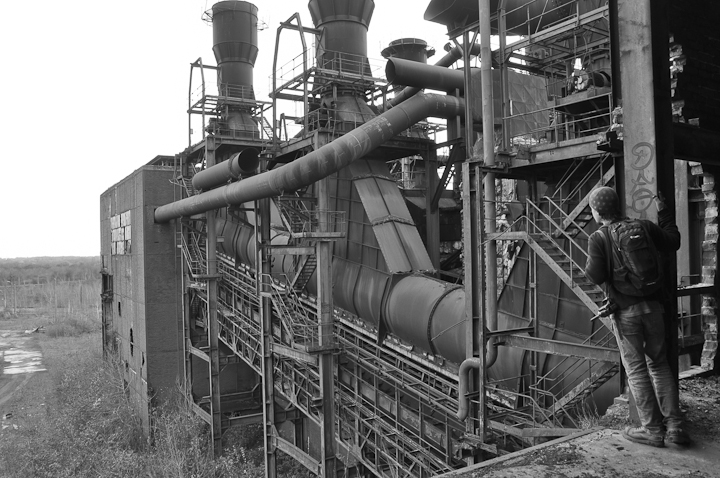
Graveyards come in many forms. When I was an archaeologist, I used to dig them up all the time. I remember once, when I lived in Hawai’i, I was digging up this skeleton that was embedded in beach sand. I had my trowel under his ribs chipping away at the sand particles embedded in the ribcage and then the whole body came tumbling down on me. This guy Kulani that I worked with said, “cool bro, now you’re cursed like the rest of us”. I put the skull in a brown paper bag and marked it XJ-107 or something. It was clearly a traumatic experience. In Paris, we party in mass human graves. And of course, the whole dereliction fetish component of urban exploration is really just an obsession with decay, death, waste and transition. We explore architectural and memorial graveyards all the time. I don’t think it’s strange though. As Geoff Manaugh muses,

…the quasi-archaeological eyes of those poets and artists [from the past] would still be enraptured today. Wordsworth could very well have gone out at 2am on a weeknight to see the cracked windshields of car wrecks on the sides of desert roads, new ruins from a different and arguable more interesting phase of Western civilisation. 

Beauty in death, filled with life

So when I was in Las Vegas this summer and heard there was a massive desert graveyard filled with hundreds of “retired” planes, beautifully preserved in the dry Mojave air, I knew we needed to get in there and play around. The problem was that it was on an active military base. So I called up the crew and they flew into McCarran from Ottawa, Paris and London. We rolled out the satellite images over a few cans of Tecate on the kitchen countertop. With Witek, Marc and Otter on this mission, success was the only option.

The Job

After driving for ages from Vegas to the high desert outside Victorville, stopping to build massive bonfires in the Mojave and climb around in some old mines at Calico, we rolled up the the perimeter fence around George Air Force Base (The Southern California Logistics Airport). I won’t lie, the security was intimidating. But, as always, there was a weak point and we found it. Luckily, the military security patrol didn’t see us before we cracked their security routines.

In our sights

Shots in the dark

Fast forward to 2am. The problem with exploring in the desert is, firstly, that you have to drive there and, secondly, that you have to park your empty automobile in a blatantly obvious place, given there’s no cover. Given the only thing within 10 miles is the military base and we really didn’t like the idea of having our truck found while we were in there, we parked it in a ruined meth den roughly two miles from the access point; rammed it in-between the buildings and prayed for the best as we set off across the desert with our camera gear. As we neared the gate, security was doing their patrol. We saw the headlights and dove behind some knee-high sage bushes, turning around the bush as they went past like a Scooby-Doo cartoon. When they had passed, we ran like hell and threw my Mom’s clearly expensive bathroom towel borrowed from the Vegas pad over the barbed wire. Once over, we booked it for the first plane we could see, a massive United Airlines 747.

Behemoth

This first fat boy was a cargo freighter (maybe converted?) and the ladder was down. It was pretty stripped out inside and not very interesting. We exited and saw the next plane in the row – a British Airways 747! Someone asked for my truck keys and popped the hatch behind the landing gear – up we went. Inside, it was sticky and hot and awesomely intact.

Saw it

Did it

Loved it

There were endless planes of all sorts, learjets, FedEx planes, little short-flight hoppers and massive military cargo aircraft. It was a wicked playground.

On time for

This encounter

It was a long night. We must’ve gone in six or seven planes. We photographed dozens. We saw hundreds. At some point we realised there was a security guard inside the fence as well and had to hide in landing gear a few times. It was the most fun I have ever had in the United States.

Hiding from security

The tail end of an

Endless array

The Boneyard was like nothing I have ever experienced – it was massive, pristine and surreal. We had a great time there and I would love a revisit, especially given we only went in something like 2% of the planes there. Then again, I hear there’s a much bigger one in Arizona that has a space shuttle in it…


London Consolidation Crew. 2011. All up in your military base.

Share
Tags : , , , , , , , , , , , , , , , , , | 8 comments

History is a social form of knowledge; the work, in any given instance of a thousand different hands. -Raphael Samuel

Art & Artefact

As many Place Hacking readers will know, I have been doing doctoral research on urban exploration for the past three years. With my PhD coming to a close soon, it seems like everything is coming full circle.

I am proud to announce the release of my new article in the journal Environment and Planning D: Society and Space. Stuart Elden, the editor of the journal, has been very supportive of my work and has agreed to leave the article open access for one month so everyone outside the Ivory Tower can read it. And I hope you will. This article was two years in the making and attempts to address one of the most significant aspects of urban exploration – our engagements with history through the practice.

The Society and Space journal has donated a fair number of its pages this year to urban exploration. In June, they published a piece by Luke Bennett on ‘Bunkerology‘ which Professor Elden has also made open access for the next thirty days. I then wrote a response to Bennett’s paper and he replied. These debates are worth reading in the context of my new paper, as they tell very different stories, ostensibly about the same practice.

The last thing I will mention is that if you head back to my Hobohemia Video Triptych post from July, you will find the video footage from the excursions discussed in the Society and Space paper.

Legacy

On a final note, thank you again to everyone I have explored with in the past few years. This paper is of course in many ways co-authored with you all and would not have been possible without your enthusiasm, support and friendship. As always, I am honoured to be the scribe for the tribe.

Share
Tags : , , , , , , , , , , , , , , , , , | 8 comments

“Our waking existence… is a land which, at certain hidden points, leads down into the underworld – a land full of inconspicuous places from which dreams arise.” -Walter Benjamin, The Arcades Project

Wanderlust

Few places in the world are as enshrined in the pantheon of urban explorer mythology as the Carrières de Paris, often referred to more colloquially (though inaccurately) as the Paris Catacombs. Since 2008, we have spent dozens of hours underneath Paris, exploring the system and meeting those who map and build it. And despite that lively and active present day cataphile culture, it is clear from looking at the history of these spaces that we are all only a blip in the long history of subsurface Paris. Parisians are melded into the very fabric of the earth through these quarries.

Sightings

As early as the 13th Century, open air quarries, and later mines, were sunk into the Left Bank of Paris to feed architectural projects on the Right Bank. Eventually, as the city became pressured for space, people began building over the Left Bank. A voidspace was created which, since the 13th Century, has been continually lost and relocated, condemned and celebrated, backfilled and re-excavated. As Winch writes on his blog, exercising access to this voidspace is not a right or a privilege, it’s just something that can be done. And we do – again and again. These sunken tombs have a magnetic pull, despite, or maybe due to, the potential for visceral terror they harbour.

Taking the privilege

While in the quarries, we find ourselves in a negative space, a spatial gap that exists because earth matter has been excavated to build something else entirely. In architecture and urban planning this is sometimes referred to as space left over after planning or SLOAP.  Geographers and urban planners find that those modern negative spaces are used for various urban subversions, like skateboarding and street art, being largely ignored and disused space; but we rarely imagine SLOAP being as vast as the urban underground in Paris. As Marc Explo told me while we were wandering the 180 miles of subterranean galleries and chambers “if you want to know how big the quarries are, just look at all the buildings made of limestone in Paris. Then you understand the immensity of what we’re in.”

Expanse

In 1774, a hundred feet of the Rue d’Enfer collapsed, revealing the voidspace underneath. When King Louis XVI asked engineers to report on the implosion, he was told that much of Paris could collapse; it was built over fragile quarries that stretched for miles. This triggered an epic ongoing urban stabilisation project that spawned many of the shafts, rooms, mines and galleries that we now temporarily occupy. But the rich history of these spaces had just begun by this point. Into the 19th century, the caverns and tunnels were mined for building stone and by the end of that period, they would contain the skeletal remains of eleven million Parisians exhumed from graves where they impeded development – the quarries were transformed into a massive Necropolis.

This system have harboured criminals, French revolutionaries and Nazis, they have been used to grow mushrooms and store wine and, increasingly, give Parisians an unmonitored space to throw parties and get high in our age of the ever-present watchers. Today the tunnels are roamed by a different clandestine group, a loose and leaderless community whose members sometimes spend days and nights below the city. This is our urban playground, a timeless organic underworld of caves, water, bone and soil.

Their underworld

Our tombs

The contemporary relationship between explorers and the catas is thought to stretch back to 1793 when a Frenchman named Philibert Aspairt journeyed by candlelight into the abandoned quarry system to find a “lost” wine cellar. His body was found eleven years later and a monument erected to his memory, which still stands to this day. In Ninjaicious’ Infiltration Zine Issue 9, back in 1998, the urban explorer Murray Battle tells tales of multi-day sub-urban rambling, nipple-crunching tunnel crawls and and port sipping in La Plage. Not much has changed since then. As National Geographic wrote in their recent article, entering the quarries has been illegal since 1955, so cataphiles tend to be young people fleeing the surface world and its rules – freedom reigns underground, even anarchy. One of the cataphiles the authors run into down there is a guy called Yopi who says “many people come down here to party, some people to paint. Some people to destroy or to create or to explore. We do what we want here. We don’t have rules.” Our time in the catas costs us nothing but the battering on our bodies and psychological stability – an increasingly rare direct feed into the nervous system and hypothalamus – and contributes nothing to society except to add the the surreal project in whatever ways we desire. Money is of no use here, imagination is the currency.

Tarry

Of course, the phenomenological primacy of accessing the void cannot be ignored. After entering the Paris catacombs last year, on our Kinky Paris trip, our expectations of what to expect, think and feel began to melt with every sip of port, dripping off of us with the sweat and blood and caked quarry mud. It seemed all we could do was act, except in those moments when we were so shocked by some sight, smell or crushing feeling we were rendered temporarily inert. We would sometimes run into other sub-urban dwellers down there, cataphiles who spend the majority of their lives below the City of Light. We also encountered groups of people hunched over single file with bobbing headlights and plastic cups full of beer, and we would nod hello as we passed, acknowledging our shared experience in this space of unregulated sensory madness. It seemed to go on endlessly, and we achieved a state of supreme disillusionment or exceptional clarity (the meld). When we left and had to reconform to social expectations the come down hit hard.

Come down

Every time I am in the catas, I can’t help but think I am headed to the last party at Zion, just before the machines drill through to inevitably annihilate the remaining humans and their wonderful little dystopia. The catas feel like a post-capitalist future where everyone took the red pill and woke up. And yet, an 1877 engraving by Charles Barbant also relays this sense that we need not go to Herculaneum or Pompeii to find buried cities, for they occur beneath our own feet. Whether those spaces are a terror or a utopia, or indeed both simultaneously, perhaps can only be known subjectively to each distinct voidspace entrant. These experiences, like so many we seek as the intrepid explorers of this age, often verge on incommunicability (perhaps contributing to my reliance on multimedia in attempts to relay these stories – see below).

Subterranean utopia

So where do these thoughts fit into the hack? Well my friends, the quarries of Paris are perhaps the best Western example of a place where humanity has become intricately interwoven into the informal subterranean urban matrix. Paris culture would suffer a grave setback with loss of access to these spaces (not that such a thing could ever happen, they are far too vast). A co-addictive symbiotic relationship has been built over nine centuries where the populace continually hacked the closed system open again and again, leading to a consistent stratigraphic memorialisation of rediscovery and renewal that is now layered so thick with history and culture you can almost eat it (I tried). The catacombs are proof that just as virtual social systems can be maintained by the multitude, so can physical space. Enter the void.

Occupied

________________________________

Want to see more? Have a look at the video footage from my first trip to the Carrières de Paris:

Then read about it in my just-released article in ACME: An International E-Journal for Critical Geographies:


Share
Tags : , , , , , , , , , , , , , , , , , , | 12 comments

Solidarity!

Posted by Bradley L. Garrett on Saturday Nov 5, 2011 Under Celebration, Civil Rights, Occupation, Spatial Politics

“What is at stake, then, is the practice of genuine democracy, of a return to the polis, the public space for the encounter and negotiation of disagreement, where those who have no place and are not counted or named, can acquire or, better still, appropriate voice…” -Erik Swyngedouw

Place hacking pledges solidarity with everyone across the globe staging occupations and interventions to force transparency from our corrupt global government, financial and regulatory systems.

Political protest takes many forms. Know that when the time comes, we have the keys, the evidence, the locations and the skills you may need for the next step. We look forward to your call. We are the 99%.

Explore everything. Occupy everything.

Share
Tags : , , , , , , , , , , , , , , , , , | 7 comments

“It’s about the risk sometimes.”
– Winch

A matter of scale and distortion

Part I: The Sounding

Let’s get those photoreceptor cells warmed up and neurons bouncing people, it’s time for Place Hacking Chicago, where secret spatial knowledge leaks out like early-morning pillow drool through cracks in the urban security infrastructure.

Chicago was a slimy glimmer as Marc and I sped in, sleep deprived, stinky and tweaked out on our successes in Detroit. We had been hearing rumours of an extensive tunnel system modelled on London’s Mail Rail where some fiendish little schizophrenic called Dr. Chaos had hidden cyanide stolen from the University of Chicago back in the early aughts. Apparently it was accessible through manhole covers, gated up with steel doors that had pins we could pop out with a hammer and screwdriver. Next stop Home Depot we figured, we’re going underground.

But Chicago presented those tunnels as false idols to be chased and worshipped by neophyte place hackers looking for lone star epics to boost international credibility and couch surfing bonus cred. Marc and I read the runes and realised our destiny lay in the heavens of the Windy City. We first hit the Hilton Chicago where we were advised the doors to the elevator controls were poppable with a credit card. Within minutes of arriving downtown, we were up the fire escape and on the roof.

Simple tech

Warm up

But the Hilton’s rooftop, sexy as it was, left us unsatiated. We looked higher and noticed a thunderstorm of epic proportions coming to meet us downtown. It was prime time to climb the highest the midwest had to offer and grab hold of Chicago’s gods – big cumulonimbus death eaters ready to thunder down bolts of righteous over Lake Michigan.

The 40-story Ritz Carlton Residences had the Eye of Suaron on them, a bulbous 360-degree inverted black dome swivelling around and gaping at the piddly four-foot fence into the site. By the time we were standing in front of it, the rain was coming in from five sides, threatening to breach our bags and assault the fragile electronics in our cameras. I looked to Marc. He nodded. We ran across the street and gave the camera the finger as we ninja’d the scaffolding and ducked inside. The first set of stairs was easy to find but hominid specific ultrasonic vibrations on the third floor revealed a fat man in a bright vest reading Maxim at a desk facing the wrong way to actually perform the job he was being paid for. We left him to it and hit the crane to bypass third floor stair ‘security’. As soon as we swung onto the crane we got hammered by the gods of Lake Michigan again. Their wrath was significant at this point. The thunderstorm had intensified into a full-fledged sensory cacophony complete with blue forked lighting strikes jabbing in dangerous proximity as our shadowy figures scaled the steel cage toward the stars. A few floors up, past the stair barriers, we snuck back to the concrete steps and climbed. Now I don’t know if you’ve ever climbed 40 floors but the thing is that if you’re in reasonably good shape at 20 you’re fucked. After that, it’s just sheer adrenaline, fear and unquenchable anticipation that keeps the legs moving. Add to that the fact the we were eating primarily trail mix and woke up that morning (14 hours ago? 20?) on top of a port building in Detroit and you start to get an idea of what we are up against here. We chilled for a second.

Our move

Then we heard them. Sirens. Everywhere. They converged on our location and the blood drained from Marc’s face. Without a blink, he cinched his pack straps and said ‘if I’m getting busted, I’m getting busted on top’ and resumed climbing. Cheeky. We hit the stairs with renewed vigour, every turn in the case cranking up the heat, the angst, the fervour. By the time we get the top, I’m locked in a perpetual dubstep stair wobble and my thighs feel like they’ve been skewered and stuck over a campfire until they involuntarily pulsate.

Nights that thunder

Dripping, panting and wrecked, we walk outside on floor 40 to a nightmare of epic proportions. The architecture is in the midst of supra-environmental contractions rolling in every two minutes, ready to electroporate holes in our cell membranes. The place is heaving and screaming as the gods of Lake Michigan hurl down forks of fury at this giant concrete and metal phallus we just climbed. I am, quiet seriously, terrified that the air ducts, which appear to be zip-tied to the scaffolding, are going to come down on us. And then I see it. Marc Explo is standing on an incomplete ledge being whipped by the rain, defying the gods of Chicago. And the rain stops. And the sirens stop. We look over the edge and there’s nobody there but methamphetamine-addled cab drivers, confused, jetlagged tourists and drunk dudes in loosened ties cruising the Magnificent Mile for violence. Turns out, the sirens probably had nothing to do with us. More false idols.

Godslayer

To this day I still swear Marc assassinated the gods of Chicago. Or maybe he just appeased them with his audacity, for they appeared to linger in wait, providing us with ample opportunity to take our photos in their image, replicating their relentless bombardment for the sake of the Powerslide. In that brief respite between aerial assaults we became the new gods of Chicago and we didn’t intend to take our responsibilities as false prophets lightly. We immediately ran back down 40 floors, bought a beer and popped a hatch in the middle of the one of the Chicago River bridges, toasting those who failed to attend this feckless roadtrip, and those who were on different ones, while the monsoon continued.

Bobble headed optimist

Tributary

The next day we found ourselves working harder than we should have to sneak into an abandoned Brach’s candy factory. The two events of note within that dirtheap of a building were (1) a guy living in a tent on the third floor of the Chewy Candies Caramels® assembly line (who had clearly located a superior ingress/egress route to us) and (2) the fact that the whole factory reeked of marshmallows, nuts and chocolate. If Place Hacking was scratch and sniff, I could have bottled and relayed the smell of derelict chocolate. Since we haven’t uncovered that particular technological wonder just yet, you will have to fly to Chicago and climb over that fence yourself. Sorry.

The bridge to Candyland

Aromaquest

We saw other places. Events transpired. Sometimes we catalysed them. In other moments we were the victims of dirty tricks and absurd bureaucratic mishaps. I got hurt again falling in a hole somewhere and reinjured my broken rib. Such is life on the road. Then I woke up on a sand dune in Gary, Indiana and Marc wasn’t with me. I found him later at Michael Jackson’s childhood home where he was hanging out with Michael’s cousin Ron (no joke).

Lost only on maps

_______________________

Part II: The Legacy

“We must act out of passion before we can feel it.”
– Jean-Paul Sartre

Fast forward a few weeks to Indianapolis where we gathered with the world’s great place hackers, blaggers, security subverters and professional infiltrators. After hearing of our successes in Chicago, Marc and I headed back downtown on our way to Minneapolis with Witek, Craig, Darlin Clem, Babushka, Otter and Adam. Everything is more fun with friends. Especially friends like these.

After nailing the Hilton one more time (in the middle of the day no less), Marc had this crazy idea to try and social engineer our way up the 72-story Legacy Tower by following in residents, acting like we were headed to a party. We all tried to hold our giggles as the residents in front of us swiped their keycard and we packed our crew into the lift with them. On the 72nd floor, the lock to the roof fell off. Must’ve been some lingering remnant of those false god superpowers.

The social building hack

No panic attack

We collectively decided to wait for sunset to see the city light up from 250 meters above the city streets. As night descended, eight of us perched on the ledge, my heart bloomed. It was one of the most spectacular things I have ever seen.

Spectacularity

A surety of

Elevated conciousness

The Great Legacy Tower Infiltration, our final mission in Chicago during the 2011 Midwest Powerslide, was a wonder. I left with the feeling that if I were ever to move back to the United States *gasp*, Chicago would be the place. When we walked out the lobby, security opened the door for us and told us to have a good night. Thus is the gift to those who don’t play by the rules.

_________________________________________

Cheers to my family for having us over in Elgin for BBQ, a much needed night’s sleep in a bed and, of course, pool time. A huge shoutout to Chicago for being such a bucket of win – that’s some city you’ve built there people.

_________________________________________

The spatial revolution is upon us; join us in making place open access again.

Explore Everything.

Share
Tags : , , , , , , , , , , , , , , , , , , , , , , , , , , , , , , , , , , , , | 23 comments