Fiberglass and Tumble Weeds – Boron Federal Prison
Posted by Bradley L. Garrett on Wednesday Apr 7, 2010 Under Uncategorized“You should create your own icons and way of life, because nostalgia isn’t glamorous…live your life now.”
-Marilyn Monroe
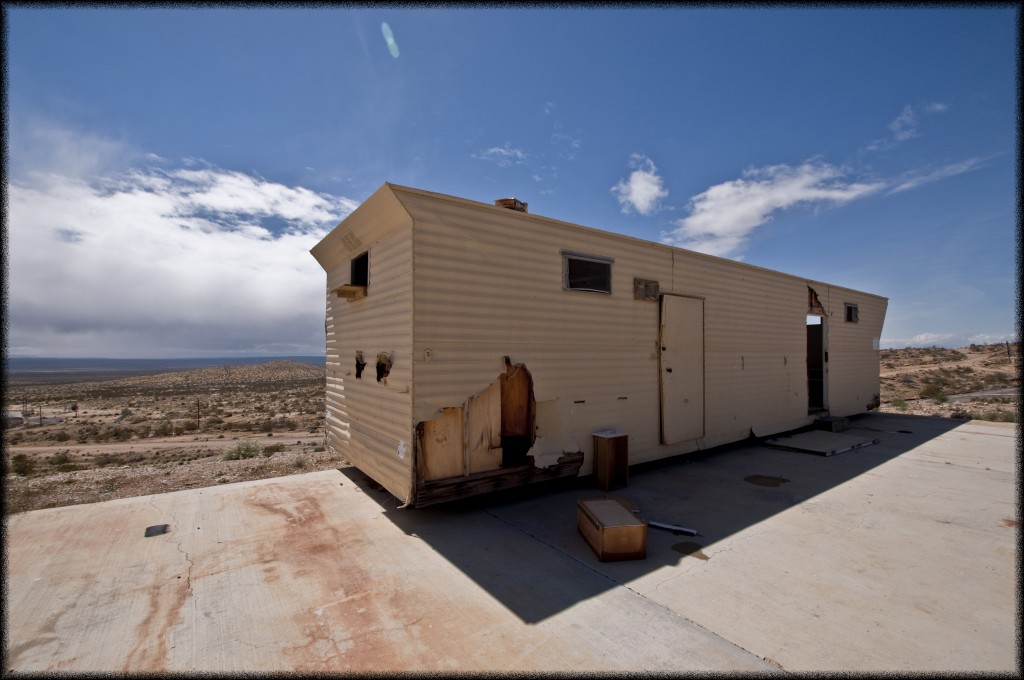
Alien dump
I grew up in Riverside, California, on the Western edge of the Mojave Desert. My interest in urban exploration came from my childhood here, full of frequent trips into the Mojave exploring old mining towns to break up my rather mundane suburban childhood. Coming back to visit this year, I knew that what I needed from this trip was to rediscover what it was that brought me down the UrbEx path. So I hit the desert for some old school federal trespass.
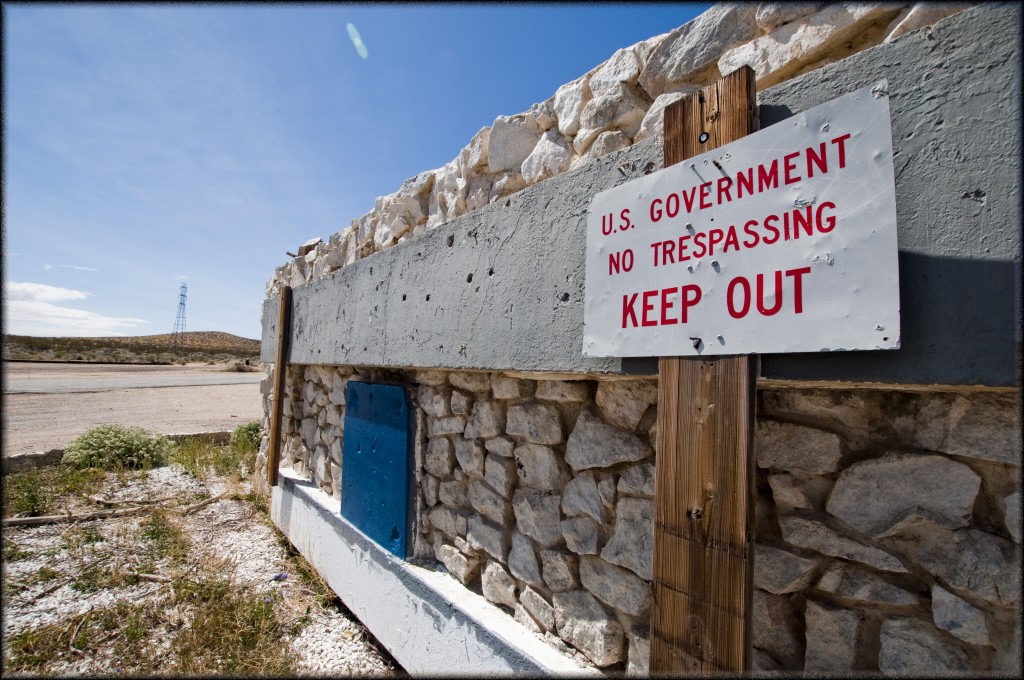
Because of that green UFO?
My friend Joel tipped me off to the existence of Boron Federal Prison Camp, a US Air Force site that was abandoned in 2000. I rolled into Boron on an incredibly windy day, with light rain splashing in off and on (rare here I assure you!). I found all the gates open and amazingly drove right past a dozen derelict buildings, straight up to the old water tower.
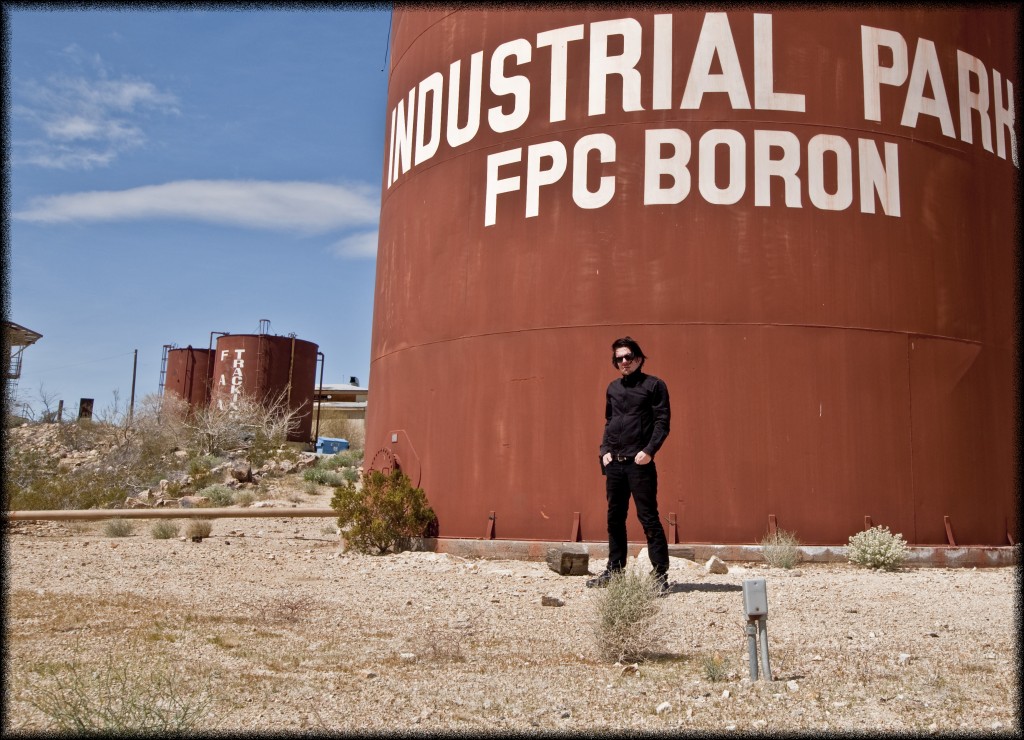
Dusty Industry
It was only when I stood at the edge of the cliff at the water tower that I realized how extensive the site really was. There were at least 30 buildings here, some multi-storied, spread out over maybe 5 or 10 acres.
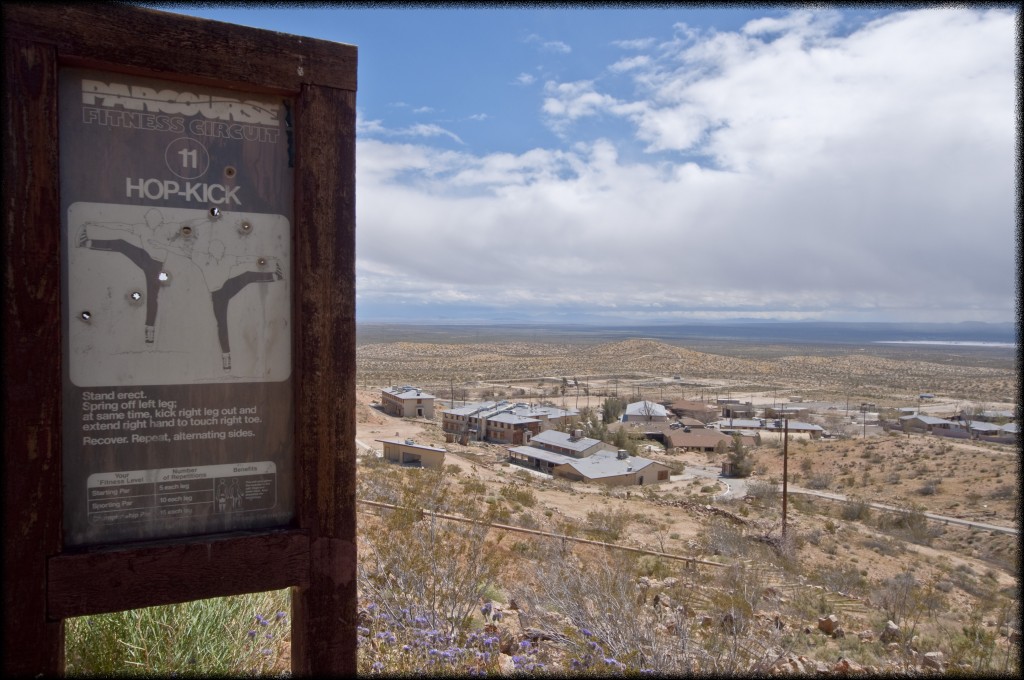
Rural Sprawl
As I looked out across the flat expanse of desert toward Barstow, the wind was whipping my hair in my face and I was constantly wiping water drops off of my lens. I decided to take shelter in the only thing higher than the water tower – the stucco church.
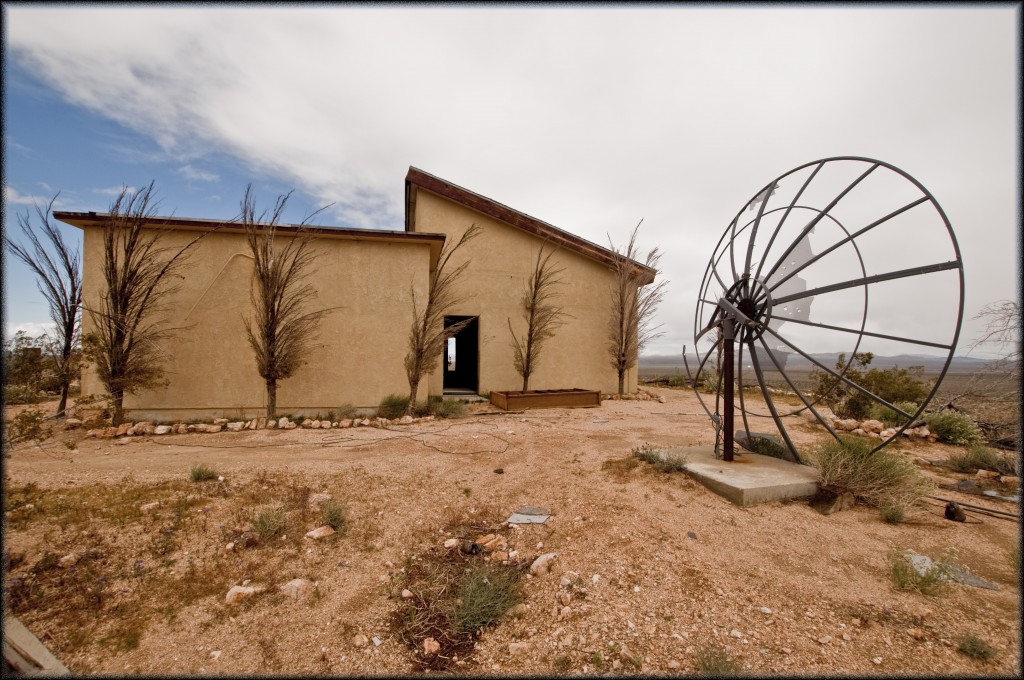
Monument to the gods of television.
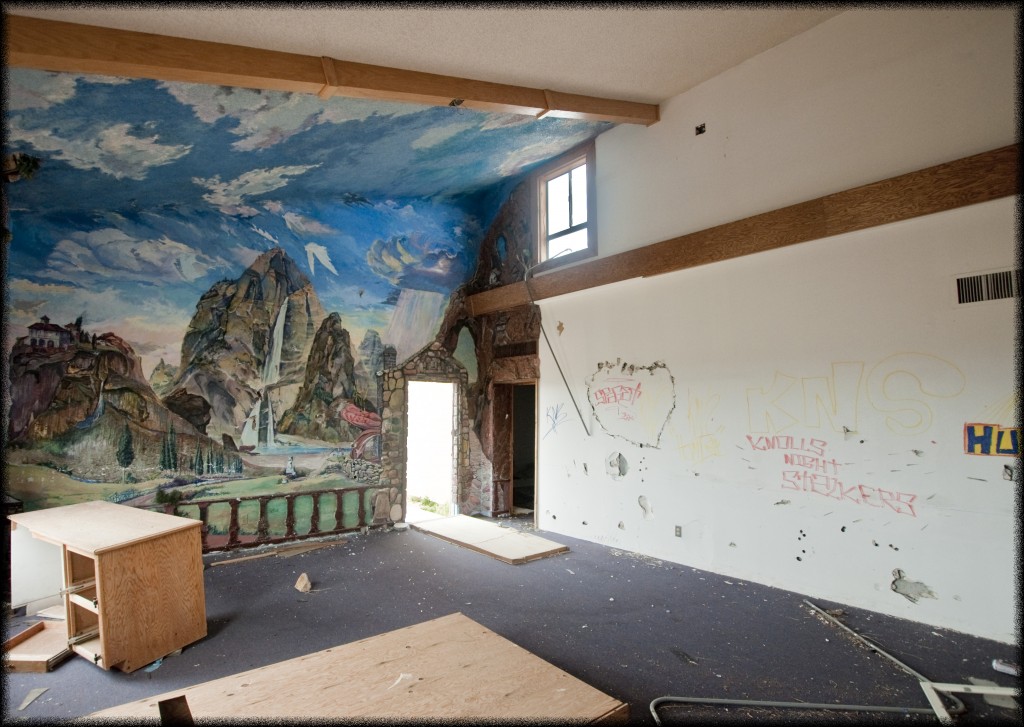
Stencil worship
I stepped into the church and found myself in a silent room that had one wall painted and others covered in banal graffiti. As I stood there, I came to realize how much different this exploration felt than those I had been undertaking in Europe. It was so much lonelier. Part of this, of course, can be chalked up to the fact that I was indeed alone, but there was also a spatial dimension. It seems to me that perhaps because of the availability of space here in the desert, it is much easier to simply walk away from a place. And when that happens, an essence of loneliness particular to this dusty landscape seeps in. It is a loneliness, a sadness, so deep that even destruction of the place does nothing to erase it.
When I explore in more urban landscapes, the predominate emotion is fear-fuelled adrenaline. There is a sense of urgency that drives explores and has been one of the difficulties I have encountered in trying to get video footage of our explorations – we never really stop to take it in. We move fast, we pack multiple explores into a day. It’s like derelict architecture speed dating.
In contrast, this federal prison invited me to stop, to spend the day, to really take the time to let it scar me. It felt less like a conquest and more like an invitation to meditate on the possible pasts that led to it’s untimely death. The site encouraged more of an archaeological eye, little artefact mysteries to be uncovered around every corner. The fear of being caught here (which was very high, with possibly sever consequences) was so overwhelmingly overshadowed by the lonely introspection the place invoked that I simply sat down for some time to listen to the wind whipping power cables and slamming doors open and closed and forgot that a patrol might roll in at any moment.
I went on to explore the kitchens, mess hall, work corridors, carpentry shop, the fire station, basketball court and finally the “vehicular component factory”, whatever the fuck that means. It had been almost completely stripped out, every window broken, and despite the emptiness of the place, it continued to have a particular thickness to it. It was a place full of sad memories, left to rot our here 50 miles from the nearest city where the incarcerated inhabitants could do no harm.
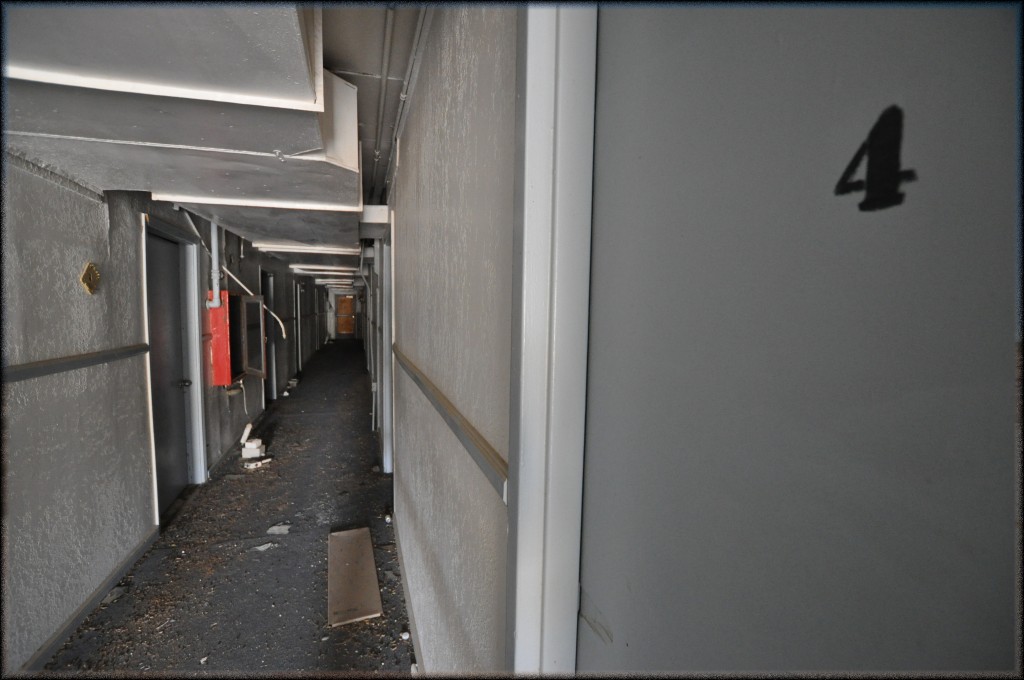
Deserted
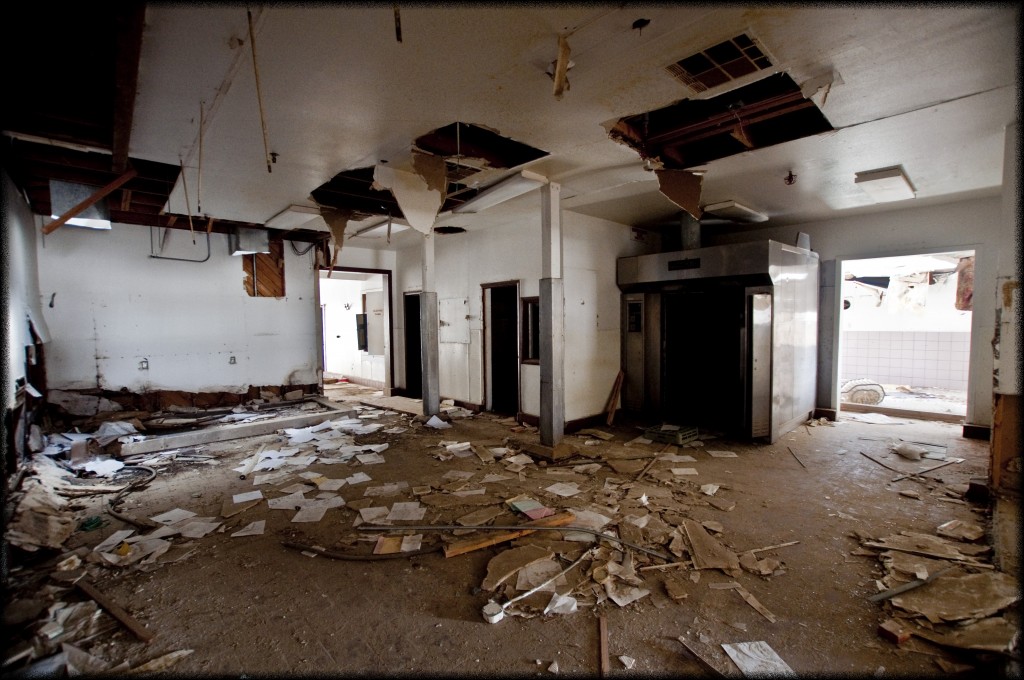
The Mess Hall
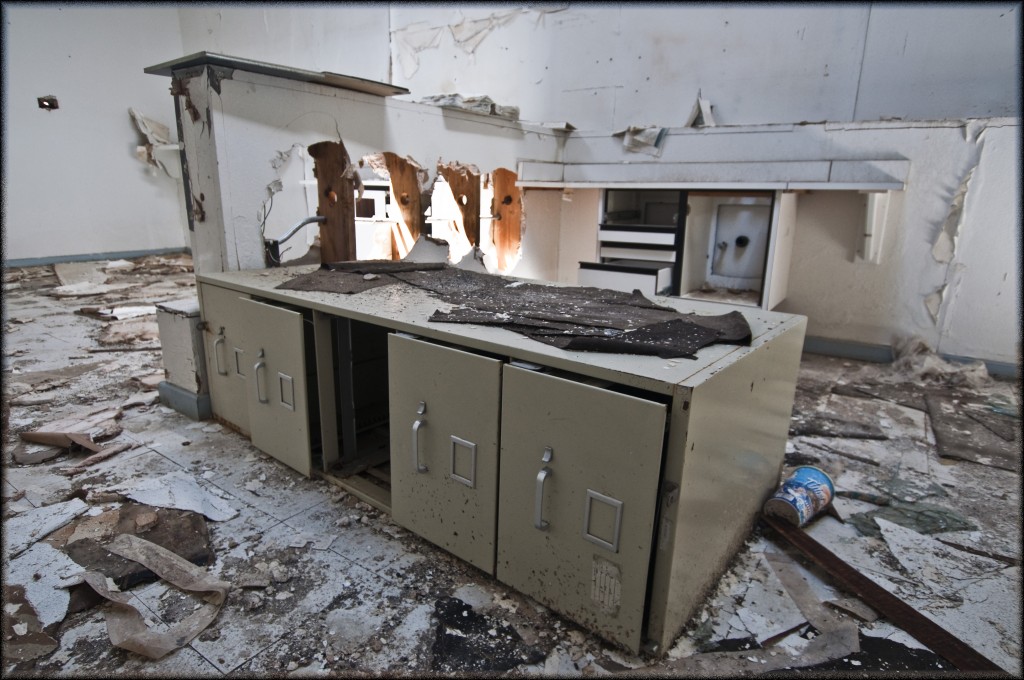
Barricaded
The camp seemed to be connected with a company called Unicor – a name which I think has an oddly Orwellian feel to it. There was also an active air traffic control station on site covered with live cameras which was beginning to make me a little nervous 3 hours in.
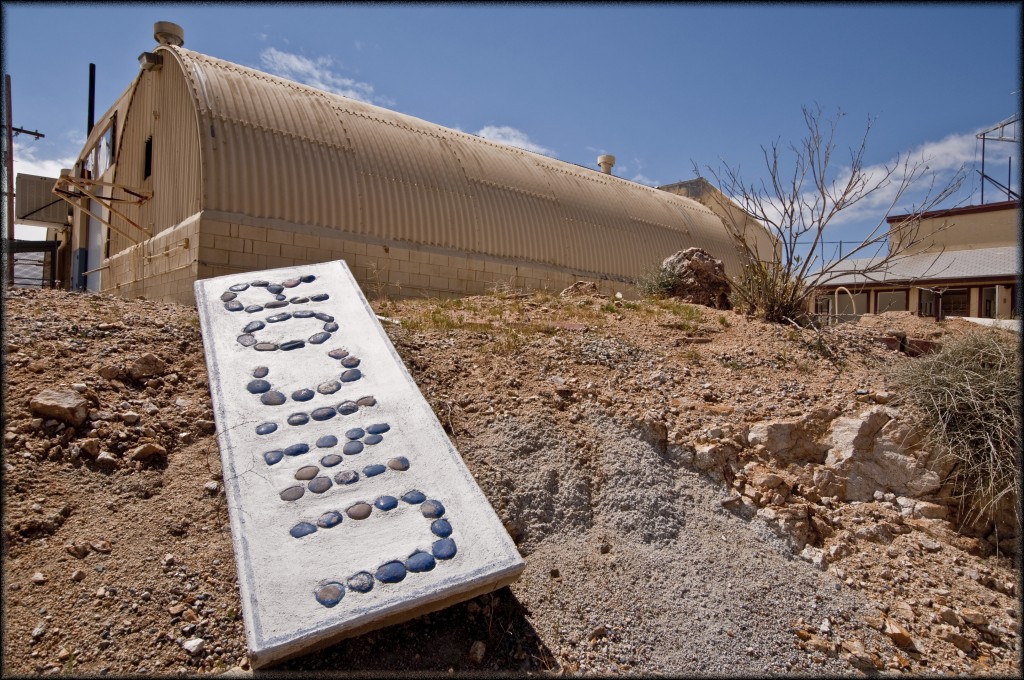
1984
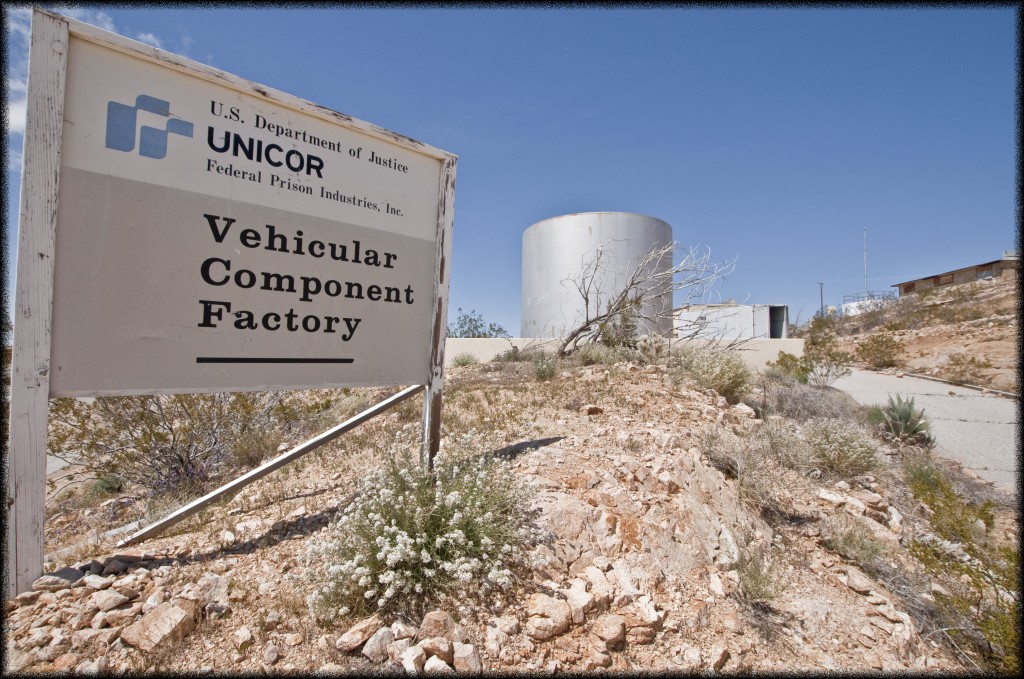
Road to government vaugeness
I jumped into the truck to follow my gut instinct that it was time to leave, feeling rather satisfied with my day, when I noticed a side street I had not seen before. I drove down it, finding nowhere to park (a vehicle is a serious limitation to exploration I have realized – hiding a car in the desert is usually almost impossible) and walked into what turned out to be derelict inmate housing.
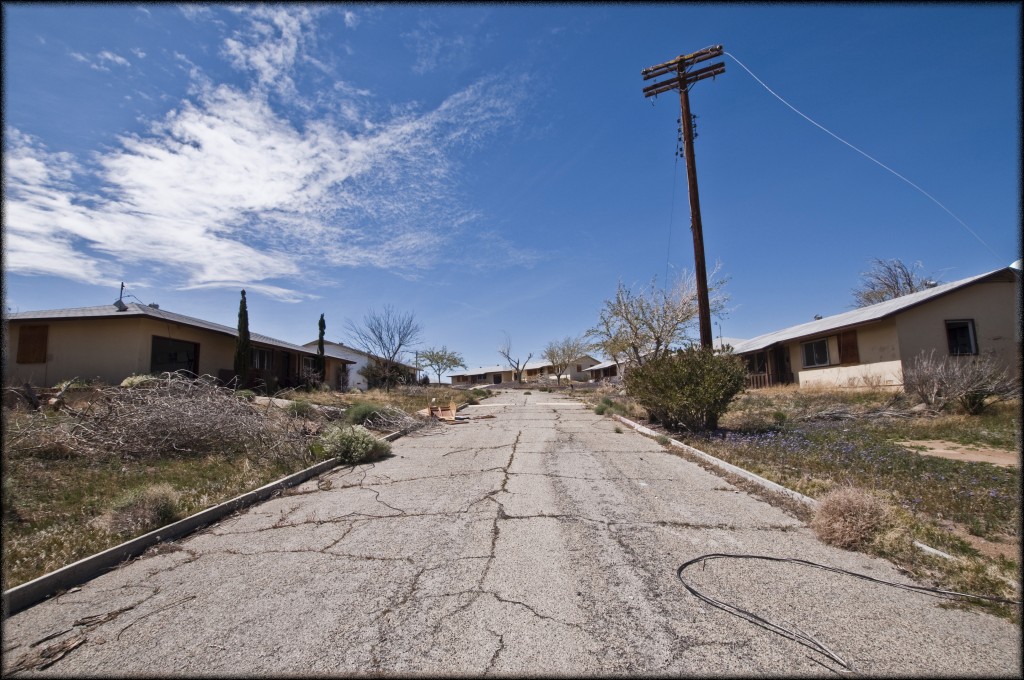
Reasonable traffic conditions
As I walked down row after row of empty cul-de-sacs lined with derelict tract homes, I was pulled right back into the sadness of the place. I walked through people’s homes and looked at their landscaped yards, taking notice of which domestic plants had escaped and were thriving without human intervention. In one, I found a constructed mini-bar and waited a while for a drink to be served. In another, a brick oven filled half the backyard. I imagined summer BBQs in 120 degree heat, families of inmates coming together for a few drinks and a chat about who-was-whose bitch that week.
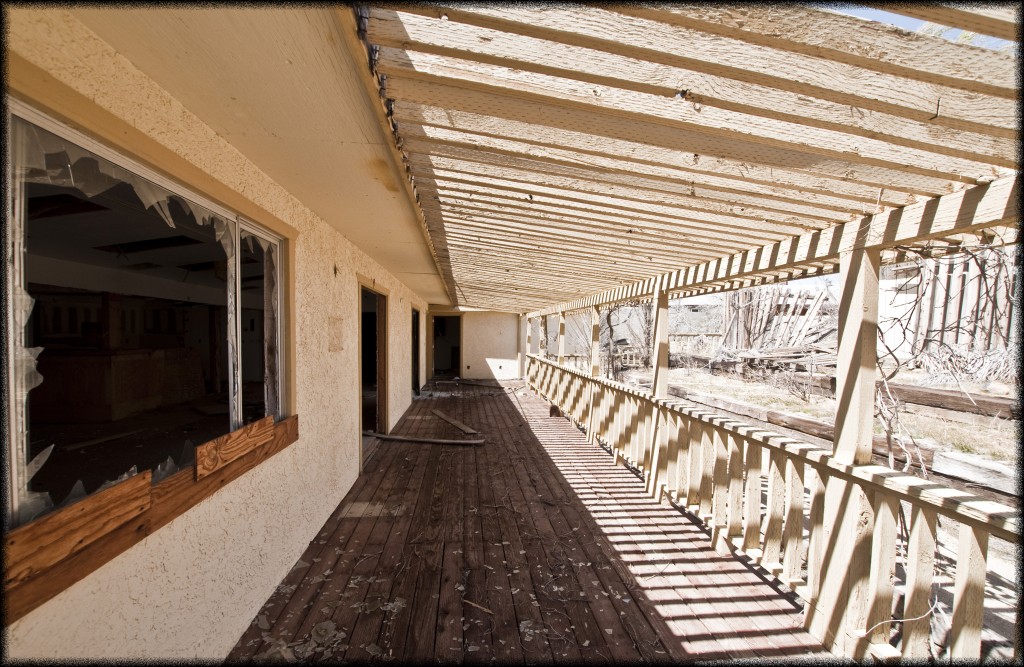
Patio Party
I was struck anew by the imposing affectual qualities of the place and when I reached an abandoned playground. I stopped to play alone on the teeter-totter.
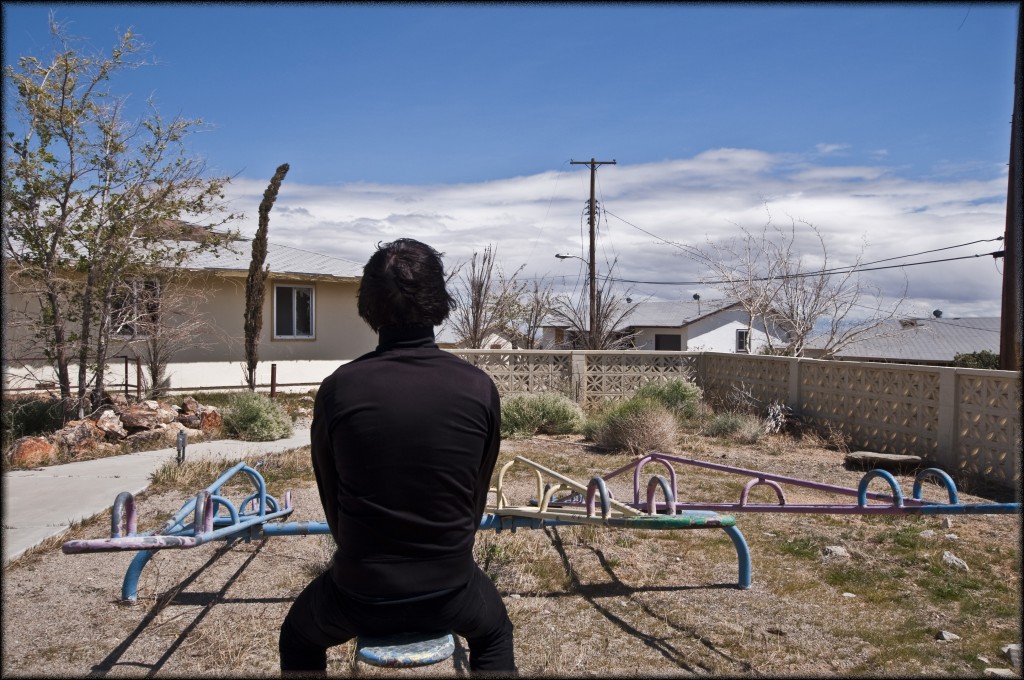
Does anyone remember playing here?
By the time I left the housing area, all numbed by the weirdness of my experience, my truck was blocked in by a stereotypically overambitious security guard wearing a fake federal badge. He told me I had been filmed and that he was supposed to call the FBI (I call bullshit on that one buddy) but I think he could sense that I had come here for different reasons than he might normally encounter. We ended up chatting about the history of the place and he sent me off with a stern warning, locking the gate behind me. After a day of modern ruins, ghosts and self reflection, I drove off into the Mojave Desert in a familiar cloud of pink dust looking for the next adventure.
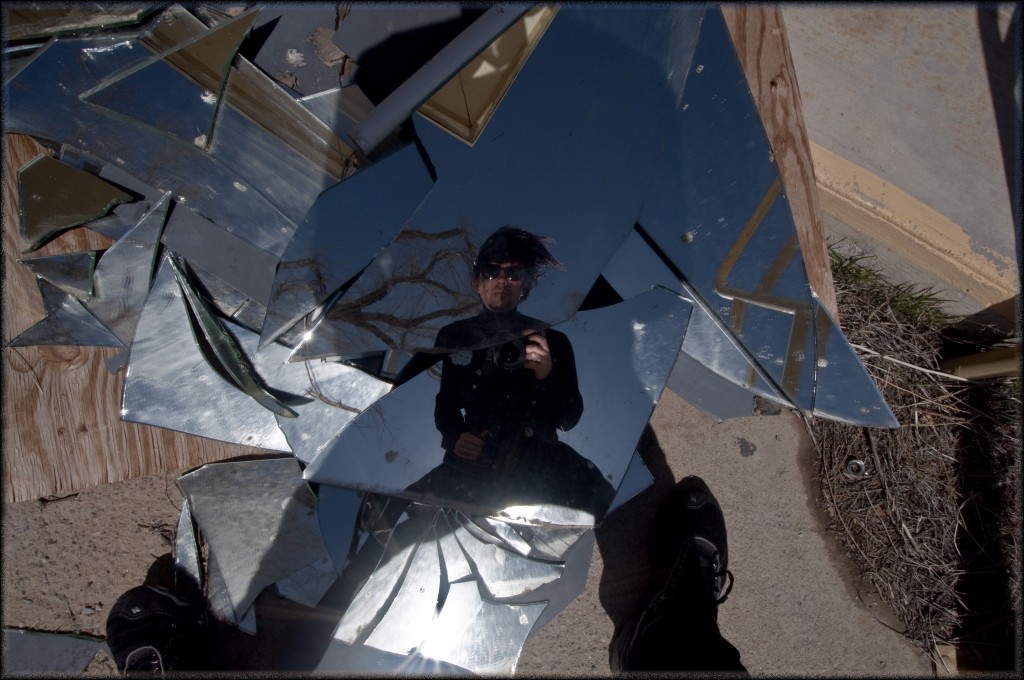
Not that I'm nostalgic or anything

 RSS
RSS Twitter
 Scribd
April 7th, 2010 at 10:51 pm
wow, what a fabulous read
April 7th, 2010 at 11:03 pm
Cool post Brad! I now hesitate between asking you to rush back to Europe or taking a flight to meet you in California… 🙂
April 9th, 2010 at 10:04 am
Nice one Brad, I'm pleased you're having some new experiences out in the US. I agree with the urgency thing we get on our european jaunts – although it's often because we're trying to to so much in such a short space of time.
April 25th, 2010 at 12:30 pm
[…] Fiberglass and Tumble Weeds – Boron FPC […]
April 25th, 2010 at 12:34 pm
[…] Air Reserve Base is a minimum security base in a rather decrepit state. Still, with an abandoned military prison now explored as well as a partially active base, it makes me wonder – how porous are these […]
September 2nd, 2010 at 8:02 pm
"Does anyone remember playing here?"
I do. My step-father was stationed at FCP Boron for one year – I was eight years old. We lived in the first house on the right as you enter the residential circle. It was an interesting place to experience. I still recall my time there fondly. Hot and sunny dry days and cold mornings were normal – our house had no carpet. I spent hours and hours exploring the desert around the camp. I never had a dull movement chasing lizards and rabbits.
The bomber jocks from Edwards used to buzz the radar tower in a B-1 followed closely by a F-111 chase plane. That is an impressive site. In fact, I used to sit on top of the jungle gym in that playground and watch them. The sky around Boron was always full of planes.
We did interact with the prisoners – they actually did our yard work. It was a very low security facility so no-one that I can recall ever worried about personal safety.
I don't think I will ever forget what snow in the desert looks like – a blanket of white as far as you can see. Barrel cacti, old dried up animal skeletons, abandoned junk scattered here and there, hills to climb, rocks full of mica – there was so much to see and do (for an 8 year old, that is…)
Great article, it's a little sad to see how much it has deteriorated since it was shut down.
September 9th, 2010 at 10:41 am
Tim, this is one of the best comments I have ever received on the blog. Although it is probably heartbreaking to see photos of a place where you spent a year of your life in a state of decay, rest assured it still retains some of that charm you remember.
I grew up on the edge of the Mojave Desert and I too have fond memories of long days wandering and discovering. It always amazes me when people talk about the desert as being a place of 'nothing' or a dead space. To me, it is always so full of life, history and potential. The desert is a wonderful place for thinking and dreaming in a world that often moves to fast to leave space for those things.
Thanks again for reading the blog. If you are ever passing through, you should stop and see the place. The skies are rather quiet now but Boron lives on.
-Brad
July 5th, 2012 at 2:07 am
Hello to all, I realize these are old posts but I will respond anyway…..I was stationed (or incarcerated) at Boron FPC from early "88 to late "89……I have to say it was an incredible place to do time if you have to……….the food was superb…..the swimming pool needed no heat and the concerts on the courts each summer were great….we got to se the shuttle come in in front row seats a few times and because I worked in the weld shop at the highest point on the compound I and others could wave at eye level to the pilots of the B1 B's and get them to wave back……..we could also get the pilots of the fighter jets to give private air shows where they might accelrate verticle just in front of us and free fall back to the desert floor………when ever I'm invited to an air show now I have to wonder if will be as good as FPC Boron??????……i plan to write a short story about living in the best Cub Fed soon……
August 12th, 2013 at 5:43 am
I was there the same time you where, from 1987-1992. I worked in the electrcial shop. I knew the guys that worked in the welding shop very well.What's your name? We probably knew each other.
September 10th, 2010 at 10:40 pm
I was stationed as an airman in the 750th Aircraft Control and Warning Squadron at Boron Air Force Station from January 1958 until May 12, 1961. While I was there we airman constructed the station swimming pool, watched the Wherry Housing Community being constructed next to the post, and watched the Air Force convert from our World War II vintage radar equipment to a Semi Automatic Ground Environment (SAGE) system. I visited the site in 2004 and was very sad to experience its rundown/abandoned state. I am preparing a personal memoir and would be interested in recieving a history of the 750th if such a thing exists.
Tom Ryan
September 14th, 2010 at 8:54 pm
Thank you for the posting Tom, it is wonderful that you have been there for the whole life of the place! If I ever run into any history on the 750th, I will certainly pass it on.
-Brad
February 23rd, 2011 at 2:57 am
Brad, wow, I was shocked at the pictures from Boron. I did part of my "time" there from 1998 to 1999, and was in fact one of the last inmates to leave when the facility was closed. We were transferred to either Taft or Nellis in Las Vegas. In fact, I was the clerk for the facilities director and responsible for closing several of the buildings as the camp was boarded up. I had forgotten just how desolate and remote the facility was, a million miles from anywhere it seemed. The recollection I always have when thinking about the Boron Camp was all the weird flying objects we would see from nearby Edwards (or elsewhere). The B1s would come in at 100 feet off the deck and rock our world. This was at a time when the "Bat Plane's" existence was being adamently denied by the Air Force, yet everyday we would see them light up the skies. Thanks for an interesting trip down memory lane.
February 23rd, 2011 at 10:29 am
Julio, I am always a bit stunned when someone finds the blog who has a personal history attached to the places I explore when they were still active. It must be shocking to see a place where you spent so much time failing into decay like this.
There was something really calm about Boron, there was a real sense of peace out there. I guess that would not have been the case while you were getting haircut from secret spy planes! Thanks for taking the time to check out the blog – I am headed back to the US in a week's time – perhaps I will post an update on Boron then.
-Brad
May 24th, 2013 at 9:31 pm
Julio, if you were there in '98 -'99 I probably filled prescriptions for you if you were ever sick. I was a PHS pharmacist and instantly regretted accepting the job. The 'PAs' there (actually foreign medical graduates) didn't give a shit if you guys lived or died. I actually cared and tried to make the inmates' health better but was up against a brick wall at every turn. I went on to Victorville and then USP Pollock, LA but left the BOP in 2005 and transferred to the Indian Health Service in South Dakota. I always enjoyed interacting with the inmates but the wardens, associate wardens and lieutenants were a different story. The vast majority were pompous assholes that thought the universe revolved around them.
I hope you are doing well post-BOP. –Rich
May 27th, 2011 at 5:02 pm
I was stationed at Boron AFS from 1960 until 1965. During my assignment I saw many changes in the Radar/Computer equipment. Probably the most facinating was the construction of the concrete radar tower[about 1962] which was built with continous pour method into sliding forms from bottom to top. Concrete trucks ran 24/7 for weeks on end. The original Radar Set was the FPS-35 and its antenna exceeded the width of the tower some 30ft and rotated at 5RPM. The antenna was painted in checkerboard pattern of bright yellow and white. I lived in the family housing with my wife and 2 children[the second one being born there]. The SR-71 was the primary plane under test at Edwards during my stay
July 21st, 2011 at 5:46 pm
It's hard to imagine new life being created in this old place now – thank you for posting this Kenneth!
July 21st, 2011 at 1:28 am
Part 1: I spent time here as a convict. The place had a distinct military feel as most guards were ex-military. My first job was to “rake the rocks.” For 8 hours a day, I would rake the gravel “landscaping” from one side of the camp to the other. Occasionally, I found a dreaded cigarette butt which the disposing of such was the object of my job. When I had picked the grounds clean of butts, the guard instructed me to continue to rake. Which I did until: 1. A bird crapped on my head. A true sign that my life had hit rock bottom. 2. The camp administration needed someone who knew how to type. Being an early computer nerd (1985), I landed the job. I became the executive secretary for the officer that ran the mess hall. It was a premier camp position as I had an air conditioned office, all the food and drink I wanted, and made the 2nd to the highest wage at the camp…46 cents/hour.
July 21st, 2011 at 1:30 am
Part 2: My “management” position allowed me to provide less fortunate convicts needed items like pencils, tablets, and typewriter ribbon (all verboten!). Many convicts had no attorney so they had to file their own appeals. Most made 16 cents/hour and couldn’t afford to buy any materials. I felt it was worth the risk of adding time to my sentence if caught. The camp was full of interesting, mostly white, characters. The majority were drug smugglers and dealers. There were politicians, doctors, Italian mobsters, lawyers, skimmers (from Las Vegas), and bank robbers. Some were finishing long sentences. If you were lucky, you could spend the last 3 years of your sentence at the camp. We were allowed visitors if they were approved by the Feds. They had some tables outside near the main entrance to sit with your relatives. Many convicts had long since lost contact with relatives and friends and had no one on the outside. I always felt guilty as I was lucky to get a visitor every other week.
July 21st, 2011 at 1:31 am
Part 3: For exercise, you could walk a long circular driveway up to the knoll, where the airdome was located, around by the "church" then back down to the main dorm area. We had a pool left over from the military days but it had no water. Our rooms were old barracks. My room had a bunk bed and a twin bed. There was a TV in the center of the building with a few metal chairs to sit on. We also had a ball field out near the camp's entrance. During the day and through the night, the guards did a "count." During the count, you were not allowed to move around. The count was done to determine if any of the convicts were missing. During my stay, one convict walked into the desert and disappeared. The guards who, in general were very nice, often stole food from the camp warehouse. They mostly took large chucks of meat home to their familites. The inmates were always blamed for the missing food. Funny because we had no way to cook meat. Don't know many convicts the like steak tartare. We wore used military hand-me-downs. Old pants, shirts, and shoes.
July 21st, 2011 at 1:34 am
Part 4: Each day seemed like a week to me. I read a lot. We had a mobile library come in once a week. Worked on some software code (tough without a computer). We had mail call every day. All mail was opened and read by the Feds. Phone calls were all recorded. You were prohibited from talking to anyone on the phone about business. Any business no matter how legit. Strange rules. We had a commissary where we could buy cosmetics, snacks, socks, etc. The money earned at our job was placed into an account at the commissary.
July 21st, 2011 at 1:35 am
Part 5: When your sentence was up, you got the remaining money in your account. You were given a bus ticket and a ride to the bus station which was a few miles from the camp. You're departure from the camp was at 6am. Instead of taking the bus, some convicts were picked up in limos, by helicopter, or by relatives. No matter how you left, you still had to leave from the bus stop. No one was permitted to pick you up at the camp. During my journey through the justice system, I managed stays in one city jail, one county jail, two federal jails, and the camp. All on one conviction. Having no previous criminal background, I have to say it was quite a journey. And yes, I was a smuggler (briefly). 8 tons! And now you can buy it legally. Go figure.
July 21st, 2011 at 5:36 pm
Steve,
I really can't thank you enough for posting this fantastic story to the blog. I got very emotional reading it. We often debate whether exploring abandoned places had any clear social value. Hearing your memories of your time at Boron has shown me, definitively, that there is value in revisiting these places that so many people are quick to forget. Thank you again.
-Brad
July 21st, 2011 at 5:59 pm
Steve,I am pretty moved,touched by your story.You transmit the feel so well that I could actually imagine you and see the whole scene.Brad..could you imagine hearing that ghost place talking to you so clearly when you first stepped in ? Now going back to the pictures after reading all those comments gives a total new meaning to it. Like a pilgrimmage.
July 21st, 2011 at 6:50 pm
What an amazing story Steve. It's chilling to think of the quality of life some of the places I've explored offered. It's so fascinating to get the chance to speak to people who used these institutions while they were still operating. Thank you for your fantastically insightful contribution!
December 28th, 2011 at 5:32 pm
Found a site that has older photos and the history of the 750th AC&W Squadron. Thanks for this great post, we are trying to find out as much as possible about this location. (http://www.radomes.org/museum/showsite.php?site=Boron+AFS,+CA)
February 7th, 2012 at 1:37 am
Thanks for posting. We went on a long motorcycle ride around the desert this weekend and this was one of our stops. We were wondering what the background was on the place. Thanks Steve for sharing the info.
February 17th, 2012 at 10:20 am
That famous quote comes to mind, “We do what we must and call it by the best names..”.
March 26th, 2012 at 5:22 am
Very interesting. Have ridden dirt bikes out there many times. Hard to believe the govt. can leave such a mess. Doubt private industry could ever get away with that.
April 6th, 2012 at 9:00 am
Pooping is fun.
July 5th, 2012 at 2:36 am
Club Fed is what the New York & Los Angeles Times called Boron……..There were a few others in the Federal Prison system, Lompoc, Yankton & Eglin Air Force base but Boron was voted # 1— 10 years in a row by Playboy magazine as the best prison to spend your time in…..the prison was coed until 1985 then the women were moved out and the prison became all male……..by 1986 things were beginning to change because of publicity…..we got a new Warden and they wanted to close down our swimming pool in 1987 and we the inmates fought back and won the pool for another year by saying it was a water reserve in case of drought or fire……..that's when the prison got smart and built a new water storage tank at a cost of about a 1/4 million dollars….I welded the water line to the camp from the new tank…..seems like the pool was cheaper???…..
September 4th, 2012 at 12:41 am
The prison camp was opened in 1979 and I started there as a correctional worker in 1982. I transferred to another institution in 1984 and came back in 1987 as the Human Resources Manager. There were no female inmates ever housed at this institution during the years it was open (1979-2000). There was one inmate that was murdered there around 1980. The victim failed to pay another inmate in cigarettes and was stabbed and shoved into a locker.
Before it was a prison camp, it was the U.S. Air Force 750th Radar Station from the 1950s to 1975. My father was stationed there in 1964-1966 (when I was 10) and we lived in the base housing (5th house on the right as you drive into the area). I remember bowling in the two lane bowling alley and playing bingo in the officers/enlisted club. Also remember spending a lot of time in the desert exploring. One time we had a race around the entire housing area and I won! I really enjoyed living there when I was young.
When the Air Force still had control of the site, a women (wife of an Air Force officer) committed suicide in her home. Years later when the Federal Bureau of Prisons was there, occupants of that particular house swore they saw/felt the presence of a ghost.
The Vehicular Component Factory run by UNICOR was a large work shop repairing starters, alternators and other automotive parts for the military. Almost every Federal prison has a UNICOR factory. Some make furniture, repairing Humvees and forklifts, making cable, military kevlar helmets, etc. When an inmate was employed by UNICOR they received the highest wages. As I recall it was about 90 cents per hour.
Other inmates that didn't work in UNICOR were bused to Edwards Air Force Base (about 35 miles away) to work on the base doing landscaping, mowing lawns, picking up trash, etc. Most inmates that were assigned to this detail loved getting away from the prison for several hours a day to work.
One of the reasons the prison shut down was because of water. For many years the water came from a small pipeline from Edwards AFB. The pipeline was about 45 years old and had greatly deteriorated and was constantly leaking. Sheepherders would bring their sheep to the area and would actually punch holes in the line to water their flocks. Eventually the pipeline was shut down and the prison actually had to truck in water on a regular basis. It would have cost too much money to build a new pipeline. When I was duty officer on the weekends I had the responsibility to drive the length of the water line and look for new leaks to get fixed.
When I was there in 1983, the Bureau of Prisons sent dozens and dozens of illegal aliens there to do their time. That didn't work out too well. Many of those inmates stuck around long enough to get new prison clothing, new work boots, etc. and then they'd escape into the desert. That practice didn't last too long at all and the Bureau put illegals into higher security institutions with fences. The prison camp did have a fence but it was built by the Air Force – not the Bureau of Prisons. Even inmates that didn't escape would crawl under the fence and hike into the desert to pick up contraband left there by wives/girlfriends, etc. We caught a lot of inmates bringing back booze, food and cigarettes. Inmates would also meet their significant other for a quick sexual encounter in the desert.
April 10th, 2015 at 2:56 am
I did crazy months at Boron. It was a kick. Old Man Johnson was a nice guy. Hell they all were nice hacks for the most part. Yea they stole food.. Straight out hijacked meat. I had a private room dorm 4. Pretty much bought it and had some white gamma swindler transferred to a all black room dorm room 🙂 We drank Champagne, smoked good pot, and took LSD which was a little crazy. I saw the first Stealth Jets one evening walking the road around the dome.. It was like silent.. I thought it was a UFO. The guy i was with asked me not to tell anyone..LOL He said people would think we were crazy. I later learned it was one of the first stealth Jets. Like 60 feet off the desert floor hauling ass.. Smuggled pot in via the Church. Lt. Called me in and told me that he knew i was giving pot to people.. But because I was not SELLING it.. it was OK. But keep it low. There was no test for POT back then. He wished inmates could have two joints a day.. and NO access to Booze because Booze caused fights. They ( guards) really knew that they were inmates too. Lots of personal issues, wifes cheating, god knows what all. Best time ever.. I mopped the top hallway of dorm 4. And the bathroom. Then I played Guitar all day.. But it got hot out there. No matter how hot it got though that pool was ICE cold.
October 25th, 2012 at 4:36 am
I find this very interesting. I hate to admit that I spent time there for about 2 years. It was 1980-82. If I remember correctly Don was the food service director. I try to forget that part of my life. I can say that the facilities was really nice compared to others around the world. I worked in the food service and as a dorm orderly. I remember driving the truck up around the tower to get supplies. I also worked for a short time at Edward's Air Force Base when the Shuttle first came in. That ended shortly because I got a girl friend there and she gave me some money to buy treats. Someone snitched on me and that ended. Basically the gaurds was pretty good. There was a girl who worked there that was really nice. I basically got my way if I just did what I was told. The other inmates there was okay except we had a few that did not treat me too well. I usually could buy my way out. I just wanted to do my own time. I even swam in the pool there. One day I got so burnt that it took days for me to not hurt. I was full red. After my stay there, I screwed up later on and violated and was sent to Englewood Colorado. Since that stay I have never got in trouble again. Even because of my age at the time and being sentenced to the youth act, I don't even have a record. I say these pictures on the internet then saw Don's post. I remember him as being the great guy. I really appreciated the way he treated me. If he reads this he might remember me. Life has been really good to me. I always prayed that those who spent time with me had the family I did not help and support me. I also remember the chaplin. He was a character, but a good man. He took us to many places to sing and participate with the community. I worked at the Boron Museum and helped hang the sheet rock and tape it. I since have been back to visit and I am proud of that experience. One thing I have learned in life, is to look for the positive in everything you do. Don't dwell on the misfortunes. I don't share any of my experiences to anyone in my family. Maybe I will write a book and share with them when I die. I do use my experiences to keep kids from going wayward. I love the youth and provide great opportunities for them in their lives so they don't make mistakes that could land them in Prison.
October 29th, 2012 at 3:54 am
I thought this was a pretty interesting read myself. It was so sad to see this place in ruins. That playground you sat at I use to play at most of my chid hood when my dad worked there. I saw my old house with so many awesome memories. The clubhouse as we called if with the bar Braque where we had my birthday parties. When the federal prison use to be family oriented we had nice Christmas parties with Santa and for the adults drinks at the bar. We use to jump down for the high ledge off the side of the park for a little excitement. Exercising with my mom and the track in back of the housing and playing softball on the softball fields there also. I Rememeber watching the inmate softball games. Which kept some of us occupied being so far out. It was a pleasant part of my life. Inmates walking around doing maintenance in the housing grounds. Some were veryinteresting people( inmates). I had lots of fond mesmerizes there. I do visit it occasionally just for memories sake. I eventually followed my da into the same job fid and went back when I worked at Victorville as an officer. I took my husband there who was also an officer at the time. I do miss it. Thank you for postin pictures it made me realize good memories with my friends.
October 29th, 2012 at 4:05 am
From 1989 I think til it closed we lived here the moved to Victorville when the federal prison there opened.
December 19th, 2012 at 7:08 pm
The place looks like it went through hell and back.
December 21st, 2012 at 7:13 am
This is such a cool post! My ex boyfriend did a few months in boron on a drug charge and was one of the last prisoners housed there before it closed. He was very impressed with the facility and never had any complaints.larry met a lot of very interesting wealthy businessmen who screwed up and were sent to camp fed with a slap on the hand.one of his cellmates was a young kid from a wealthy family in stockton, my hometown. I wrote my boyfriend everyday,and was completely devistated by his incarceration.the images of the giant water tower will always be etched in my mind as the last thing that connected me to him for the next six months. I still go through my photo album 14 years later to look at the photos i took of that tower and relive the memories of those days. the desert was beautiful and tranquil and hauntingly quiet. What a sad ghostly image as it stands today. the day I picked larry up, we saluted his buddies with a line of meth,a joint, and a shot of burbon!! Cheers to boron.
April 11th, 2013 at 5:17 pm
I worked there from 82 – 85, probably knew Don. It is sad to see the run down housing as it was kept up pretty good when it was opened. We had a tight community in the housing area. The kids had the whole desert to play in. One spring the surrounding hills lit up with desert flowers, pretties thing you ever saw. We would receive snow occassionally. Sometimes the local rabbit population would over populate and there would be 20 to 30 eating at your lawn. There was no problems with the inmates, they were usually cordial and well behaved. My kids grew up here and there are good memories of this camp community!
May 7th, 2014 at 9:04 am
I was @ 'camp fluffy' 96-97. Tammy Faye Baker drove over every visiting day from Cal City to visit her husband Ross. I worked in the carpentry dept. and the place was kept in good repair. They trucked in water everyday to keep the place running. Most of the doctors and literati were in the Toastmaster's Club. I developed two close friendships while there. Mr. Irish was in charge of carpentry and he was always very kind to me. I still miss Glenn Barrett and Rudy Corona to this day. They both watched my back when they could. They were switching wardens toward the end of my stay and I did quite alot of work on that particular home. Some of they other homes and barracks were also kept in good repair by our dept. The constant sun and fierce wind did alot of structural damage. There was always a new work order to fix this or that. Some of the guys were invited to a deputy's home for beer one time. I was afraid to go along. But the civilians in the housing units who had Federal jobs there got bored out of there gourds too. There was just so little to do in that heat. Thinking back, it was very risky for that guard to invite prisoners into his home, but I can totally understand his aloneness and desperation out there. They had filled in the pool with sand, and would frequently have concerts in that area, particularly on holidays. I sang in the church choir and attended AA meetings just to break up the day. There is no way to describe the beautiful huge full moon rises I observed on the high desert horizon, or a rainbow I observed over the entire camp after a heavy rain. So mainly my recollections are quite upbeat. I also hung out alot at the library and, strangely, have many memories of happy, productive times, while being at Camp Boron. If you have any questions or desire more feed back, please email me at = [email protected]………..Lastly, there is a 15 minute bike tour of the delapidated camp on you tube with an electric guitar slow jam in the background. I highly recommend it to anyone nostalgic about this special place. Though just the physical skeletal remains are left, the crystal clear skies and the desert environs are forever unchanging! Thanks, Alan 510 654 0121
April 9th, 2015 at 6:26 pm
You're lucky you didn't get caught trespassing. If anyone else is considering visiting what is left of the FPC Boron prison, I would strongly advise against it: http://www.bop.gov/locations/fpc_boron.jsp
May 1st, 2015 at 7:33 pm
I was there as an inmate in 1981. I even had a private room in dorm 4 upper as i was the orderly. My job was to keep the common area clean. Took about an hour a day tops.. It was the easyist time ever.. Guards for the most part were pretty nice. They were prisoneers too in some respect. We smoked pot, drank champaine, had pizza delivered via our wifes and out RUNNERS who wrapped their legs in layers of burlap to protect themselves from the rattlesnakes as they went under the fence to the 395 and back. We were smugglers and we smuggled in whatever we desired. One guy was missing on a Quick-Count.. HE was out meeting his wife. So when the guard came up short.. I would him the guy was returning soon.. He smiled and covered for him. I was looking pretty good back then and a young woman guard would hang around talking to me smiling… Nothing happened of course. But it was relaxed and for the most part there was little drama.